
Relapse in addiction recovery means going back to alcohol, drugs or tobacco after a period of staying off them. It is common, it is not a moral failure, and it does not mean treatment has failed. The US National Institute on Drug Abuse (NIDA) reports that relapse rates for substance use disorders, about 40 to 60%, are similar to those of other long-term conditions such as high blood pressure and asthma, and it treats a relapse as a signal to restart, adjust or change treatment.
This guide explains the difference between a lapse and a relapse, the three stages relapse moves through (it starts weeks before the first drink or dose), 15 warning signs, the triggers Indian studies report most often, what to do in the first 24 hours after a slip, how to write a relapse prevention plan, and when it is time to go back to rehab. It is written for education and does not replace a doctor’s advice. If someone has used after a long break and is very drowsy, breathing slowly, cannot be woken, is confused, or is having a seizure, call 108 or 112 straight away.
Last updated: October 2026.
Key Takeaways
- Relapse is a process, not a single moment. It usually begins with emotional signs such as poor sleep, isolation and bottled-up stress, weeks before any use.
- About 40 to 60% of people treated for substance use disorders relapse at some point, a rate NIDA compares with high blood pressure and asthma. Relapse does not mean treatment has failed.
- A lapse (one drink or one dose) is not the same as a full relapse. What you do in the next 24 hours decides which one it becomes.
- After a break, tolerance drops. Using the same amount as before can cause an overdose, and going back to heavy daily drinking can bring back dangerous withdrawal.
- Common triggers in India include peer pressure, weddings and festivals, family conflict, money worries, loneliness after discharge, pain, poor sleep and overconfidence.
- A written relapse prevention plan, therapy, medicines where they exist, family support and regular aftercare all lower the risk.
- Shame keeps people away from help. Telling someone early and returning to treatment sooner gives the best chance of getting back on track.
What Is Relapse in Addiction Recovery?
Relapse is a return to substance use after you have tried to stop or after a period of abstinence. It applies to alcohol, drugs such as opioids, cannabis and stimulants, and nicotine. Clinicians separate a brief slip, called a lapse, from a relapse, which is a return to the earlier pattern of use.
| Term | What it means | Example |
|---|---|---|
| Lapse | A brief or one-time use after a period of staying sober. You stop again quickly. | One drink at a wedding, after which you stop and tell your counsellor the next day. |
| Relapse | A return to regular or uncontrolled use, often with strong craving and loss of control. | A weekend of drinking turns into drinking every day within a few weeks. |
| Relapse into dependence | A return to the earlier level of use, with tolerance and withdrawal symptoms. | Morning drinking, shaking hands and sweating come back. |
The difference matters because a lapse that is handled well often stays a lapse. What turns it into a relapse is usually the thought that everything is ruined, so there is no point in stopping again. Our article on motivation in addiction recovery explains why willpower alone fails and what works better.
Relapse is not limited to alcohol and drugs. People who quit tobacco go through the same cycle, as covered in our guides on how to quit smoking and quitting gutkha in Maharashtra.
How Common Is Relapse?
NIDA puts relapse rates for people treated for substance use disorders at 40 to 60%, based on a comparison published in JAMA in 2000, against 50 to 70% for hypertension and asthma. NIDA’s conclusion is that substance use disorders should be treated like any other chronic illness, and that a relapse is a sign to resume, modify or try a different treatment, not proof that treatment failed. You can read the same idea in our guide to substance use disorder.
Treat that range as a broad average, not a prediction. Individual risk depends on the substance, how severe the dependence was, whether a mental health condition is present, how much support the person has, and whether treatment continued after the first few weeks.
Research from India points to the same pattern and shows what drives it locally:
- A small qualitative study from Pondicherry interviewed 15 patients who had relapsed after a 21-day inpatient programme for alcohol dependence. They named peer pressure, confidence that they would not become dependent again, craving, stress, pain and insomnia, and a wish to test whether the treatment worked.
- The same study found why people delayed returning to treatment: guilt about letting down the treatment team, fear that doctors would be upset, poor social support and money problems.
- A tertiary-hospital study by Chennai researchers found craving, pleasurable events, family conflict, financial problems and the loss of a loved one among the main risk factors for relapse or lapse.
- Cross-sectional studies from India and Sweden, cited in a paper on relapse in rural Karnataka, link long-term recovery with strong self-belief, support from family and friends, active coping and positive life events.
The message is practical. Relapse risk is mostly about stress, social pressure, craving and support, and all four can be planned for.
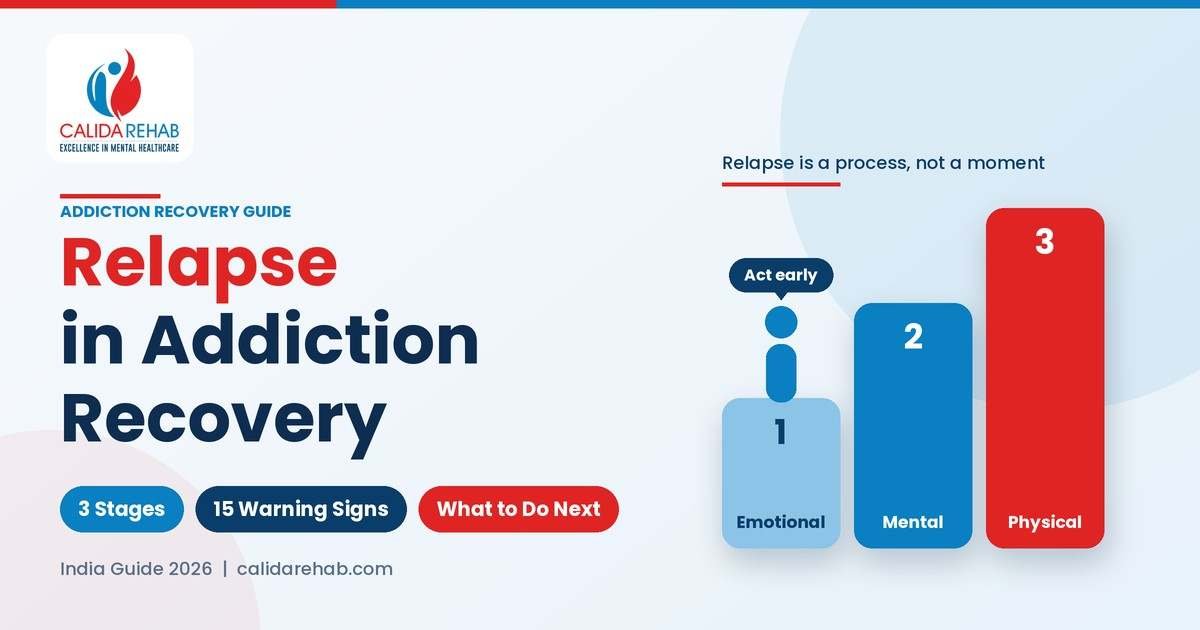
The 3 Stages of Relapse: Emotional, Mental and Physical
Psychiatrist Steven Melemis, writing in the Yale Journal of Biology and Medicine in 2015, describes relapse as a gradual process that begins weeks and sometimes months before a person picks up a drink or drug. He divides it into three stages. The aim of treatment is to help you spot the early stages, when your chances of stopping the slide are best.
| Stage | What it looks like | What helps |
|---|---|---|
| Emotional relapse | You are not thinking about using. Self-care slips: bottled-up feelings, isolation, skipped sessions or meetings, poor sleep and eating, irritability. | Restore the basics: sleep, food, movement and routine. Talk to someone. Go back to your sessions. |
| Mental relapse | A tug of war in the mind. Cravings, thoughts of old people and places, remembering only the good times, bargaining (just one), lying, planning a slip. | Use craving tools, tell your counsellor or sponsor, avoid high-risk places, review your plan. |
| Physical relapse | Actual use. It can start as a single lapse. | Stop, stay safe, tell someone and see your doctor within a day or two. |
Melemis notes that the common thread in emotional relapse is poor self-care, and that prolonged poor self-care is what moves a person into mental relapse. That is why the earliest warning signs often look like ordinary stress rather than addiction. The brain changes that make cravings loud are covered in our guides on how dopamine receptors recover and how long it takes to rewire the brain from addiction.
15 Early Warning Signs of Relapse
Use this list as a self-check, and share it with a family member you trust. Family members often notice changes before you do.
Emotional warning signs
- Bottling up feelings or sudden mood swings
- Irritability or anger over small things
- Pulling away from family and friends
- Skipping therapy, doctor visits or support meetings
- Poor sleep, skipped meals, or neglecting hygiene and exercise
Mental warning signs
- Cravings that feel stronger or more frequent
- Thinking often about old using friends, places or routines
- Remembering only the pleasant side of past use
- Bargaining, such as only beer, only weekends or only once
- Playing down past harm, with thoughts like it was not that bad
Behavioural warning signs
- Lying about where you were or how money was spent
- Visiting old places or meeting old friends just to say hello
- Stopping prescribed medicines without telling your doctor
- Keeping alcohol, pills or tobacco at home in case of guests
- Sudden overconfidence, such as I have this under control, I can handle one
If several of these sound familiar, do not wait for a slip. Speak to your doctor or counsellor this week. Families can find more changes to watch for in our guides to hidden drug addiction signs and signs you need a rehab centre.
Common Relapse Triggers in India
NIDA lists stress, cues linked to past use (people, places, things and moods) and contact with the substance as the most common triggers. Indian studies add family and social factors. The table below turns them into planning prompts.
| Trigger | Why it is risky | What to do |
|---|---|---|
| Weddings, festivals and parties | In many social settings, alcohol is offered as hospitality and saying no can feel rude. | Decide your answer in advance, carry your own soft drink, go with an ally and set a time to leave. |
| Peer pressure and old friends | Peer pressure was the first reason patients gave in the Pondicherry study. | Tell friends clearly that you have stopped. Meet them in places without alcohol or drugs, or pause the friendship for now. |
| Family conflict and money stress | Family conflict and financial problems were major risk factors in a Chennai study. | Ask for family therapy sessions, agree on how money is handled and plan a calm response to arguments. |
| Grief and loss | The loss of a loved one was linked with relapse or lapse. | Get counselling, avoid being alone on difficult dates and tell someone how you are coping. |
| Loneliness and boredom after discharge | Going home to the same routine and the same people leaves a gap. | Fill the day with structure, keep up aftercare, and join a group therapy or support group. |
| Pain and poor sleep | Patients in the Pondicherry study named pain and insomnia as reasons for drinking again. | See a doctor. Do not use alcohol or sleeping pills to cope. |
| Overconfidence and testing yourself | Some patients drank to see whether treatment had worked, or believed they could not become dependent again. | Remember that the first drink or dose is the risk. Treatment works when you keep following it, not when you test it. |
| Untreated depression, anxiety or trauma | Low mood and anxiety make cravings harder to resist. | Treat both conditions together. See dual diagnosis treatment. |
What to Do When a Craving Hits
Cravings rise, peak and fall like a wave. Most pass if you do not act on them, often within minutes to an hour. You do not have to win forever, only through the next wave.
- Name it. Tell yourself: this is a craving, not an order.
- Delay. Set a timer for 15 minutes before you decide anything.
- Distract. Walk, shower, cook, tidy a room, play with a child or listen to music.
- Discuss. Call a person from your plan. If nobody is available, call Tele-MANAS on 14416, a free 24×7 helpline.
- Check HALT. Are you hungry, angry, lonely or tired? Fix the one that applies. Eat, rest, or reach out.
- Remind yourself why. Keep your top three reasons for staying sober in a note on your phone and read them.
Cognitive behavioural therapy and dialectical behaviour therapy teach these skills in depth, and acceptance and commitment therapy helps you notice an urge without acting on it.
What to Do If You Slip: The First 24 Hours
A slip is a signal, not a verdict. NIDA says a relapse means treatment needs to be resumed, modified or changed. How you respond in the first day matters most.
- Stop and stay safe. Do not use more to finish what you started or to punish yourself. Do not drive. Get rid of what is left.
- Know the risks. After a break, your body’s tolerance falls. NIDA warns that using as much as before you quit can easily cause an overdose. If the person is very drowsy, breathing slowly or cannot be woken, call 108 or 112. If you were drinking heavily every day before you stopped, do not stop suddenly again without medical advice. Read about alcohol withdrawal symptoms and safe treatment.
- Tell one person today. This could be a family member, counsellor, doctor or sponsor. Secrecy feeds relapse.
- See your doctor or counsellor within a day or two. Medicines and therapy may need adjusting.
- Trace what led to it. Write down what happened in the 48 hours before: who you were with, where you were, what you felt and thought. Clinicians call this a relapse chain, and it is a core exercise in relapse prevention therapy.
- Change one thing in your plan. Pick the step that failed and fix it.
- Do not let shame decide. The thought that you have already failed, so you may as well carry on, is common enough to have a name: the abstinence violation effect. In the Pondicherry study, guilt and fear of disappointing the treatment team delayed people from going back. Going back early is the better choice.
How to Build a Relapse Prevention Plan
A relapse prevention plan is a short written plan that you make when you are well, so that you can follow it when you are not. Keep it on paper and on your phone, share it with one or two trusted people and review it every month.
| Part of the plan | What to write |
|---|---|
| My reasons | Three to five reasons to stay sober, in your own words |
| My triggers | The people, places, times, feelings and events that led to use in the past |
| My warning signs | Signs from the list above, plus the ones your family notices |
| My craving steps | Three things you will do in the first 15 minutes of a craving |
| My people | Three names and numbers, including one person who can be reached at night |
| My daily routine | Sleep and wake times, meals, exercise, medicines and meetings |
| My high-risk dates | Weddings, festivals, birthdays, salary days and anniversaries, each with a plan |
| My emergency steps | Your doctor, nearest hospital, 108 or 112, and Tele-MANAS 14416 |
Our relapse prevention therapy page describes how this planning is done with a therapist, and our guide to 17 evidence-based therapies used in rehab shows where it fits among other treatments.
Treatments That Lower the Risk of Relapse
No single treatment suits everyone. NIDA advises that treatment should be matched to the person’s pattern of use and should address medical, mental, social and family needs. The main options are:
- Cognitive behavioural therapy. Helps you recognise, avoid and cope with the situations in which you are most likely to use. See cognitive behavioural therapy.
- Medicines. For alcohol, doctors prescribe naltrexone, acamprosate or disulfiram. For opioids, options include methadone, buprenorphine and extended-release naltrexone. For nicotine, there are patches, gum, bupropion and varenicline. NIDA notes that no medicines are currently approved for stimulant or cannabis addiction, so treatment relies on behavioural therapy. All need a prescription. Read about medication-assisted treatment in Mumbai and Pune and how to stop drinking alcohol safely.
- Counselling. One-on-one counselling and group therapy build coping skills and a sense of belonging.
- Family therapy. Family therapy repairs conflict and teaches relatives how to support recovery without blame.
- Mutual support. Groups such as Alcoholics Anonymous give ongoing peer support. NIDA describes them as a complement to medical treatment, not a replacement.
- Treatment of other conditions. Depression, anxiety, trauma and ADHD raise relapse risk when left untreated. See abnormal psychology and addiction disorders.
- Aftercare. NIDA says detoxification alone, without further treatment, generally leads to a return to use. Detoxification is the first step, and follow-up care is what protects it.
Should You Go Back to Rehab After a Relapse?
Not every slip needs readmission, but waiting too long is a common mistake. Use this table as a guide and ask your doctor to confirm.
| Situation | Suggested next step |
|---|---|
| One brief slip, you stopped at once and you have support | Tell your counsellor, review your plan and add more sessions. Outpatient care may be enough. |
| Use over several days, constant craving, lying or hiding | See a doctor this week. Consider an intensive outpatient or day programme. |
| Back to daily use, withdrawal symptoms, or repeated failed attempts to stop alone | Medical detox and residential rehab. Do not stop suddenly on your own. |
| Use together with severe depression, suicidal thoughts or another mental health crisis | Get urgent psychiatric help. Call 112 or Tele-MANAS 14416 now. |
| Your home is unsafe or full of triggers | A residential programme gives distance and structure. See rehab vs home recovery. |
Going back to rehab is not starting from zero. The skills, insight and support you built are still there. To know what to expect, read what happens in the first week of rehab, the real cost of rehab in India and your rights under the Mental Healthcare Act 2017. If you are choosing a centre, our guide to choosing a de-addiction centre lists what to check.
How Families Can Help After a Relapse
A relapse is frightening for families, and anger is natural. What you do next can make it easier or harder for your loved one to return to treatment.
- Stay calm and avoid shaming. Ask what happened and what they need, not why they did it again.
- Support recovery, not the substance use. Avoid giving cash, covering up for missed work or hiding the problem from others.
- Learn the warning signs and agree on a plan together, when things are calm.
- Encourage a doctor or counsellor visit within a day or two, and offer to go along.
- Join family sessions. Relapse affects the whole household, and family therapy helps everyone.
- Look after your own sleep, health and support. You cannot do this alone.
- If your loved one refuses help, read how to convince someone to go to rehab.
- Call 108 or 112 if they are very drowsy, cannot be woken, are confused, or are having a seizure.
Help for Relapse in Mumbai and Pune
Calida Rehab offers psychiatrist-led treatment for alcohol and drug addiction in both cities. In Mumbai, start with the rehab centre in Mumbai page (consultation in Colaba, residential care at Karjat) or the de-addiction centre in Mumbai page. In Pune, see the rehabilitation centre in Pune and de-addiction centre in Pune pages, or our checklist for choosing a rehabilitation centre in Pune. For treatment by condition, see alcohol addiction treatment and drug addiction treatment.
You can call +91-8452940789 or contact us even if you are not sure that what happened counts as a relapse. Tele-MANAS (14416) offers free, 24×7 tele-counselling across India.
Frequently Asked Questions
What is relapse in addiction recovery?
Relapse is a return to alcohol, drug or tobacco use after a period of staying off it. It is common and is treated as part of a chronic condition, not a sign of weakness. NIDA reports that about 40 to 60% of people treated for substance use disorders relapse at some point.
Does relapse mean rehab failed?
No. NIDA states that relapse does not mean treatment has failed. Like high blood pressure or asthma, addiction is managed over time, and relapse is a sign to restart, adjust or change treatment. Returning early to a doctor or counsellor gives the best chance of getting back on track.
What are the 3 stages of relapse?
Emotional, mental and physical relapse. In emotional relapse you are not thinking about using, but self-care slips through isolation, poor sleep and bottled-up feelings. In mental relapse, cravings, bargaining and thoughts of old routines build up. Physical relapse is actual use. The first two stages can last weeks, which gives you time to act.
What are the first signs of relapse?
Early signs are usually emotional rather than about substances: irritability, mood swings, isolating, skipping sessions or meetings, and poor sleep or eating. Cravings, remembering only the good side of past use and bargaining follow. Families often notice secrecy, lying about money and old friends reappearing.
What triggers relapse most often?
Stress, cues linked to past use such as people, places and moods, and contact with the substance are the most common triggers, according to NIDA. Indian studies also point to peer pressure, craving, family conflict, financial problems, loss of a loved one, pain, insomnia and overconfidence.
Is one drink or one slip a relapse?
A single brief use is usually called a lapse. It becomes a relapse if it leads back to regular or uncontrolled use. A lapse still needs attention. Stop, tell someone and see your doctor or counsellor within a day or two. If you were drinking heavily every day before, do not stop suddenly again without medical advice.
What should I do right after a relapse?
Stay safe, stop using, tell one trusted person today and contact your doctor or counsellor within a day or two. Write down what led up to the slip and change one part of your plan. After a break, using the same amount as before can cause an overdose, so call 108 or 112 if someone is very drowsy, breathing slowly or cannot be woken.
Can you relapse after many years of sobriety?
Yes, it can happen, even after many years. Life stress, illness, grief or overconfidence can bring cravings back. That is why a written plan and regular check-ins with a doctor or counsellor are useful at every stage of recovery, not only in the first year.
When should I go back to rehab after a relapse?
Consider it if you are using daily again, have withdrawal symptoms, have been unable to stop on your own, have depression or another mental health problem, or live somewhere unsafe. Do not stop suddenly on your own if you were drinking heavily or taking sedatives. A doctor can advise whether outpatient care or residential rehab is right.
The Bottom Line
Relapse is common, but it is not inevitable and it is not the end of recovery. It starts early, usually with poor self-care and rising stress, which means you have time to notice and act. Know your triggers, keep a written plan, tell someone when you slip, and go back to treatment early instead of waiting until things are worse. If you want expert help, the team at Calida Rehab can assess you in Mumbai or Pune. Start with the rehab centre in Mumbai page or the rehabilitation centre in Pune page, or call +91-8452940789.
Sources and Further Reading
- NIDA, Drugs, Brains, and Behavior: The Science of Addiction, Treatment and Recovery
- Melemis SM. Relapse Prevention and the Five Rules of Recovery. Yale Journal of Biology and Medicine, 2015
- Ethirajan P, Simiyon M, Thilakan P. Reasons for relapse after in-patient de-addiction treatment for alcohol dependence: a qualitative analysis from India. BJPsych Open, 2022
- Risk factors for relapse among patients with alcohol dependence syndrome. Bioinformation
- Factors contributing to alcohol relapse in a rural population: lessons from a camp-based de-addiction model from rural Karnataka