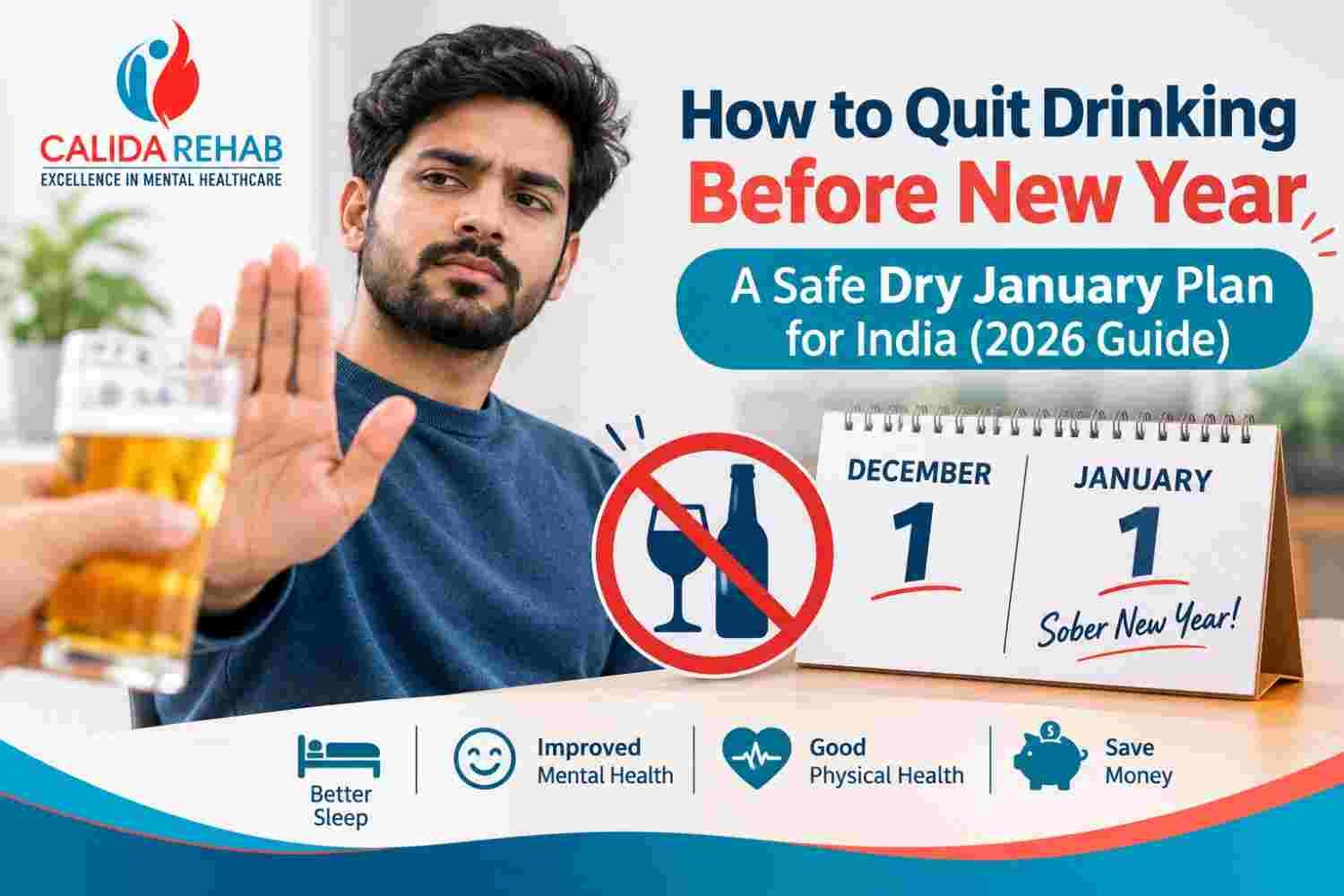
Yes, you can quit drinking before New Year, and January is a good time to try. How you do it safely depends on how much and how often you drink. If you drink only now and then, you can usually stop at home with a simple plan. If you drink every day, need a drink in the morning, or feel shaky and sweaty when you skip one, do not stop suddenly on 31 December. Alcohol withdrawal can cause seizures and delirium tremens, which can be life-threatening, so see a doctor first.
This guide explains what Dry January is and whether it works, how to check if it is safe for you to go alcohol-free, a four-week countdown you can start on 1 December, how to handle weddings, office parties and New Year’s Eve, and where to find help at a rehabilitation centre in Mumbai or a rehabilitation centre in Pune and nearby. It is written for education and does not replace a doctor’s advice. If someone has a seizure, confusion, hallucinations or a racing heartbeat after stopping alcohol, call 108 or 112 straight away.
Last updated: 13 November 2026.
Key Takeaways
- Quitting before New Year is realistic, but safety comes first. Heavy daily drinkers should get a doctor’s assessment before stopping, not stop suddenly on New Year’s Eve.
- Dry January is a month without alcohol. It suits people who want to reset or cut down. It is not a treatment for alcohol dependence.
- A University of Sussex study of more than 6,000 people found that Dry January participants were still drinking less six months later.
- Start on 1 December, not 31 December. A four-week countdown gives you time to check your risk, remove alcohol from your home and plan for every party.
- If you need a drink in the morning, shake when you skip a drink, or have had a withdrawal seizure before, book a medical detox in early December so it is finished before the festive rush.
- Decide before you arrive at a party. Hold an alcohol-free drink, keep one short line ready and set a time to leave.
- A slip is not the end. Stop again, note what triggered it and tell someone.
- Free help is available. Tele-MANAS (14416) offers 24×7 tele-counselling across India.
What Is Dry January, and Does It Work?
Dry January is a month-long break from alcohol that began in the UK and is run by the charity Alcohol Change UK. People now try it in many countries, including India, because 1 January gives a natural and shared starting point. Friends, colleagues and family members can do it together, which makes it easier to stick to.
The best evidence so far comes from the University of Sussex, which surveyed more than 6,000 adults in 2019. Six months later, people who had taken part were still drinking less than at the start of the year, while other drinkers had not changed. People who used the campaign’s website, app or emails were twice as likely to finish the month without a drink. The findings rely on self-reported data and on people who chose to sign up, so they do not prove the same result for everyone.
There is also a simple health reason to take a break. The World Health Organization says that no level of alcohol consumption is safe for health. A month off lets you see how alcohol affects your sleep, mood, energy and spending, and shows you how much you rely on it. You can read more about what alcohol does inside your head in our guide to the effects of alcohol on the brain.
Dry January, Quitting for Good or Cutting Down: Which One Is for You?
| Option | What it means | Best for |
|---|---|---|
| Dry January | No alcohol for 31 days, then review | Social or occasional drinkers who want a reset |
| Quitting for good | No alcohol, with a plan, support and sometimes medicines | People with a pattern of heavy drinking, health problems or repeated failed attempts |
| Cutting down | Fewer drinking days and fewer drinks per day | People who drink lightly and have never had withdrawal or cravings |
| Supervised detox, then recovery | Doctor-led stop, then therapy and relapse prevention | Daily drinkers and anyone with withdrawal symptoms |
If you have already tried to cut down and could not keep to your own limits, that is useful information. It often means stopping completely, with support, is easier than moderating. Our guide to how to stop drinking alcohol explains the full medical route.
Why December Is the Hardest Month to Stay Sober in India
December puts more drinking occasions into a few weeks than almost any other month. Common triggers include:
- Wedding season. Many families have several functions in the same month, often with a bar and strong social pressure.
- Christmas and New Year parties. Clubs, house parties and trips to Goa or hill stations are built around drinking.
- Office year-end events. Colleagues and seniors may offer drinks, and refusing can feel awkward.
- Year-end stress. Targets, family visits, travel and money worries can push people to drink to cope.
- Social habits. In many groups, offering a drink is a sign of welcome, and ‘just one peg’ is hard to refuse.
This matters because alcohol use in India is already widespread. The national survey Magnitude of Substance Use in India found that about 5.2% of Indians, or more than 5.7 crore people, have harmful or dependent alcohol use. Our report on addiction statistics in India has more detail on the treatment gap.
Is It Safe to Quit Drinking on 1 January? A Quick Self-Check
Answer these four questions honestly. They are the widely used CAGE screening questions.
- Have you ever felt you should cut down on your drinking?
- Do people annoy you by criticising your drinking?
- Have you ever felt guilty about your drinking?
- Have you ever had a drink first thing in the morning to steady your nerves or get rid of a hangover?
Two or more ‘yes’ answers suggest a drinking problem and are a good reason to see a doctor before you stop. A ‘yes’ to the morning drink is a warning sign of physical dependence. Then match your situation to the table below.
| Your situation | What to do |
|---|---|
| You drink at weekends or parties and feel fine on the days you skip | Dry January at home is usually fine. Follow the countdown below. |
| You drink most days but have no shakes or sweats when you skip a day or two | See a doctor first. You may need a gradual plan or medicines. |
| You drink daily for months or years, or feel shaky, sweaty or anxious when you miss a drink | Do not stop suddenly. Medical detox is advised. |
| You need a morning drink, or had a seizure, confusion or hallucinations in an earlier break | Hospital or rehab-based detox only. |
| You have liver disease, epilepsy, heart disease, diabetes, or are pregnant, or you take sleeping pills or other drugs | Doctor-supervised plan only. |
| You drink to cope with depression, anxiety or past trauma | Get a mental health assessment alongside your alcohol plan. |
Heavy weekend drinking is risky too, even if you stay dry on weekdays. Our guide to binge drinking explains why, and the stages of alcoholism page helps you see where your own pattern sits. If you already know you are drinking daily, read about alcohol dependence syndrome.
Why Heavy Drinkers Should Not Quit Suddenly on New Year’s Eve
If your body has adapted to alcohol, stopping suddenly sets off withdrawal. The timeline below shows why the date you choose matters.
| Time after your last drink | What can happen |
|---|---|
| 6 to 12 hours | Tremor, sweating, anxiety, nausea, headache, poor sleep |
| 6 to 48 hours | Withdrawal seizure window, with the highest risk around 24 hours |
| 24 to 72 hours | Symptoms usually peak, with a rising heart rate and blood pressure |
| 48 to 96 hours | Delirium tremens can begin: confusion, hallucinations, fever, very fast heartbeat |
If your last drink is at midnight on 31 December, the danger window falls on 1 to 4 January. That is when many people are travelling, recovering from parties or hard to reach. A better plan is to see a doctor in the first week of December and finish a supervised detox by mid-December. You then spend the festive weeks building routines instead of fighting withdrawal. Read the full alcohol withdrawal symptoms timeline, the page on detoxification and our guide to when to go to hospital in an addiction emergency.
Call 108 or 112 immediately if you or someone else has a seizure, confusion, hallucinations, a very fast heartbeat or a high fever after stopping alcohol.
A 4-Week Countdown to a Sober New Year (1 December to 1 January)
This plan is for people who are not heavily dependent, or who have been cleared by a doctor. If you drink heavily every day, do not cut down on your own. Use week 1 to book a medical assessment.
Week 1 (1 to 7 December): Check, decide and tell someone
- Do the self-check above. If any warning sign applies, book a doctor or a psychiatrist appointment this week.
- Write your reason in one sentence, such as ‘I want to sleep well, save money and feel in control.’ Keep it on your phone.
- Start a simple drink diary: what you drank, when, with whom, and why. Count in standard drinks. A 30 ml peg of spirits is about one standard drink, so a 60 ml peg is about two.
- Tell one trusted person about your plan and ask them to check in with you.
Week 2 (8 to 14 December): Prepare your space and your calendar
- List every wedding, party and work event between now and 1 January. Decide in advance which ones you will attend, for how long and what you will drink.
- Remove alcohol from your home, or ask family members to keep it out of sight.
- Stock alternatives you actually like: soda with lime, nimbu pani, cold coffee, coconut water, tea or a good mocktail.
- Protect your sleep, meals and exercise. Tired, hungry and stressed people are more likely to drink.
Week 3 (15 to 21 December): Practise alcohol-free days
- Try several alcohol-free days, including one social occasion. Notice when cravings come and what helps.
- Note which people, places and moods trigger the urge to drink.
- If you cannot manage even a few days, or you feel shaky or anxious when you try, that is not a failure. It is a sign you need medical advice before going further.
Week 4 (22 December to 1 January): Get through the festive stretch
- Keep your own transport so you can leave when you choose.
- Check in with your support person every evening, even for two minutes.
- Plan 31 December in detail: where you will be, who you will be with, what you will drink and when you will leave.
- Plan something enjoyable for the morning of 1 January, such as a walk, a long breakfast or a family outing.
How to Handle Weddings, Office Parties and New Year’s Eve
Most people drink at parties because of pressure and habit, not thirst. A few simple steps take away much of the pressure.
- Decide before you go. Choose your drink and your leaving time at home, when you are calm.
- Arrive with a drink in your hand. An alcohol-free glass stops people from offering you another.
- Keep one short line ready. ‘No thanks, I’m good.’ ‘I’m taking a month off.’ ‘I’m driving tonight.’ You do not owe anyone a long explanation.
- Tell the host or one friend in advance. They can help you if someone keeps pushing.
- Stay away from the bar. Sit near the food, the music or the people you enjoy.
- Offer to drive. It gives you a clear reason to stay sober and helps others get home safely.
- Leave early if cravings build. Leaving is a plan, not a defeat.
- Avoid the hardest events in the first week. If a gathering is only about drinking, skip it this time.
How to Handle Cravings and Urges
Cravings rise like a wave and usually fall again within 20 to 30 minutes if you do not act on them. These steps help you ride the wave:
- Delay. Tell yourself you will decide in 20 minutes, then do something else.
- Check the basics. Ask whether you are hungry, angry, lonely or tired. Fix that first.
- Move. A brisk walk, a shower or a few stretches changes your state quickly.
- Call someone. Talking to your support person breaks the loop.
- Do not swap alcohol for sleeping pills or other drugs. They carry their own risks.
For people who struggle with strong urges, structured therapy helps. Cognitive behavioural therapy, relapse prevention therapy and mindfulness-based relapse prevention teach practical skills for handling triggers.
What Changes in the First Month Without Alcohol?
Everyone is different, but many people notice a pattern like this.
| Period | What you may notice |
|---|---|
| Week 1 | Poor sleep, restlessness, irritability and the strongest cravings |
| Week 2 | Sleep and energy begin to improve for many people |
| Week 3 | Steadier mood, clearer thinking, more money in your pocket |
| Week 4 | Cravings are less frequent and your confidence is higher |
If low mood, anxiety or panic gets worse instead of better, speak to a doctor. Alcohol and mental health problems often feed each other. If you take blood pressure or diabetes medicines, tell your doctor you have stopped drinking, because your readings can change. Our article on alcohol and blood pressure explains the link.
What to Do If You Slip
One drink does not erase your progress. What matters is what you do next.
- Stop again straight away and do not wait for the next Monday or the next January.
- Tell your support person or doctor. Secrecy makes slips grow.
- Write down what triggered it: a person, a place, a feeling or a time of day.
- Adjust the plan and carry on.
If one drink keeps turning into a binge, or you slip repeatedly, get professional help. Our guide to relapse in addiction recovery explains the warning signs, and the alcohol relapse case study shows how one person recovered after a setback.
After January: Turn a Month Off Into a Lasting Change
On 1 February, review honestly. Ask what was easy, what was hard and how you feel. Then choose one of three paths: stay alcohol-free, drink only on set days with clear limits, or ask for professional help. If you found it hard to stay off alcohol even for a week, if cravings were strong, or if you had withdrawal symptoms, that suggests dependence. It is a medical condition, not a lack of willpower.
Staying motivated helps, and our article on motivation in addiction recovery explains why willpower alone often fails. Doctors can also prescribe medicines to reduce cravings and prevent relapse. You can read how medication-assisted treatment works, and the MAT service page for treatment details. These medicines need a prescription and medical follow-up.
When to Get Professional Help Instead of Going It Alone
Asking for help is a sign of good judgement. Consider professional support if:
- You have tried to stop before and could not.
- You drink daily, or you drink first thing in the morning.
- You shake, sweat or feel very anxious when you miss a drink.
- You have had a seizure, confusion or hallucinations while stopping.
- You have liver, heart or neurological illness, or you use sleeping pills or other drugs.
- Your home is not a safe or supportive place to stop.
- Depression, anxiety or trauma are part of your drinking.
A good rehabilitation centre in Mumbai or Pune offers supervised detox, daily therapy and distance from triggers. Our guides on the signs you need a rehab centre, 30, 60 or 90-day programmes and rehab versus home recovery will help you decide. Many families worry about privacy, so read is rehab confidential. For money questions, see does health insurance cover rehab in India and the rehab centre cost in Mumbai.
Help to Quit Drinking in Mumbai, Pune and Nearby
Calida Rehab offers psychiatrist-led alcohol treatment at its rehabilitation centre in Mumbai and rehabilitation centre in Pune, including medical assessment, supervised detox, medicines for cravings where needed, individual, group and family therapy, and relapse prevention. You can learn about the alcohol rehab centre in Mumbai (consultation in Colaba, residential care at Karjat), the alcohol rehabilitation centre in Pune, and our alcohol addiction treatment programme.
Families in Navi Mumbai, Panvel and Thane can also read about our Nasha Mukti Kendra in Panvel, the rehabilitation centre in Navi Mumbai and the rehabilitation centre in Thane. Our guide to choosing a rehabilitation centre in Mumbai lists 12 questions to ask any centre before admission. To speak to someone, use the contact page or call +91-8452940789. You can also call Tele-MANAS on 14416 for free, 24×7 counselling.
How Family and Friends Can Help
- Keep alcohol out of the house during the first weeks, and offer alcohol-free drinks at your own gatherings.
- Avoid nagging, shaming or checking pockets. Ask how the person is doing and listen.
- Never put drugs or powders in someone’s drink to make them stop. This is unsafe and breaks trust.
- Learn the warning signs of withdrawal and know to call 108 or 112 in an emergency.
- Join in. Doing Dry January together makes it easier for everyone.
- If the person refuses help, read how to convince someone to go to rehab, and consider family therapy to support the whole household.
Frequently Asked Questions
Can I quit drinking before New Year?
Yes, if it is safe for you. Light or occasional drinkers can usually stop at home with a plan. Daily or heavy drinkers should see a doctor first, because stopping suddenly can cause seizures and delirium tremens. Start planning on 1 December so you have time to prepare.
Is Dry January safe for everyone?
No. It is safe for most light and social drinkers, but not for people who drink heavily every day, need a morning drink, shake or sweat when they skip a drink, or have had withdrawal seizures. These people should detox under medical supervision.
How do I quit drinking safely if I drink every day?
See a doctor before your last drink. The doctor will assess your risk, check your health and decide between home, outpatient or inpatient detox. Medicines and thiamine (vitamin B1) are often used. Do not use home remedies or sleeping pills to cope with withdrawal.
How long should Dry January last?
The campaign runs for 31 days, from 1 to 31 January. Any break helps, and many people carry on for longer. Use the end of the month to review how you feel and decide your next step.
What happens to my body if I stop drinking for a month?
Many people report better sleep, more energy, steadier mood and savings on spending. Alcohol can raise blood pressure, so readings may improve. Early withdrawal can cause poor sleep, restlessness and cravings, and heavy drinkers need medical advice first.
How do I say no to alcohol at a wedding or party in India?
Decide before you go, hold an alcohol-free drink, and keep a short line ready, such as ‘No thanks, I’m good’ or ‘I’m taking a month off.’ Tell the host or one friend in advance, stay away from the bar, and set a time to leave.
What if I fail Dry January?
A slip does not cancel your effort. Stop again, note what triggered it and tell someone. Research on Dry January suggests that even people who did not complete the month tended to drink less afterwards. If you slip often, speak to a doctor.
Can I just cut down instead of quitting?
Light drinkers can try cutting down. If you have already failed to keep to your own limits, have cravings or drink daily, stopping completely with support is usually easier and safer. Heavy drinkers should not cut down on their own because withdrawal can start between drinks.
Which medicines help people quit drinking?
Doctors commonly prescribe naltrexone, acamprosate or disulfiram to reduce relapse, plus short-term medicines and thiamine during detox. All need a prescription. The right choice depends on your liver and kidney health, other medicines and drinking pattern.
Where can I get help to quit drinking in Mumbai or Pune?
Calida Rehab offers psychiatrist-led alcohol treatment in both cities, with a rehab centre in Mumbai (consultation in Colaba, residential care at Karjat) and a rehabilitation centre in Pune. You can also call Tele-MANAS on 14416 for free, 24×7 counselling.
What should I do if someone has a seizure after stopping alcohol?
Call 108 or 112 immediately. Lay the person on their side, keep hard objects away, do not put anything in their mouth and note when the seizure started. A seizure after stopping alcohol is a medical emergency even if the person seems fine afterwards.
The Bottom Line
Quitting before New Year works best when you start early, check your risk and plan for the hardest moments. Light drinkers can use December as practice and January as a reset. Heavy daily drinkers should book a medical assessment in the first week of December, not stop suddenly on New Year’s Eve. If you need help, explore our rehabilitation centre in Mumbai or rehabilitation centre in Pune, contact Calida Rehab or call Tele-MANAS on 14416.
Sources and Further Reading
- University of Sussex, Dry January research summary
- World Health Organization, No level of alcohol consumption is safe for our health
- Nasha Mukt Bharat Abhiyaan and survey findings, Vikaspedia (Government of India)
- Alcohol withdrawal, Harvard Health Publishing
- Tele-MANAS, Ministry of Health and Family Welfare