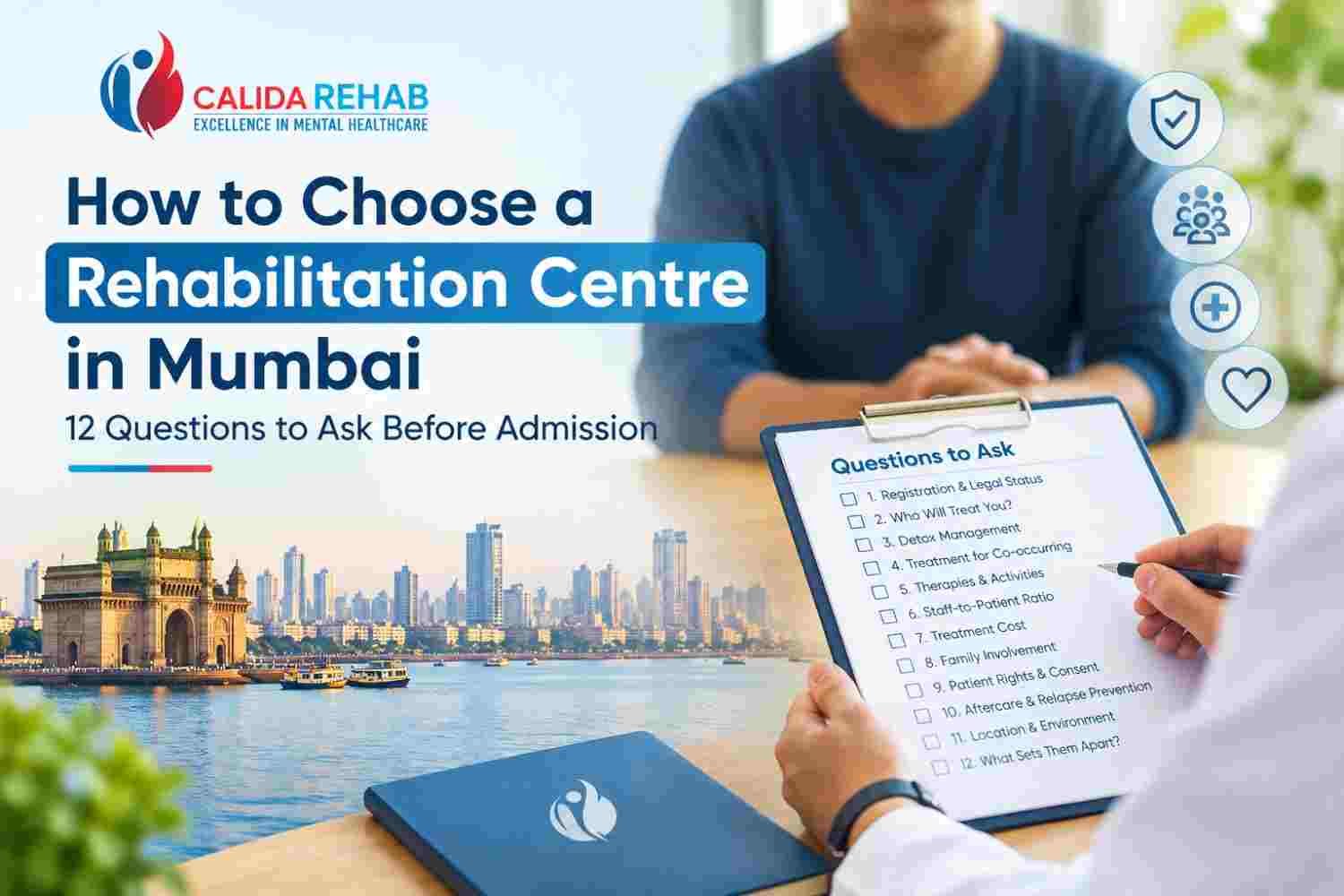

The safest way to choose a rehabilitation centre in Mumbai is to check five things before you pay: legal registration, who actually treats the patient, how detox is managed, what the fee includes and what happens after discharge. This guide is for families who are comparing centres for alcohol, drug or mental health problems, and it gives you 12 questions to ask each one, plus warning signs to watch for. Use the answers, not the brochure, to decide. If you are still shortlisting, see how a psychiatrist-led rehabilitation centre in Mumbai handles admission, detox and aftercare.
If the person has seizures, severe confusion, heavy shaking or has taken an overdose, go to the nearest hospital or call 112 first. Do not wait for an admission.
The 12 questions at a glance
| # | Ask this | A good sign | A warning sign |
|---|---|---|---|
| 1 | Is the centre registered? | Gives its State Mental Health Authority registration number | Dodges, or says registration is not needed |
| 2 | Who treats the patient? | Qualified psychiatrists and doctors, with clear medical cover | Only counsellors or ex-patients |
| 3 | Is there an assessment first? | Reviews medical and psychiatric history before admitting | Admits anyone immediately, no questions |
| 4 | How is detox managed? | Doctor, nursing and emergency backup | Detox done by non-medical staff |
| 5 | Can it treat addiction and mental illness together? | Psychiatric care is part of the programme | Treats addiction only |
| 6 | What therapies are used? | Individual, group and family therapy on a schedule | Only prayer, discipline or lectures |
| 7 | What is the staff-to-patient ratio? | Gives a clear number for day and night | Will not say |
| 8 | What does it really cost? | Written, itemised quote | Verbal price, large advance, hidden extras |
| 9 | How is the family involved? | Counselling, updates and clear visiting rules | No contact for weeks without reason |
| 10 | How are rights and consent protected? | Explains consent, privacy and complaints | Force, confiscation or ill-treatment stories |
| 11 | What happens after discharge? | Relapse-prevention plan and follow-up | Discharge and nothing more |
| 12 | Does the setting support recovery? | Calm, safe, away from triggers | Crowded, locked, poorly kept |
1. Is the centre legally registered?
Under the Mental Healthcare Act 2017, mental health establishments are expected to be registered with the State Mental Health Authority. In Maharashtra that is the Maharashtra State Mental Health Authority (MSMHA). Ask for the registration number and the validity date, and ask to see the certificate. Calida Rehab publishes its licences and certificates for this reason. Do not rely on a name that merely sounds medical.
2. Who will actually treat my family member?
Look for qualified psychiatrists and doctors, with a clear answer on who is available at night. Counsellors are important, but they cannot manage withdrawal, prescribe medicines or treat a psychiatric emergency. A psychiatrist-led rehab centre in Mumbai keeps medical decisions with trained doctors.
3. Is there an assessment before admission?
A responsible centre reviews medical and psychiatric history first, and tells you honestly if hospital care should come first. Some people need a hospital before rehab. Our guide to rehab vs psychiatric hospital explains the difference.
4. How is detox managed?
Withdrawal from alcohol, opioids and sedatives can be dangerous. Ask whether a doctor and nurses supervise detox on site, what medicines are used and what happens in an emergency. Read about alcohol withdrawal symptoms and when detox needs medical care and how our detoxification programme is structured.
5. Can it treat addiction and mental illness together?
Depression, anxiety, bipolar disorder and other conditions often come with addiction. Treating only one can lead to relapse. Ask how psychiatric conditions are assessed and treated alongside substance use. See what dual diagnosis means.
6. Which therapies are used, and how often?
Ask for a sample weekly schedule. Evidence-based approaches such as CBT, motivational interviewing and relapse-prevention work, together with group and family therapy, should be part of the plan. Our overview of therapies used in rehab shows what to expect.
7. What is the staff-to-patient ratio?
The ratio shapes how much individual attention a patient gets. Ask for the number during the day and overnight. A centre that cannot answer has probably not measured it.
8. What does it really cost?
Get a written, itemised quote that shows what is included and what is billed separately, such as tests, medicines and hospital transfers. Compare what each fee covers, not just the number. Our guide to rehab centre cost in Mumbai lists the questions to ask.
9. How is the family involved?
Family counselling, regular updates and clear visiting and phone rules are part of good care. Ask what is allowed, when and why. A centre that cuts off all contact without a clinical reason deserves caution.
10. How are patient rights, consent and confidentiality protected?
The Mental Healthcare Act 2017 protects dignity, confidentiality and informed consent. Ask how consent is taken, how privacy is protected and how a patient or family can raise a complaint. Read about patient rights in rehab under the Mental Healthcare Act. Be wary of any centre that relies on force, confiscation or humiliation.
11. What happens after discharge?
Recovery continues after the stay. Look for a relapse-prevention plan and structured follow-up. Understanding relapse and how to prevent it will help you judge a centre's aftercare promises.
12. Does the setting support recovery?
Distance from triggers matters. Some families prefer a centre inside the city for easy visits, while others choose a calmer setting outside it. Compare rehab vs home recovery and see our residential centre in Karjat, which is a short journey from Mumbai.
Red flags that should make you walk away
- Guarantees of a cure or a fixed success rate.
- Refusal to show registration or qualifications.
- No doctor involved in detox or admission decisions.
- Pressure to pay a large advance before any assessment.
- No written quote or hidden charges.
- Patients kept without consent, or reports of beating or ill-treatment.
- Misleading names. Check whether a place calling itself a nasha mukti kendra is actually registered. Our guide to the right nasha mukti kendra explains what to check.
Government or private: which suits you?
Both routes have a place. Government and government-funded centres can be free or low cost, though beds and waiting times vary. Private centres charge fees and usually admit faster. We compare them in government vs private rehab centres.
How Calida Rehab approaches these questions
Calida Rehab is a psychiatrist-led addiction and mental health care centre registered with the Maharashtra State Mental Health Authority, with consultations in Colaba and residential care in Karjat. Every admission begins with an assessment, and we are happy to answer all 12 questions in writing. You can read how treatment works on our rehabilitation centre in Mumbai page or speak confidentially to our Mumbai admission team.
Frequently asked questions
How do I choose a rehab centre in Mumbai?
Check registration first, then ask who treats the patient, how detox is managed, what the fee includes and what aftercare is offered. Use the 12 questions above and compare answers in writing.
Which is the best rehab centre in Mumbai?
There is no single best centre for everyone. The right one depends on the substance, severity, any mental health condition, budget and family needs. Compare centres on registration, medical care and transparency rather than on rankings or advertising.
What is a psychiatrist-led rehab centre?
It is a centre where psychiatrists make the medical and treatment decisions, manage withdrawal and medicines and treat any co-occurring mental health condition, supported by counsellors and therapists.
How can I check whether a rehab centre is registered?
Ask for the Maharashtra State Mental Health Authority registration number and certificate and check it with the authority. Do not accept a verbal assurance.
Should I choose a rehab centre inside Mumbai or outside the city?
Inside the city makes visits easier. A centre outside the city offers distance from triggers and a calmer routine. The best choice depends on the person's situation and the family's ability to take part.
How much does rehab cost in Mumbai?
Fees vary widely by room, medical care and length of stay. See our detailed guide to rehab centre cost in Mumbai.
Sources and editorial note
Legal reference: Mental Healthcare Act 2017 (registration of mental health establishments, rights of persons with mental illness). This article is for information and does not replace medical advice.