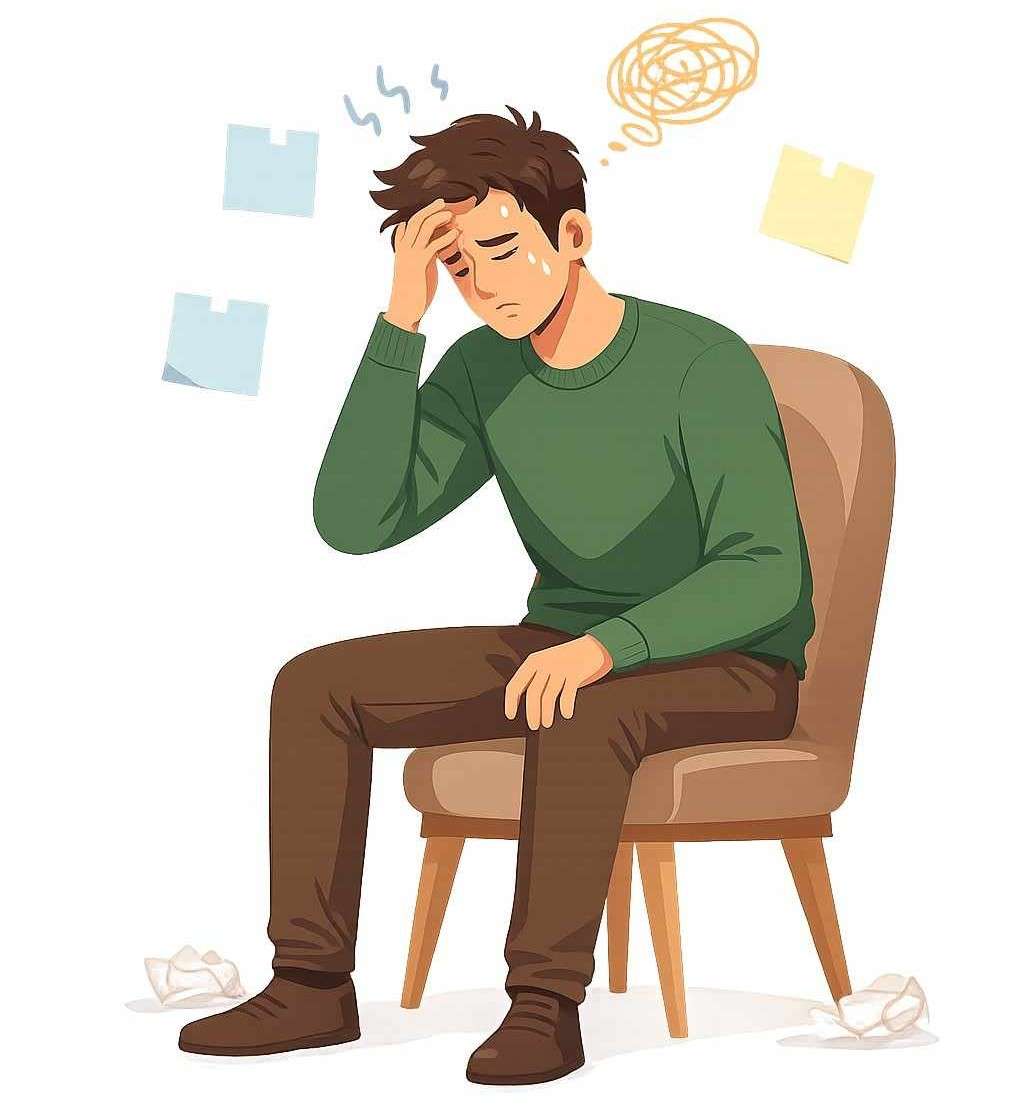


Ask a twenty-two-year-old in Pune or Mumbai how life is going and the answer is usually “fine, bas busy hai.” Behind that reply there is often a packed calendar, a phone that never goes quiet, and a nagging feeling that everyone else is coping better.
This guide is for Gen Z readers (born roughly between 1997 and 2012) and for the parents, partners and friends who live alongside them. It explains why anxiety, burnout, loneliness and broken sleep have become so common among young Indians, how to tell a hard phase from a health problem, which changes actually help, and at what point a psychiatrist should be involved.
The short version
Struggling does not make this generation fragile. The pressures are real and they stack up: endless comparison, news that never stops, thin sleep, a competitive job market and very few safe places to say “I am not okay.” The good news is that most of these problems respond well to treatment, especially when they are caught early.
- Think of it as health, not attitude. Persistent worry, low mood, panic and exhaustion are medical experiences, not character flaws.
- Start with sleep and screens. They are the quickest levers you can pull on your own.
- Keep at least one person who really knows you. A group chat is not the same thing.
- Choose evidence-based care. Talk therapy works well for most young people, and medicines are added only when a doctor judges they are needed.
- Do not wait for a crisis. Two weeks of feeling off, or any thought of self-harm, is reason enough to book a consultation.
What the research says, and what it cannot tell us
Globally, the World Health Organization estimates that 14.3% of adolescents aged 10 to 19, roughly one in seven, live with a mental disorder, and that most of them never receive care. WHO also points out that half of all mental health conditions begin by age 14, which is why early recognition matters so much.
For India, the most detailed national picture is still the NIMHANS National Mental Health Survey of 2015 to 2016. It found that 7.3% of people aged 13 to 17, around 98 lakh young people, had a mental disorder. Among adults, mental health problems were far more common in urban metros (13.5%) than in rural areas (6.9%), and most people who needed treatment were not getting it. The survey is nearly a decade old and predates today’s short-video habits and the pandemic years, so treat its numbers as a floor rather than a current headcount.
On social media, a 2023 advisory from the US Surgeon General reported that teenagers who spent more than three hours a day on these platforms had about twice the risk of depression and anxiety symptoms. The same document acknowledged benefits such as connection and support, and admitted that the evidence is still developing. The sensible reading is that the amount, the timing and the type of use matter more than the apps themselves. Our article on the effects of mobile phones on students goes deeper into the everyday side of this.
Why so many young Indians feel stretched thin
1. Comparison on a loop
Feeds are built from highlights: the offer letter, the holiday, the gym transformation. Measuring your unedited Tuesday against someone else’s best month is a losing game, and it quietly erodes self-worth. Over time many young people start to feel they are behind in a race nobody explained to them.
2. Doomscrolling turns the feed into a worry machine
Doomscrolling is the habit of scrolling through upsetting news or content long after it stops being useful. It is not a diagnosis, but it keeps the nervous system on alert and pushes sleep later and later. Anxious people check more, and checking makes them more anxious. If this loop sounds familiar, our guide on how to stop overthinking offers techniques for breaking it.
3. Sleep debt that never gets repaid
Late-night screens, deadlines and worry cut sleep short, and short sleep makes mood and anxiety harder to manage the next day. When bad nights become a pattern, a structured, medicine-free programme such as CBT for insomnia is usually more effective than sleeping pills.
4. Degrees, deadlines and the cost of living
Entrance exams, placement season, layoffs, rising rents and family expectations all land in the same few years. In Mumbai, Navi Mumbai, Thane and Pune, a long commute and an expensive room can leave almost no time for rest, exercise or friends. Hustle culture then tells you that being exhausted is proof you are doing it right.
5. Connected, yet lonely
A thousand followers do not guarantee a single person to call when things go wrong. Many young adults who move cities for college or a first job lose their daily contact with family and school friends, and the replacement is mostly digital.
6. “Log kya kahenge” still has a vote
Young people talk about mental health more openly online than any earlier generation, yet at home they may still hear “it is just stress” or “everyone goes through this.” Fear of being judged is one of the biggest reasons people wait years before seeing a professional.
7. Coping with alcohol, vapes, cannabis or pills
Switching off the noise with a drink, a vape, cannabis or a pharmacy sedative can feel like relief for an evening. Over weeks it usually worsens anxiety, mood and sleep, and can slide into dependence. Our pages on drug addiction treatment, college students in Pune and young professionals in Mumbai describe how this pattern develops and how it is treated.
Common conditions and how they show up
| Condition | How it often looks in a young person | Read next |
|---|---|---|
| Anxiety and panic | Constant what-ifs, tight chest, racing heart, skipping lectures or meetings to avoid triggers | Anxiety disorder and the panic attack guide |
| Depression | Flat or irritable mood, losing interest, hopelessness, sleeping far too much or too little | Depression in teenagers and students and high-functioning depression |
| Burnout | Drained, detached and less effective, tied to study or work demands | Overcoming depression and anxiety |
| Social anxiety | Dreading presentations, calls and group plans because of fear of being judged | Social anxiety case study |
| Health anxiety | Body-checking, late-night symptom searches, repeated tests that never reassure | Health anxiety case study |
| Attention problems | Trouble starting or finishing tasks, which can be ADHD, anxiety, poor sleep or all three | ADHD treatment |
| Substance misuse | Drinking, vaping or using pills to cope with stress, social situations or sleep | Drug addiction treatment |
One clarification on burnout: the WHO classifies it as an occupational phenomenon, not a medical condition. Its symptoms overlap with depression, so if exhaustion does not lift after a proper break, a clinical assessment is worth having.
How long has it been going on?
Duration is one of the most useful clues. This table is a rough guide, not a diagnosis.
| What you notice | For how long | What it may mean | What to do |
|---|---|---|---|
| Nervous or low before an exam or deadline, then back to normal | A few days | An ordinary stress response | Rest, routine, talk to someone |
| Low mood, worry or irritability on most days | Two weeks or more | Possible depression or an anxiety disorder | Book a psychiatric assessment |
| Broken sleep on three or more nights a week | A month or more | An insomnia pattern that may be feeding mood or anxiety | Sleep reset steps, then CBT-I if it persists |
| Cannot cut down scrolling despite trying, and studies, work or sleep suffer | Several weeks | Problematic use, sometimes covering an underlying anxiety or low mood | Speak to a professional |
| Using alcohol, vapes, cannabis or pills to get through the day or night | Any length | Coping that is turning risky | Early consultation, do not wait |
| Thoughts of ending your life or hurting yourself | Any length | An emergency | Same-day help: Tele-MANAS 14416 or 112 |
Eight changes that make a real difference
- Fix the wake-up time first. A steady morning anchor stabilises the whole sleep cycle faster than chasing an early bedtime.
- Park the phone across the room at night. Use a basic alarm clock if you need one, and keep the last half hour screen-free.
- Trim the feed. Mute or unfollow accounts that leave you feeling worse and set an app timer you actually respect.
- Give the news a window. Check it twice a day at fixed times, never in bed.
- Hold one honest conversation a week with a person who knows how you really are, not how you look online.
- Shrink the task. When everything feels huge, write down the next 20-minute action only. Our guide to overcoming depression and anxiety has more step-by-step ideas.
- Move your body most days. A brisk 20 to 30 minute walk, a sport or a workout lifts mood and improves sleep.
- Treat online labels as questions, not answers. “Trauma,” “ADHD” and “OCD” in a reel can describe ordinary experiences. A clinician can tell the difference, and our article on sadness versus depression is a useful starting point.
What professional help looks like
Most young people with anxiety, low mood or burnout are treated as outpatients with talk therapy, and with medicines when a psychiatrist recommends them. If you are unsure whom to see first, read psychiatrist vs psychologist vs counsellor. Approaches your care team may use include:
- Cognitive behavioral therapy (CBT) to untangle unhelpful thought and behaviour loops in anxiety, panic and depression.
- Acceptance and commitment therapy (ACT) to stop fighting every anxious thought and act on your values instead.
- Interpersonal therapy (IPT) when low mood is tied to loneliness, conflict or a big life transition.
- Dialectical behavior therapy (DBT) to handle intense emotions and impulsive urges.
- Mindfulness-based cognitive therapy (MBCT) to prevent depression from returning.
- Group therapy and social skills training to rebuild confidence around other people.
- Family therapy and psychoeducation so that parents understand what is happening and how to support recovery.
- Medicines such as antidepressants or anti-anxiety treatment, only on a psychiatrist’s advice and with regular review.
- Simultaneous treatment for alcohol or drug use when it is part of the picture.
Our pages on anxiety disorder treatment and depression treatment explain what to expect, the overview of mental health treatment in India compares care options, and our child and adolescent psychiatry service supports younger patients. If you want to see what recovery can look like, read the anxiety case study and the depression case study. Gentle practices such as yoga therapy can sit alongside treatment, not replace it.
When a hospital stay is the right call
Inpatient care is not meant for everyday stress. It is considered when someone is at risk of suicide or serious self-harm, is hearing voices or holding fixed false beliefs, is in a severe manic or depressive episode, cannot eat, sleep or look after themselves, or has not improved with outpatient care. The decision is made with the person and the family, within the framework of the Mental Healthcare Act, 2017.
Families in Pune can read how our mental hospital in Pune assesses young patients and what the mental hospital admission in Pune process involves. Families travelling in from Mumbai, Navi Mumbai or Thane will find the details on our mental hospital in Mumbai page. If you are weighing a psychiatric hospital against a recovery programme, rehab vs psychiatric hospital sets out the difference, and our Pune and Karjat centres cover the residential recovery side.
For parents, partners and friends
- Listen first, fix later. Skip “in my time” and comparisons with cousins or classmates.
- Notice shifts rather than moods. Changes in sleep, appetite, grades, friends or substance use over a few weeks are the signal.
- Ask the direct question. If you are worried about suicide, ask plainly. Asking does not plant the idea and it often brings relief.
- Negotiate phone limits together. Rules that feel like punishment usually backfire.
- Offer to come along to the first appointment, then let the young person decide how much to share.
- Look after yourself too. Supporting someone through a hard phase is tiring, and your own steadiness helps them most.
Gen Z mental health: common questions
Are young people really more anxious, or just more open about it?
Probably both. Awareness is higher and more people are willing to speak up, but young people also face genuinely new pressures such as constant comparison, an insecure job market and disrupted sleep. India does not yet have a recent national survey focused on Gen Z, so no one can give an exact answer, which is one more reason to take persistent symptoms seriously instead of dismissing them.
Is doomscrolling an addiction?
Doomscrolling is not a formal diagnosis. It is a habit that can feed anxiety, low mood and poor sleep. If you keep scrolling even though you want to stop, and it is costing you sleep, concentration or relationships, it is worth speaking to a professional, because an underlying anxiety or depression is often part of the story.
Can a student or a fresher really get burnout?
The WHO definition of burnout is tied to the workplace, but students and first-job freshers can develop the same pattern of exhaustion, cynicism and falling performance under constant pressure. If the tiredness stays after a proper break, a doctor can check whether it is burnout, depression or something else.
How do I tell my parents I want to see a therapist?
Pick a calm moment, describe specific changes such as poor sleep or constant worry, and ask for one appointment rather than a long commitment. You can share this article, suggest going together for the first visit, and explain that you see it as looking after your health, the way you would for a fever.
Where can I get help in Mumbai or Pune?
Tele-MANAS (14416) offers free, round-the-clock support across India. For an in-person assessment, Calida Rehab provides psychiatric care through its Pune and Karjat centres, and families in Mumbai can start with the mental hospital page or contact the team directly.
Your next step
You do not need to be in crisis to ask for support, and you do not have to prove that things are “bad enough.” If worry, low mood, exhaustion or sleeplessness is shrinking your days, a first conversation can clear up whether this is a passing phase or something to treat. Calida Rehab works with young people and their families from Mumbai, Navi Mumbai, Thane and Pune, offering everything from outpatient guidance to inpatient psychiatric care in Pune and psychiatric hospital care for Mumbai families. You can meet the doctors on our team, or get in touch whenever you are ready.
Medical disclaimer: This article is for general education and is not a substitute for advice from a qualified doctor or mental health professional. Never start or stop a medicine without medical guidance. If you or someone you know is in immediate danger or at risk of self-harm, call 112 or Tele-MANAS on 14416, or go to the nearest hospital.
Sources: WHO, Adolescent mental health fact sheet; NIMHANS, National Mental Health Survey of India 2015 to 2016; US Surgeon General, Social Media and Youth Mental Health advisory, 2023; WHO, Burn-out as an occupational phenomenon (ICD-11); Tele-MANAS, Government of India; Government of India, The Mental Healthcare Act, 2017.