
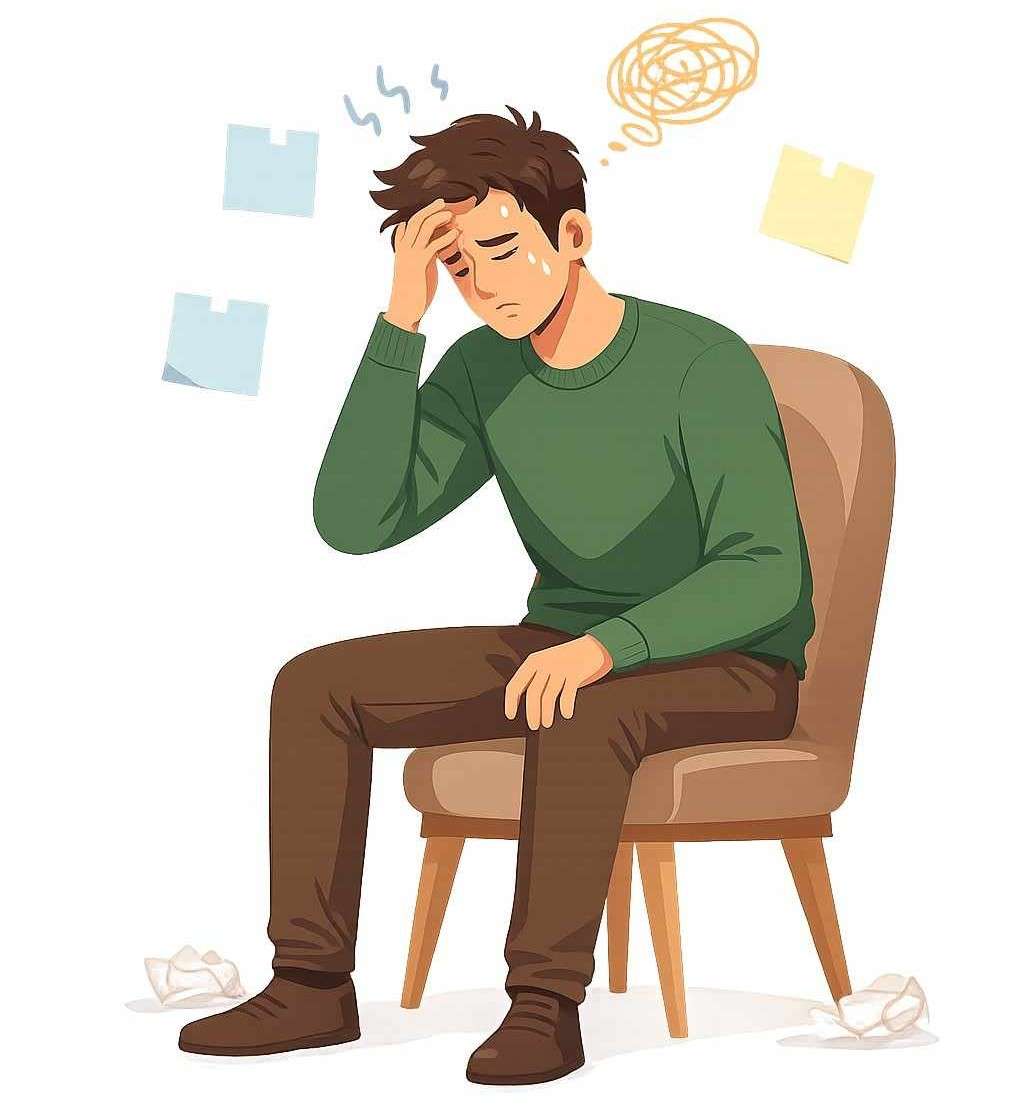

It is 1:40 a.m. The room is dark, the phone is face down, and your mind is replaying a sentence you said in a meeting three days ago. Or an exam result that has not come yet. Or what your relatives will say if you quit that job. You know that thinking about it again will not change anything. You do it anyway.
If that sounds familiar, you are not weak and you are not “dramatic”. Overthinking is one of the most common ways stress shows up in the mind, and it is a question many people in India type into Google at night. The good news is that it responds well to specific, learnable skills. This guide explains what overthinking is, why it happens, 12 techniques that work, how to stop overthinking at night, and how to tell when it is a sign of anxiety, OCD or depression that needs treatment.
Quick answer: how to stop overthinking
There is no switch that turns thoughts off, and trying to force a thought away usually makes it louder. What works is changing your relationship with the thought and moving from thinking to doing. In short:
- Notice and name it: “I am ruminating” or “I am worrying.”
- Ask whether it can be solved today. If yes, write one next step. If no, practise letting it be.
- Give worry a fixed slot of 15 to 20 minutes a day, and postpone it the rest of the time.
- Get thoughts out of your head and onto paper.
- Shift your attention to something absorbing, and move your body.
- Protect your sleep, and stop checking, Googling and asking for reassurance.
- Get help if it lasts for weeks, hurts your sleep or work, or comes with panic, low mood or compulsions. Overthinking is a symptom that can be treated.
What is overthinking?
Overthinking is not a medical diagnosis. It is an everyday word for repetitive, unproductive thinking: going over the same thoughts again and again without reaching a decision or a feeling of relief. Psychologists usually describe two forms, and both are different from healthy problem-solving.
| Type | Focus | What it sounds like |
|---|---|---|
| Rumination | The past | “Why did I say that? What is wrong with me? They must think I am a fool.” |
| Worry | The future | “What if I fail? What if I lose my job? What if something goes wrong tomorrow?” |
| Problem-solving (healthy) | A specific problem | “What can I do about this? What is my next step? Who can help me?” |
The difference matters. Problem-solving ends in a plan. Overthinking goes round in a circle. Research on repetitive negative thinking shows that rumination and worry are linked with both anxiety and depression, and that they can help to keep these conditions going.
Why do we overthink?
There is rarely a single cause. Several things usually come together:
- A threat system on high alert. When the brain senses uncertainty, it tries to prepare by thinking through every possibility. This works for a real, solvable danger and fails when the “danger” is vague.
- Beliefs about worry itself. Many people quietly believe that worrying keeps them safe, shows that they care, or stops them from being caught off guard. Metacognitive therapy targets these beliefs, and they are a big reason why overthinking continues.
- Low tolerance for uncertainty and perfectionism. If “not knowing” feels unbearable, the mind keeps hunting for a certainty that does not exist.
- Stress and poor sleep. A tired, stressed brain finds it harder to let go of thoughts, and worries feel bigger at night.
- Pressure that never switches off. Board exams, rank lists, job insecurity, EMIs, marriage expectations, comparison on social media and the fear of “log kya kahenge” give the mind a constant supply of material.
- A medical or mental health condition. Anxiety, depression, OCD, ADHD, trauma, thyroid problems and hormonal changes can all show up as racing or stuck thoughts. We cover this below.
Is it overthinking or problem-solving? Three quick questions
- Am I getting closer to a decision or a plan, or am I going in circles?
- Do I feel a little calmer after thinking, or more tense?
- Is this something I can act on in the next day or two?
If your answers are “circles”, “more tense” and “no”, you are overthinking.
12 techniques to stop overthinking
1. Notice it and name it
Say it, silently or aloud: “This is rumination” or “This is worry.” Naming creates a small gap between you and the thought. You stop being inside the loop and start watching it. This alone is often enough to loosen its grip.
2. Ask: can I solve this today?
Sort the thought into one of two boxes. If it is solvable, decide on one concrete next step and when you will do it (“Email HR on Monday at 10 a.m.”). If it is not solvable, such as what someone else thinks of you or what will happen next year, the skill is acceptance: “I cannot know this now, and I can still do what matters today.”
3. Set a daily “worry time”
This is one of the best-studied techniques. Choose a 15 to 20 minute slot at the same time each day, not close to bedtime. When a worry comes up at any other time, jot it down and tell yourself, “I will think about this at 6 p.m.” At worry time, go through the list. Many worries will no longer matter by then, and the rest can be handled in a focused way. Early research on this “stimulus control” approach found that it reduced worry.
4. Get it out of your head: the brain dump
Keep a notebook or a notes app. Write every thought without editing for five to ten minutes. Then circle the ones you can act on and write one next step beside each. Writing turns a swirling cloud into a short, finite list.
5. Step back from the thought
Change the sentence from “I am going to fail” to “I am having the thought that I am going to fail.” Thoughts are mental events, not facts or instructions. A short daily mindfulness practice, even 10 minutes of following the breath and gently returning each time the mind wanders, trains this skill. Mindfulness-based cognitive therapy was designed to reduce rumination. See our page on mindfulness-based cognitive therapy.
6. Check the evidence
This is a core skill in Cognitive Behavioural Therapy (CBT). Write down the thought, then ask:
- What is the evidence for it, and what is the evidence against it?
- What is the most likely outcome, not just the worst one?
- What would I tell a close friend who had this thought?
Then write a more balanced version. You are not trying to be positive. You are trying to be accurate. Learn more on our cognitive behavioural therapy page.
7. Move your body and change your focus
When you are stuck in a loop, thinking harder rarely helps. Stand up and do something that needs your attention: a brisk 10-minute walk, cooking, a household task, a phone call, a game with friends, a short workout. Regular physical activity also helps anxiety, mood and sleep, the three things that feed overthinking.
8. Calm the body first
An overthinking mind often sits in an anxious body. Try slow breathing with a longer breath out than in (for example, in for four counts and out for six, for two to three minutes), or the 5-4-3-2-1 grounding exercise: name five things you can see, four you can touch, three you can hear, two you can smell and one you can taste. These do not erase the thoughts, but they lower the physical alarm so that you can think more clearly.
9. Stop checking, Googling and asking for reassurance
Re-reading a message ten times, searching symptoms at midnight, asking family “Do you think it will be okay?” again and again: these give a few minutes of relief and then feed the loop. Each time you check, the brain learns that the thought was dangerous and needed checking. Set a limit (“one check, then I leave it”) and sit with the discomfort until it fades. This is also the key skill in treating OCD and health anxiety.
10. Put a deadline on decisions
Overthinking loves big choices: which course, which job, whether to say yes to a proposal. Decide how much information you need, set a date to decide, limit yourself to two or three options and aim for “good enough”. Most decisions can be adjusted later. Few are perfect.
11. Protect your sleep, caffeine and screen time
Sleep loss makes worry louder. Keep fixed sleep and wake times, avoid tea, coffee and energy drinks after midday, and keep your phone out of bed. Alcohol may seem to quiet the mind, but it breaks up sleep and tends to raise anxiety the next day. See our article on the effects of alcohol on the brain.
12. Talk it through, but not in circles
Talking to someone you trust helps, as long as you are looking for perspective or a plan. Going over and over the same worry with a friend, which researchers call co-rumination, can make both people feel worse. Ask for one specific thing: “Can you help me work out my next step?” If you do not have anyone to talk to, a counsellor or psychologist can fill that role.
How to stop overthinking at night
Night is when overthinking is loudest, because nothing else is competing for your attention. A few things help:
- Do your brain dump and write tomorrow’s top three tasks before you get into bed, ideally an hour earlier.
- Keep a regular wind-down: dim lights, no work messages, and no news or social media in the last hour.
- If you are still awake and spinning after about 20 minutes, get up, sit somewhere dim and do something quiet, such as reading a paper book, until you feel sleepy. Lying in bed and fighting your thoughts teaches the brain to link bed with worry.
- Do not watch the clock. Turn it away.
- Try slow breathing or a body-scan exercise, and let thoughts pass like traffic outside a window.
- Do not rely on alcohol, ganja or sleeping tablets to switch your mind off. They bring their own problems, including dependence and worse sleep.
If poor sleep has lasted more than a few weeks, see a doctor. Insomnia is itself treatable, often with CBT for insomnia.
When overthinking is a sign of something else
Everyone overthinks sometimes. It becomes a clinical concern when it is persistent, hard to control and affecting your life. The pattern of your thoughts can point to what may be going on:
| What it feels like | Condition to consider | What else to look for |
|---|---|---|
| Worry about many different things (work, health, money, family) on most days for six months or more, and hard to control | Generalised anxiety disorder | Restlessness, muscle tension, tiredness, irritability, poor sleep. See our anxiety disorder page and anxiety case study. |
| Going over failures and guilt, with thoughts that there is no point | Depression | Low mood, loss of interest, low energy, changes in sleep and appetite. See our depression page and depression case study. |
| Unwanted, disturbing thoughts that will not go away, followed by checking, cleaning, mental rituals or asking for reassurance | Obsessive-compulsive disorder (OCD) | Time-consuming rituals and distress when you cannot do them. See our OCD case study. |
| Replaying conversations and fearing judgement | Social anxiety disorder | Avoiding social situations, dread before events. See our social anxiety case study. |
| Fear of the next attack, racing heart and breathlessness | Panic disorder | Sudden surges of intense fear. See our panic disorder case study. |
| Intrusive memories or constant alertness after a frightening event | Post-traumatic stress disorder (PTSD) | Flashbacks, nightmares, avoidance. See our PTSD case study. |
| Racing, jumping thoughts and mental chatter, with trouble finishing tasks | ADHD or a mood disorder | Distractibility, forgetfulness, restlessness. See our ADHD case study. |
Medical and hormonal causes can also produce anxiety-like symptoms. Thyroid problems, anaemia, vitamin B12 deficiency, some medicines, and hormonal changes such as those described in our case studies on PMDD and perimenopausal depression can all play a part, which is why a good assessment includes a medical check.
When to see a professional
Please speak to a psychiatrist or clinical psychologist if:
- Overthinking is present on most days for two weeks or more
- It disturbs your sleep, work, study or relationships
- It comes with a racing heart, breathlessness, chest tightness, headaches or stomach upset (after a medical check has ruled out other causes)
- You have panic attacks, compulsions or growing avoidance
- You feel low, hopeless or have lost interest in things
- You are using alcohol, ganja, sleeping tablets or other substances to switch your mind off
- You have any thoughts of harming yourself. If you are in danger, call 112 or Tele-MANAS on 14416 (free, 24 hours) straight away.
What treatment looks like
When overthinking is part of an anxiety disorder, depression or OCD, it responds well to treatment. A psychiatrist or clinical psychologist will usually begin with a full assessment, and the plan may include:
- Cognitive Behavioural Therapy (CBT): a first-choice talking therapy for anxiety and depression. It teaches you to test your thoughts, face feared situations step by step and drop unhelpful habits such as checking.
- Metacognitive therapy: works directly on beliefs about worry and rumination. Trials and reviews show good results for anxiety and depression.
- Mindfulness-based cognitive therapy and Acceptance and Commitment Therapy: help you to relate to thoughts differently, and to stop being pulled along by them.
- Exposure and response prevention: the specific therapy for OCD.
- Medication: antidepressants such as SSRIs, prescribed by a psychiatrist when an anxiety disorder or depression is diagnosed. They are not needed by everyone, and should never be started or stopped without medical advice.
- Sleep, activity and stress changes: a regular routine, exercise and, where needed, CBT for insomnia.
Not sure whom to see first? Read our guide on psychiatrist vs psychologist vs counsellor.
Common myths about overthinking
- “Overthinking means I am just being careful.” Careful thinking ends in a decision or an action. Overthinking does not.
- “I just need to think positive.” Forced positivity can backfire. Aim to be balanced and accurate instead.
- “If I stop worrying, something bad will happen.” Worrying does not prevent events. It only uses up your energy.
- “Only weak people overthink.” Overthinking is common and treatable, and it is often seen in capable, conscientious people.
Overthinking in students and young professionals
Competition, comparison and fear of disappointing the family make students and early-career professionals especially prone to rumination. Break work into short timed blocks, write down what you will do next before you stop, limit how often you check results, ranks and other people’s updates, and keep a fixed sleep time even in exam season. If studying has become impossible because of worry or low mood, see our guides on studying when depressed and how Pune college students cope with pressure.
Frequently asked questions
Is overthinking a mental illness?
No. Overthinking is a habit of thinking, not a diagnosis. But it is a common feature of anxiety disorders, depression, OCD and other conditions, so overthinking that is persistent and hurts your life deserves an assessment.
Why do I overthink everything?
It is often a mix of stress, perfectionism, low tolerance for uncertainty, poor sleep and a belief that worrying keeps you safe. Sometimes an anxiety disorder, depression or ADHD is behind it.
How can I stop overthinking right now?
Name it, take a few slow breaths with a longer breath out, write the thought down, and switch to a short task that needs your attention, such as a brisk walk. Then decide when you will think about it properly.
How do I stop overthinking at night?
Write a brain dump and tomorrow’s task list before bed, keep a regular wind-down without screens, and get up for a quiet activity if you are still awake after about 20 minutes. Avoid alcohol, ganja and sleeping tablets as a fix.
Can overthinking cause physical symptoms?
Yes. Chronic worry keeps the stress response switched on, which can bring headaches, muscle tension, stomach upset, a racing heart, tiredness and poor sleep. These symptoms should be checked by a doctor to rule out other causes.
Is overthinking a sign of anxiety?
It can be. Excessive worry about many things on most days for six months or more, which is hard to control and comes with restlessness, tension or poor sleep, may be generalised anxiety disorder.
How do I stop overthinking in a relationship?
Separate what you know from what you are guessing, ask the person directly instead of mind-reading, and avoid repeated reassurance-seeking or checking their phone or messages. If the pattern is constant, it may be an anxiety pattern worth discussing with a therapist.
Are there medicines for overthinking?
There is no medicine for overthinking itself. When it is caused by an anxiety disorder or depression, medicines such as SSRIs can help, along with therapy, but only when prescribed by a doctor.
Which doctor should I see for overthinking?
A psychiatrist or a clinical psychologist. A psychiatrist can assess for anxiety, depression, OCD or ADHD and prescribe medicine if needed, and a psychologist provides therapy such as CBT. Many people see both.
Will overthinking ever go away?
It can improve a great deal with the right skills and, where needed, treatment. Many people learn to spot it early and step out of the loop. Expect progress, not perfection, because occasional overthinking is normal.
When to reach out for help
If overthinking has taken over your sleep, your work or your peace of mind, you do not have to manage it alone. A confidential conversation with a specialist can help you work out whether it is ordinary stress or something that needs treatment, and which kind of care fits. Calida Rehab offers confidential guidance to individuals and families across Mumbai, Navi Mumbai, Thane and Pune. You can read about our anxiety disorder treatment and our mental hospital in Pune, or contact us for a private conversation.
Medical disclaimer: This article is for general education and does not replace advice from a qualified doctor or mental health professional. Do not start or stop any medicine without medical advice. If you or someone you know is in immediate danger or at risk of self-harm, call 112 or Tele-MANAS on 14416, or go to the nearest hospital.
Sources: Ehring T, Watkins ER. Repetitive negative thinking as a transdiagnostic process. International Journal of Cognitive Therapy, 2008; 1(3): 192-205. Nolen-Hoeksema S, Wisco BE, Lyubomirsky S. Rethinking rumination. Perspectives on Psychological Science, 2008; 3(5): 400-424. Borkovec TD, Wilkinson L, Folensbee R, Lerman C. Stimulus control applications to the treatment of worry. Behaviour Research and Therapy, 1983; 21(3): 247-251. Normann N, Morina N. The efficacy of metacognitive therapy: a systematic review and meta-analysis. Frontiers in Psychology, 2018; 9: 2211. Rose AJ. Co-rumination in the friendships of girls and boys. Child Development, 2002; 73(6): 1830-1843. National Institute for Health and Care Excellence. Generalised anxiety disorder and panic disorder in adults: management (CG113). American Psychiatric Association. DSM-5-TR, 2022.