
People often ask which is the most addictive drug in the world, expecting a single one-word answer. The honest answer is: it depends on what you are measuring. Some drugs create dependence in more people who try them (like nicotine). Some cause the most intense physical withdrawal (like heroin and alcohol). Some cause the fastest, most compulsive cravings (like crack cocaine and methamphetamine).
Worried about your own or a loved one’s drug use?
Calida Rehab offers 24/7 confidential support.
In this blog, we rank the most addictive drugs based on scientific research, explain why addiction potential differs between substances, and outline the warning signs and treatment options available in India.
How Addictiveness Is Measured
Addiction researchers don’t rely on gut feeling — they score drugs across a few measurable dimensions:
- Dependence potential: How strongly the drug hijacks the brain’s reward (dopamine) system.
- Dependency rate: What percentage of people who try the drug go on to develop dependence.
- Withdrawal severity: How dangerous or intense the symptoms are when use stops.
- Reinforcement/craving strength: How quickly the drug drives repeat use.
The most cited scientific ranking comes from a 2010 study published in the journal The Lancet by Professor David Nutt and the Independent Scientific Committee on Drugs, which scored 20 substances on 16 harm and dependence criteria. Separate research on dependency rates has found that roughly 3 in 10 people who try nicotine go on to become dependent — a higher conversion rate than any other drug studied. You can read more on substance dependence research at the National Institute on Drug Abuse (NIDA).
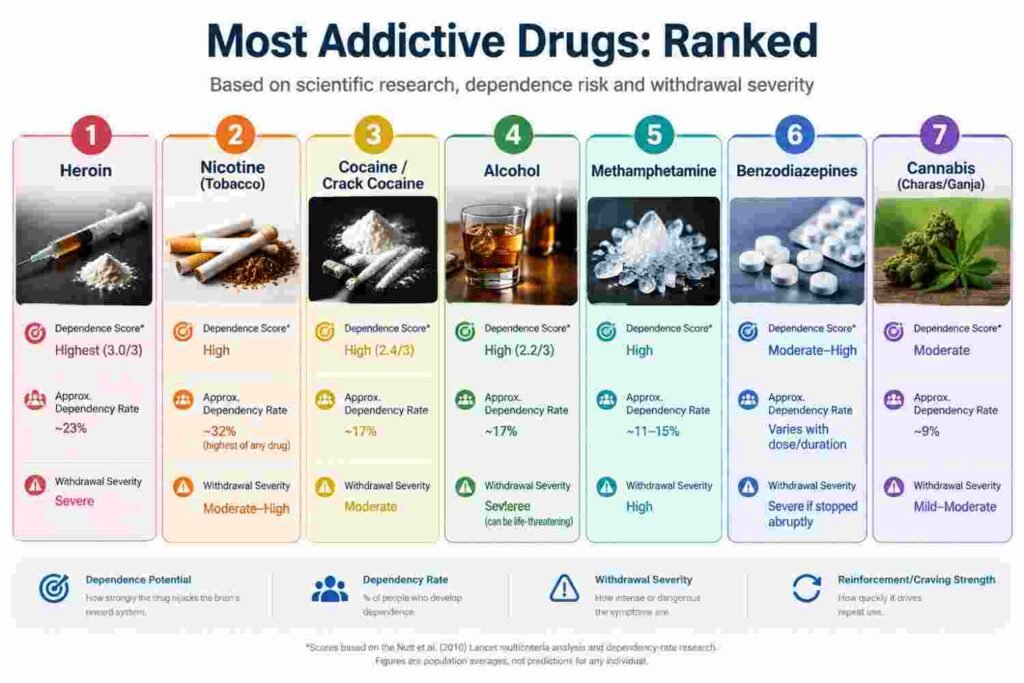
Most Addictive Drugs: Ranked
| Rank | Drug | Dependence Score* | Approx. Dependency Rate | Withdrawal Severity |
|---|---|---|---|---|
| 1 | Heroin | Highest (3.0/3) | ~23% | Severe |
| 2 | Nicotine (Tobacco) | High | ~32% (highest of any drug) | Moderate–High |
| 3 | Cocaine / Crack Cocaine | High (2.4/3) | ~17% | Moderate |
| 4 | Alcohol | High (2.2/3) | ~15% | Severe (can be life-threatening) |
| 5 | Methamphetamine | High | ~11–15% | High |
| 6 | Benzodiazepines | Moderate–High | Varies with dose/duration | Severe if stopped abruptly |
| 7 | Cannabis (Charas/Ganja) | Moderate | ~9% | Mild–Moderate |
*Scores based on the Nutt et al. (2010) Lancet multicriteria analysis and dependency-rate research. Figures are population averages, not predictions for any individual.
Why Some Drugs Are More Addictive Than Others
Addictive drugs act on the brain’s dopamine reward pathway — the same circuit that reinforces eating and social bonding. The faster and stronger a drug spikes dopamine, the more the brain “remembers” it as worth repeating.
- Speed of onset: Smoked or injected drugs (nicotine, crack, meth) reach the brain in seconds, reinforcing use more powerfully than slower routes.
- Intensity of the high: Larger dopamine surges create stronger cravings.
- Tolerance build-up: The brain adapts, needing more of the drug for the same effect — this is what drives escalating use.
- Withdrawal discomfort: Painful or dangerous withdrawal (heroin, alcohol, benzodiazepines) keeps people using just to avoid feeling sick.
Heroin and Opioids
Heroin consistently ranks first on dependence-potential scales. It binds strongly to opioid receptors, produces intense euphoria, and causes severe physical withdrawal (body aches, vomiting, insomnia, anxiety) within hours of the last dose — which is why relapse rates are high without medical support.
Nicotine (Tobacco, Gutkha, Vaping)
Nicotine has the highest dependency conversion rate of any studied drug — roughly a third of people who try it become dependent. It’s legal and socially normalised, which is part of why so few people seek treatment for it despite how hard it is to quit.
Cocaine and Crack Cocaine
Cocaine produces an intense but short-lived dopamine surge, driving a binge-and-crash pattern. Crack (a smokable form) reaches the brain faster than powder cocaine, making it more reinforcing and more addictive.
Alcohol
Alcohol is legal and widely used, but it ranks among the most harmful drugs overall once you factor in withdrawal risk (delirium tremens can be fatal), organ damage, and social harm. Long-term heavy drinkers should never stop “cold turkey” without medical supervision. See our guide on alcohol addiction treatment.
Methamphetamine
Meth causes an especially long-lasting dopamine release compared to cocaine, which is part of why cravings and compulsive use patterns can be so severe, alongside serious long-term neurological and dental effects (“meth mouth”).
Benzodiazepines
Prescribed for anxiety and insomnia, benzodiazepines (like alprazolam, clonazepam) are addictive with regular use, and abrupt withdrawal can trigger seizures — making medical detox essential rather than optional.
Warning Signs of Drug Addiction
- Needing more of the drug over time to feel the same effect (tolerance)
- Withdrawal symptoms when not using
- Repeated failed attempts to cut down or quit
- Continuing use despite harm to health, work, or relationships
- Spending significant time obtaining, using, or recovering from the drug
Expert Insight: The “most addictive drug” for any one person is often simply the one that’s most available to them combined with their personal risk factors — genetics, mental health, and environment matter as much as the substance itself.
Treatment for Drug Addiction
Regardless of which drug is involved, evidence-based treatment follows a similar path:
Medical Detoxification
The first step for drugs with dangerous withdrawal (alcohol, opioids, benzodiazepines) — always done under medical supervision to manage symptoms safely. Learn more about our detoxification program.
Therapy and Counselling
Individual and group counselling help identify triggers and the underlying reasons behind substance use.
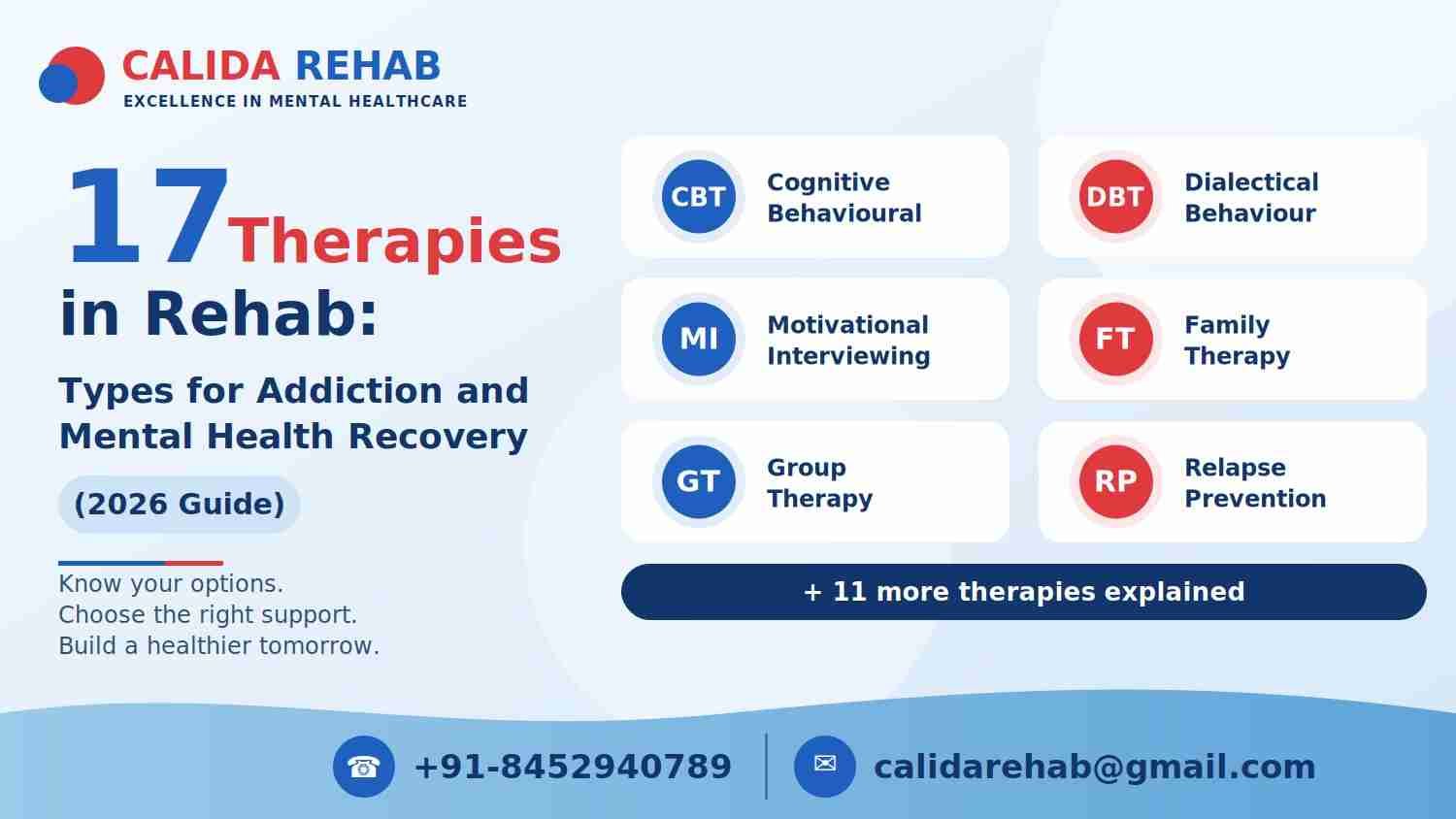
CBT (Cognitive Behavioural Therapy)
Through CBT, patients learn to recognise and change the thought patterns that drive cravings and relapse.
Rehabilitation Programs
Structured, supervised rehabilitation programs combine medical care, therapy, and routine — especially valuable for long-term or severe dependence.
Family Therapy
Rebuilds trust and communication, and creates a supportive home environment for recovery.
Relapse Prevention
Equips patients to recognise and manage triggers like stress, social pressure, and emotional lows.
Myths vs Facts About Addictive Drugs
| Myth | Fact |
|---|---|
| Legal drugs (alcohol, nicotine) aren’t “real” addictions | Alcohol and nicotine rank among the most addictive and harmful substances studied |
| Only “hard” drugs cause dependence | Even commonly prescribed medicines like benzodiazepines can cause severe dependence |
| You can quit anytime if you’re not “that addicted” | Withdrawal and craving strength, not willpower, drive most relapses |
| Trying a drug once means you’re safe | Some drugs (nicotine, meth) can create strong cravings after very limited use |
| Addiction is a choice or moral failing | Addiction is a recognised brain disorder that responds to medical and psychological treatment |
FAQs
What is scientifically the most addictive drug?
By dependence-potential score, heroin ranks first. By the percentage of users who become dependent, nicotine ranks first. There isn’t one single “most addictive” answer — it depends on the measure used.
Is alcohol more addictive than marijuana?
Yes — alcohol has a significantly higher dependency rate and far more dangerous withdrawal than cannabis.
Can prescription drugs be as addictive as illegal drugs?
Yes. Benzodiazepines and opioid painkillers are prescription medicines that carry real addiction and withdrawal risk with regular use.
If you or someone you love is struggling with drug or alcohol addiction, early professional help makes recovery far more likely. Find the right de-addiction centre near you or call our specialists for a confidential conversation today.