
Last updated: October 2026
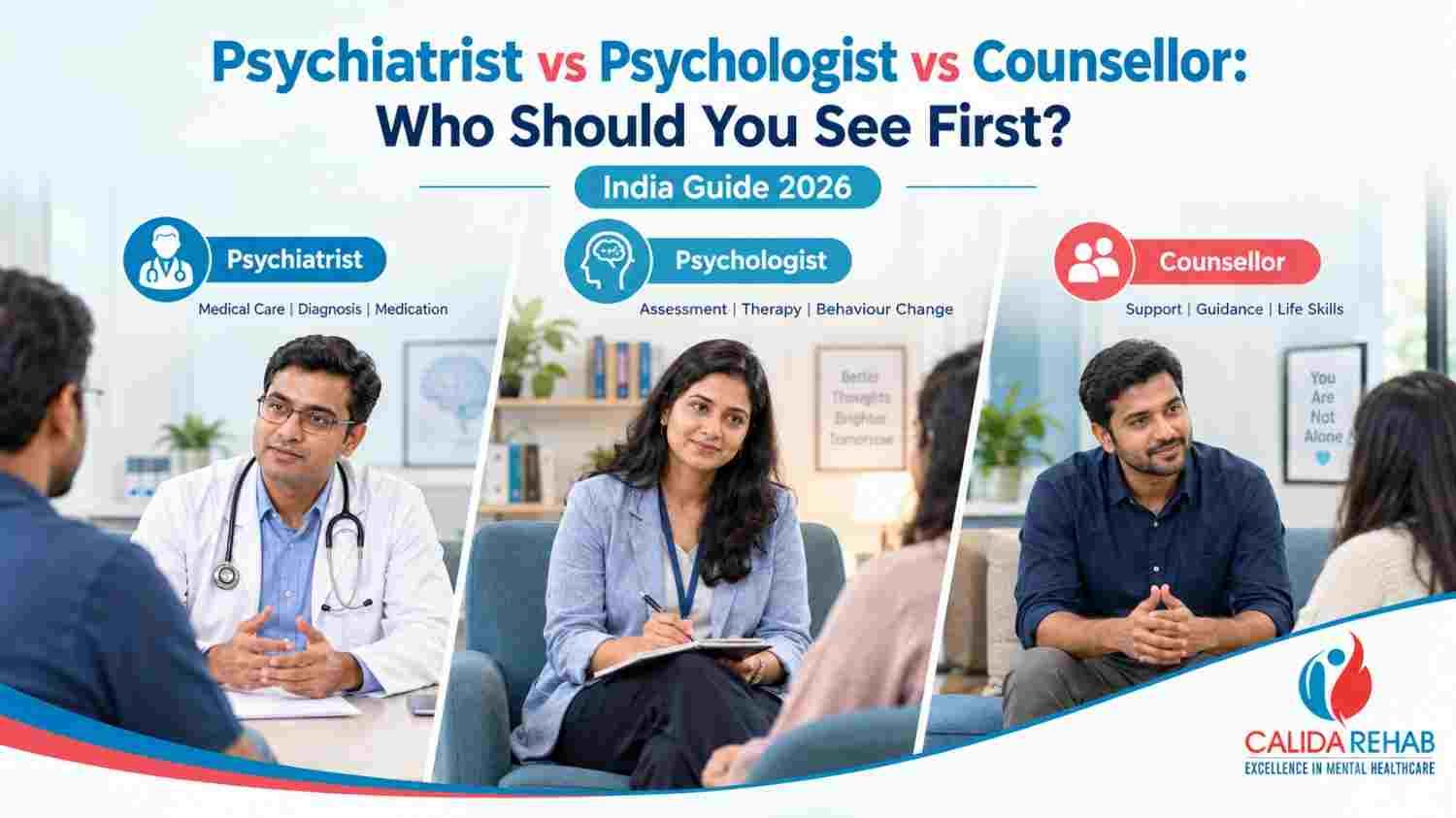
Quick answer: A psychiatrist is a medical doctor who diagnoses mental illness and prescribes medicine. A clinical psychologist assesses your thoughts and behaviour and treats you with therapy, but cannot prescribe medicine. A counsellor gives short-term guidance for everyday stress, grief and relationship problems. If your symptoms are severe or last more than two weeks, start with a psychiatrist.
You have been feeling low for weeks. Or your mind will not switch off at night. A friend says, “You should talk to someone.” But who? A psychiatrist, a psychologist or a counsellor?
Most people in India are unsure, and that confusion often delays care by months or even years. The three roles sound alike, yet they differ in training, tools and the problems they treat. Choosing the right one first saves time, money and worry.
This guide explains each role in plain language. You will learn what they do, how they are trained in India, who to see for which problem, and how to check that a professional is genuine.
Key takeaways
- Only a psychiatrist (a medical doctor) can prescribe psychiatric medicine.
- A clinical psychologist is trained in psychological testing and structured therapy such as CBT.
- A counsellor supports you through life problems. Counsellors do not diagnose illness.
- Severe symptoms, mania, hearing voices or addiction withdrawal need a psychiatrist first.
- Many people do best with a team, for example a psychiatrist plus a psychologist or counsellor.
- Seeing the “wrong” one first is not a disaster. A good professional will refer you onward.
Psychiatrist vs psychologist vs counsellor: at a glance
| Psychiatrist | Clinical psychologist | Counsellor | |
|---|---|---|---|
| Who they are | Medical doctor (MBBS plus MD, DNB or DPM in psychiatry) | Mental health professional (usually M.Phil in Clinical Psychology) | Trained support professional (qualifications vary) |
| Can prescribe medicine? | Yes | No | No |
| Can diagnose? | Yes, a medical diagnosis | Psychological assessment and diagnostic formulation | No |
| Main tools | Medicines, medical tests, therapy, procedures such as ECT in selected cases | Psychotherapy, psychological tests, behaviour plans | Talk-based guidance, listening, coping skills |
| Best for | Severe, complex or medical-linked conditions | Anxiety, depression, trauma, OCD, ADHD, relationship and behaviour problems | Stress, grief, exams, career, relationships, mild low mood |
| Typical visit | Often 15 to 45 minutes | Often 45 to 60 minutes | Often 45 to 60 minutes |
| Registration in India | National Medical Commission (NMC) or State Medical Council | Rehabilitation Council of India (RCI) | No single national register yet |
What is a psychiatrist?
A psychiatrist is a doctor who specialises in mental health. In India, a psychiatrist completes MBBS (about five and a half years) and then a postgraduate course: MD or DNB in Psychiatry (three years) or a Diploma in Psychological Medicine, called DPM (two years). They are registered with the NMC or a State Medical Council.
Because they are doctors, psychiatrists look at the whole picture. They check how your body and brain affect your mood. They may order blood tests or a scan to rule out causes such as thyroid problems, vitamin deficiency or a head injury.
What a psychiatrist does
- Diagnoses mental health conditions
- Prescribes and adjusts medicines
- Manages severe illness, emergencies and withdrawal
- Advises when hospital care is needed
- Offers therapy in some cases, although many focus on medicine and work alongside psychologists
Conditions they commonly treat: depression, anxiety disorders, bipolar disorder, schizophrenia, OCD, ADHD, dementia, and alcohol or drug addiction.
Medicines do not work overnight. Many antidepressants take two to four weeks, sometimes longer, before you notice a clear change. Your psychiatrist will review you regularly and change the dose if needed. Never stop a psychiatric medicine suddenly on your own.
Some people with severe illness, such as active psychosis or a serious manic episode, need round-the-clock medical care. In that case, a psychiatrist may advise admission to a mental hospital. If you live in Maharashtra, you can learn about our mental hospital in Mumbai and mental hospital in Pune.
Want to know more about the specialty? Read our explainers on the full form of ADS in psychiatry and who is called the father of psychiatry in India.
What is a clinical psychologist?
A clinical psychologist is a trained mental health professional who uses assessment and therapy to help people with emotional and behavioural problems. They are not medical doctors, so they do not prescribe medicine.
In India, a clinical psychologist usually holds a master’s degree in psychology followed by an M.Phil in Clinical Psychology (two years) from an institute recognised by the Rehabilitation Council of India (RCI). They are listed on the RCI’s Central Rehabilitation Register (CRR). Someone with only an MA or MSc in psychology is a psychologist, but not a clinical psychologist.
What a clinical psychologist does
- Conducts structured interviews and psychological tests (for memory, personality, attention, intelligence and mood)
- Provides evidence-based therapy such as Cognitive Behavioural Therapy (CBT), Dialectical Behaviour Therapy (DBT) and Acceptance and Commitment Therapy (ACT)
- Helps you understand thought patterns, triggers and habits
- Teaches practical skills for anxiety, anger, trauma and relapse prevention
- Works with children, adults and families
Sessions are usually weekly. Therapy takes effort and time, often several weeks or months, but the skills you learn can last for life.
Not every psychologist is clinical. Counselling psychologists, school psychologists and organisational psychologists have different training and focus. Always ask which type you are seeing.
What is a counsellor?
A counsellor is a trained professional who helps you talk through problems, make decisions and build coping skills. Counselling is usually short-term and focused on the present.
India does not yet have one national licence for counsellors, so qualifications vary. Many hold a master’s in counselling or psychology, or a postgraduate diploma, followed by supervised practice. This makes it important to ask about training and experience.
What a counsellor does
- Listens without judgement
- Helps you sort out confusing feelings and options
- Teaches stress management and communication skills
- Supports you through grief, breakups, job loss or major life changes
- Guides students and young professionals on exams and career choices
What a counsellor does not do: diagnose mental illness, prescribe medicine or treat severe disorders on their own.
In addiction recovery, counsellors play a vital role. They provide daily support, motivation and family guidance. You can read how this works in our guide to one-on-one counselling for drug and alcohol addiction.
A good counsellor knows their limits. If your problem is getting worse, they will refer you to a psychologist or psychiatrist.
What is the difference between a psychiatrist and a psychologist?
The main difference is that a psychiatrist is a medical doctor who can prescribe medicine, while a psychologist treats mental health problems mainly through assessment and therapy.
Think of it this way. A psychiatrist looks at the medical and biological side, such as brain chemistry, sleep and physical health. A psychologist looks at thoughts, feelings, habits and behaviour. Both can diagnose in their own way, and both work toward the same goal: helping you feel better and function well.
What is the difference between a psychologist and a counsellor?
A psychologist is trained to assess and treat mental health conditions, while a counsellor is trained to support people through life problems. Clinical psychologists have longer and more specialised training, use formal tests and treat conditions such as anxiety, depression, OCD and trauma. Counsellors usually work on shorter-term goals, such as stress, relationships and decision-making.
Who should you see first? A guide by problem
Use this table as a starting point. It is a guide, not a diagnosis.
| What you are experiencing | Who to see first | Why |
|---|---|---|
| Sad, low or empty for more than two weeks | Psychiatrist or clinical psychologist | It could be depression, which may need assessment and sometimes medicine |
| Panic attacks, racing heart, constant worry | Clinical psychologist or psychiatrist | Therapy works well for anxiety, and medicine can help when it is severe |
| Hearing voices or strong beliefs that others are plotting against you | Psychiatrist (urgent) | These can be signs of psychosis or schizophrenia and need quick medical care |
| Very high energy, almost no sleep, risky spending | Psychiatrist | These may be manic symptoms of bipolar disorder |
| Repeated unwanted thoughts and rituals | Clinical psychologist and psychiatrist | OCD responds well to therapy, often with medicine |
| Drinking or drug use you cannot control | Psychiatrist | Withdrawal can be dangerous and needs medical supervision |
| Flashbacks, nightmares after a traumatic event | Clinical psychologist, with a psychiatrist if severe | Trauma-focused therapy is the main treatment for PTSD |
| Exam stress or career confusion | Counsellor | Short-term guidance is usually enough |
| Grief, a breakup or relationship problems | Counsellor | Support and coping skills help most. See a psychologist if it lasts or worsens |
| Child with behaviour or school problems | Child psychologist or child psychiatrist | Read our parent’s guide to child and adolescent psychiatry |
| Memory loss or confusion in an older adult | Psychiatrist or neurologist | Could be dementia or another medical cause |
When to see a psychiatrist first: warning signs
Go to a psychiatrist first, or as soon as you can, if you notice any of these:
- Thoughts of ending your life or harming yourself or others
- Hearing or seeing things that others do not
- Days of very little sleep with unusually high energy or risky behaviour
- Being unable to eat, sleep, work or look after yourself for more than two weeks
- Heavy drinking or drug use, with shaking, sweating, seizures or confusion when you try to stop
- Sudden confusion or a big change in personality, especially in an older person
- Panic attacks that keep returning and stop you from leaving home
If you or someone you know is in immediate danger, call 112 or go to the nearest emergency room. You can also call Tele-MANAS, India’s free mental health helpline, at 14416.
Not sure whether you need a psychiatric hospital or a rehab centre? Our guide on rehab vs psychiatric hospital explains the difference.
Do you need more than one professional?
Often, yes. Mental health care works best as teamwork.
Here is a common example. A person with moderate depression sees a psychiatrist to get the right medicine. They also see a clinical psychologist for weekly CBT. During a stressful month at work, a counsellor helps them plan their time and set boundaries. Each professional covers a different part of recovery. For many people with moderate to severe depression or anxiety, medicine plus therapy works better than either alone.
Addiction and mental health often go together. Many people who struggle with alcohol or drugs also live with depression, anxiety or trauma. Treating only one usually leads to relapse. This is called dual diagnosis, and you can read more in our guide to abnormal psychology and addiction disorders.
In a good rehab setting, the roles fit together like this:
- The psychiatrist manages detox, withdrawal and medicines, including medication-assisted treatment
- The clinical psychologist leads therapy to deal with triggers, thoughts and relapse
- The counsellor gives daily support, motivation and family sessions
If you are looking for this kind of team-based care in Maharashtra, explore our rehabilitation centre in Mumbai and rehabilitation centre in Pune.
Other professionals you may meet
- Psychiatric social worker: trained in M.Phil Psychiatric Social Work, they help with family issues, community support and getting you back to work or school.
- Mental health nurse: supports medicine routines and day-to-day care, especially in hospitals.
- Occupational therapist: helps you rebuild daily skills and routines. Learn more in our guide to occupational therapy.
- Neurologist: treats brain and nerve conditions such as epilepsy, stroke and some memory disorders. They are different from psychiatrists.
- Family doctor (general physician): a good first stop if you are unsure. They can check your health and refer you to the right specialist.
How to check a professional’s credentials in India
Anyone can call themselves a “counsellor” or a “therapist.” Take a few minutes to check.
- Psychiatrist: ask for their degree and registration number with the NMC or State Medical Council.
- Clinical psychologist: ask for their M.Phil in Clinical Psychology and their RCI registration (CRR) number.
- Counsellor: ask about their degree, training, supervised experience and the problems they usually work with.
- Ask about confidentiality. A professional should explain clearly how your information is kept private.
Red flags to avoid:
- Promises of a guaranteed or “instant” cure
- Telling you to stop prescribed medicine without a doctor’s advice
- No clear qualifications or registration
- Pressure to buy expensive packages before assessing you
What to expect at your first appointment
The first visit is mostly a conversation. The professional will ask about your symptoms, when they began, your sleep and appetite, family history, any medicines you take and your use of alcohol or drugs. There are no right or wrong answers.
- A psychiatrist may suggest blood tests and may start medicine if needed.
- A clinical psychologist may use tests or questionnaires and then suggest a therapy plan.
- A counsellor will usually set goals with you and agree how many sessions you need.
How to prepare
- Write down your symptoms and roughly when they started
- List all medicines and supplements you take
- Bring a trusted family member if you want support
- Note your questions so you do not forget them
Cost, privacy and online options in India
Fees vary by city, experience and whether you visit a clinic, hospital or online service. Government hospitals and Tele-MANAS offer free or low-cost help. Many professionals also see patients online, which can be helpful if you live far away or want more privacy.
India’s Mental Healthcare Act 2017 recognises every person’s right to access mental healthcare and to confidentiality. It also requires health insurers to treat mental illness on par with physical illness, so check your policy. You can read more in our guide to the Mental Healthcare Act 2017 and patient rights.
Common myths about psychiatrists, psychologists and counsellors
Myth: Psychiatrists only treat “mad” people.
Fact: Psychiatrists treat everyday conditions such as depression, anxiety and sleep problems, as well as severe illness. Needing help is a health matter, not a weakness.
Myth: Psychiatric medicines are always addictive.
Fact: Most psychiatric medicines, including antidepressants, are not addictive. Some sedatives and sleeping pills can cause dependence, which is why they should only be taken under medical supervision. If you are worried about this, read about the dangers of sleeping pills.
Myth: Counselling is just talking, so it cannot help.
Fact: Skilled counselling gives you tools to handle stress, change habits and make better decisions. For many everyday problems, it is enough.
Myth: A psychologist is a “lesser” doctor.
Fact: A clinical psychologist is not a medical doctor, but they have specialised training in therapy and assessment. Neither role is better. They do different jobs.
Myth: It will pass on its own.
Fact: Some low phases do pass. But symptoms that last more than two weeks or affect work, sleep or relationships deserve professional attention. Early help usually means faster recovery.
How Calida Rehab can help in Mumbai and Pune
If you or a family member is dealing with addiction, depression, anxiety or another mental health condition, you do not have to work out the right professional alone. Talk to the team at Calida Rehab in Mumbai or Pune. We can help you understand which type of care fits your situation and what the next step should be.
Meet our team or contact us for a private, judgement-free conversation.
Frequently asked questions
Can a psychologist prescribe medicine in India?
No. Only a doctor, and in practice a psychiatrist, can prescribe psychiatric medicine. A clinical psychologist can assess you and provide therapy. If medicine could help, your psychologist will refer you to a psychiatrist and often work with them.
Should I see a psychiatrist or a psychologist for anxiety?
Both can help. For mild to moderate anxiety, a clinical psychologist and therapy such as CBT are often the first choice. If anxiety is severe, includes frequent panic attacks or affects sleep and daily life, see a psychiatrist. Many people use both.
Does a psychiatrist also do therapy?
Some do, but many psychiatrists focus on diagnosis and medicine because of limited appointment time. They often work with a psychologist or counsellor who provides regular therapy sessions.
Can a counsellor treat depression?
A counsellor can support you with mild low mood and stress. They cannot diagnose or treat clinical depression on their own. If your sadness lasts more than two weeks or affects daily life, see a psychologist or psychiatrist.
Which is better, a psychiatrist or a psychologist?
Neither is better. They have different skills. A psychiatrist is best when you need a medical diagnosis or medicine. A clinical psychologist is best when you need testing or structured therapy. Many conditions need both.
Who should I see for addiction?
Start with a psychiatrist, especially for alcohol or drugs, because withdrawal can be dangerous and may need medicine. After detox, psychologists and counsellors help you build skills, handle triggers and prevent relapse.
Do I need a referral to see a psychiatrist or psychologist?
No. In India, you can book an appointment directly. A family doctor can help you choose, but a referral is not required.
How many sessions will I need?
It depends on the problem. Counselling for a specific issue may take a few sessions. Therapy with a clinical psychologist often runs for several weeks or months. Psychiatric follow-ups continue for as long as medicine is needed. Your professional will explain the plan after the first visit.
Is my information kept private?
Yes. Mental health professionals are expected to keep your information confidential, and Indian law recognises your right to confidentiality. Ask your professional to explain how your records are stored and when information may be shared.
Final thoughts: start with the right door, but do start
Here is the simple rule. See a psychiatrist when you need a medical diagnosis, medicine or urgent care. See a clinical psychologist when you need assessment and structured therapy. See a counsellor when you need guidance through a life problem.
If you are still unsure, start with whoever you can reach first. A good professional will guide you to the right place. The most important step is the first one.
This article is for general information and does not replace medical advice, diagnosis or treatment. If you are in crisis, call 112 or Tele-MANAS at 14416.