
Everyone has good days — bursts of energy, confidence, and motivation that feel great. But when that “high” becomes extreme, doesn’t fade, and starts affecting sleep, money, relationships, or judgment, it may not be a good mood at all. It could be a manic episode, one of the defining features of bipolar disorder.
Recognising the difference early — for yourself or a loved one — is often the first step toward getting the right help before a crisis happens.
What Is Mania, Exactly?
Mania is a distinct period of abnormally elevated, expansive, or irritable mood accompanied by unusually high energy levels. According to the National Institute of Mental Health (NIMH), for a diagnosis of bipolar I disorder, these symptoms must last at least seven days (nearly every day, most of the day) — or be severe enough to require hospital care.
A hypomanic episode is a milder, shorter version of mania (lasting at least four days) that doesn’t cause the same level of disruption to daily life, and rarely requires hospitalisation. Someone experiencing hypomania may even seem unusually productive or charming — which is exactly why it often goes unnoticed until a depressive episode follows.
Not sure if what you’re seeing is mania or something else? Read our comparison of depression vs. bipolar disorder to understand how mood episodes differ.
Common Symptoms of a Manic Episode
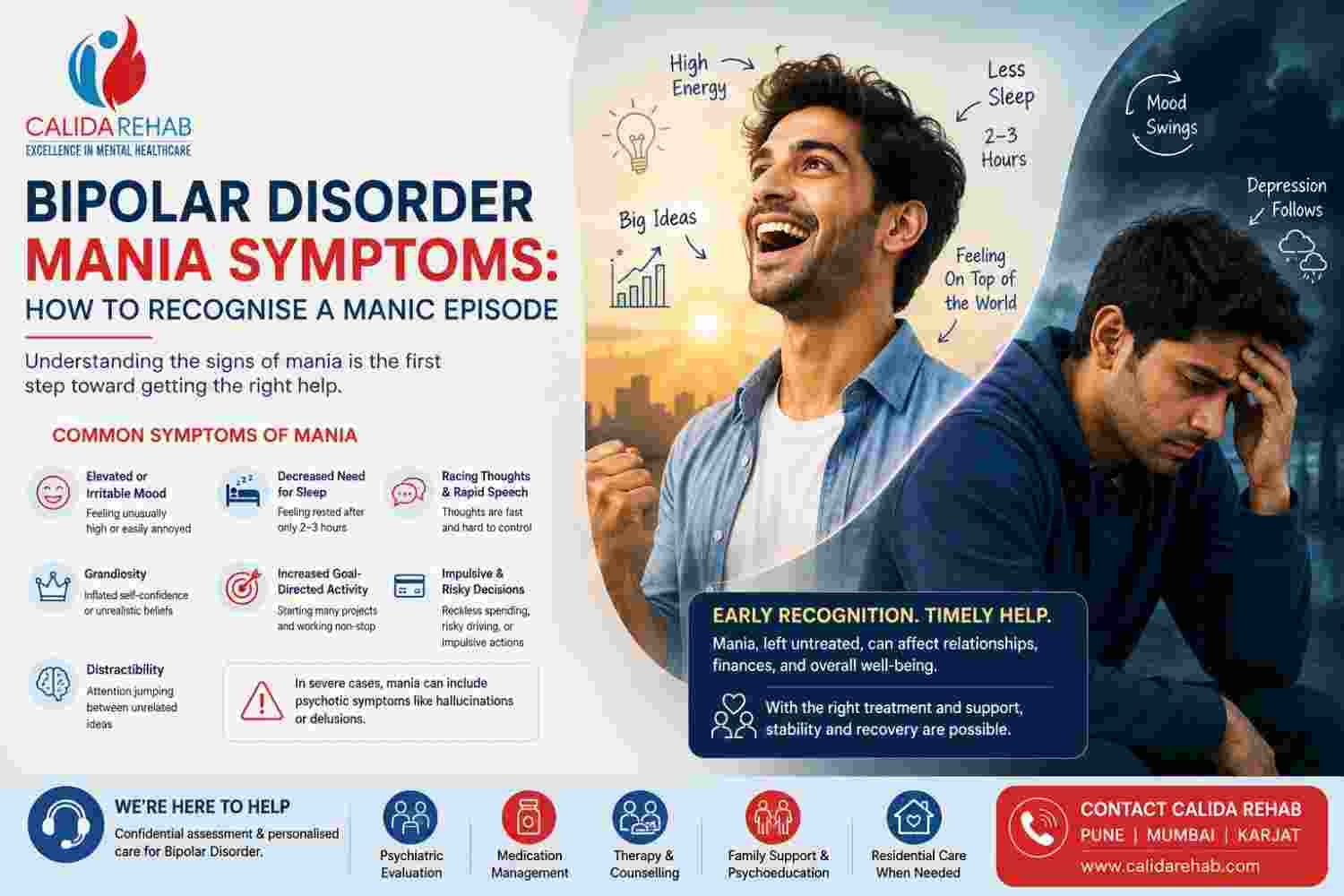
During mania, a person may show several of the following changes at once:
- Elevated or irritable mood that feels “too good to be true” or unusually short-tempered
- Decreased need for sleep — feeling rested after only 2–3 hours
- Racing thoughts and rapid, pressured speech that’s hard to interrupt
- Grandiosity — inflated self-confidence or unrealistic beliefs about one’s abilities
- Increased goal-directed activity — starting multiple projects at once, working non-stop
- Impulsive, risky decisions — reckless spending, risky driving, impulsive business decisions, or sexual indiscretion
- Distractibility — attention jumping rapidly between unrelated ideas
In severe cases, mania can include psychotic symptoms such as hallucinations or delusions, which are sometimes mistaken for schizophrenia. According to NAMI, these psychotic features usually mirror the person’s extreme mood — for example, grandiose delusions of special powers or importance.
Mania vs. Just Being “Happy” or “Energetic”
This is the question families ask most often: how is this different from someone just being in a great mood?
| Normal high energy | Manic episode |
|---|---|
| Fades naturally within hours or a day | Persists most of the day, for a week or more |
| Doesn’t interfere with responsibilities | Disrupts work, relationships, sleep, finances |
| Judgment stays intact | Judgment is impaired — risky, out-of-character decisions |
| No pattern of highs followed by lows | Often followed by a depressive crash |
If the “high” is consistently followed by a period of intense sadness, hopelessness, or fatigue, that back-and-forth pattern is a strong indicator of bipolar disorder rather than a personality trait or temporary mood.
Bipolar I vs. Bipolar II — Where Does Mania Fit?
- Bipolar I disorder: Defined by at least one full manic episode, often with separate depressive episodes.
- Bipolar II disorder: Defined by a pattern of depressive episodes and hypomanic episodes — never a full manic episode.
- Cyclothymic disorder: Recurrent hypomanic and depressive symptoms that don’t fully meet the criteria for either, but still affect quality of life.
Getting this distinction right matters clinically, because treatment plans and medication choices differ between bipolar I and bipolar II.
Why Mania Often Goes Undiagnosed in India
In Indian households, the early signs of mania — high energy, ambition, confidence, reduced need for sleep — are frequently seen as positive traits, not warning signs. A family member might even be praised for “finally being productive” during what is actually a manic phase. It’s usually only after the depressive crash, or after a serious impulsive decision (financial loss, a public outburst, risky behaviour), that families seek help.
This delay matters. Left untreated, manic episodes tend to become more frequent and more severe over time, and can significantly affect a person’s career, finances, and relationships.
When to Seek Professional Help
Consider reaching out to a psychiatrist if you notice, in yourself or a loved one:
- A sudden, sustained change in mood, energy, or sleep lasting several days
- Uncharacteristic risky or impulsive behaviour (spending, driving, relationships)
- Racing thoughts or speech that’s difficult to follow or interrupt
- Alternating cycles of extreme highs and lows over weeks or months
- Any signs of psychosis — hearing or seeing things others don’t, or fixed false beliefs
A manic episode with psychotic features, or one involving danger to self or others, is a psychiatric emergency and needs immediate evaluation — not a “wait and watch” approach.
How Bipolar Disorder and Mania Are Treated
There is no single cure, but bipolar disorder is highly manageable with the right combination of care:
- Mood-stabilising medication (such as lithium or anticonvulsants) prescribed and monitored by a psychiatrist
- Psychotherapy, including CBT and Interpersonal and Social Rhythm Therapy (IPSRT), which helps regulate daily routines that influence mood stability
- Family-focused therapy, so loved ones can recognise early warning signs before a full episode develops
- Medically supervised care during acute manic or mixed episodes, especially where safety is a concern
At Calida Rehab, our medication-assisted and psychiatric care programs in Pune, Mumbai, and Karjat combine psychiatric evaluation, therapy, and structured routines to help stabilise mood episodes and prevent relapse. Many patients also arrive with co-occurring substance use, which our team is equipped to treat alongside bipolar disorder. Learn more about our dedicated Bipolar Disorder Treatment program or our residential care approach in Pune.
Frequently Asked Questions
Is mania the same as being happy?
No. Normal happiness is proportionate to circumstances and doesn’t impair judgment or daily functioning. Mania is a distinct, sustained mood state that disrupts sleep, decision-making, and relationships, often followed by a depressive episode.
How long does a manic episode usually last?
For a bipolar I diagnosis, symptoms must last at least seven days, or less if hospitalisation is needed. Hypomanic episodes last at least four days but are milder.
Can mania happen without depression?
A single manic episode is enough for a bipolar I diagnosis, but most people with bipolar disorder experience depressive episodes as well, sometimes years apart.
Is bipolar disorder treatable long-term?
Yes. With consistent medication, therapy, and lifestyle structure, most people with bipolar disorder can manage symptoms effectively and lead stable, fulfilling lives, according to Cleveland Clinic.
What should I do if a family member is in a manic episode right now?
Prioritise safety — remove access to large sums of money, vehicles if judgment is impaired, and avoid confrontation. Contact a psychiatrist or a rehabilitation centre with psychiatric emergency support as soon as possible.
If you or someone you love is showing signs of a manic episode, Calida Rehab’s psychiatric team in Pune, Mumbai, and Karjat can help with assessment and a personalised treatment plan. Contact us to speak with our care coordinators confidentially.