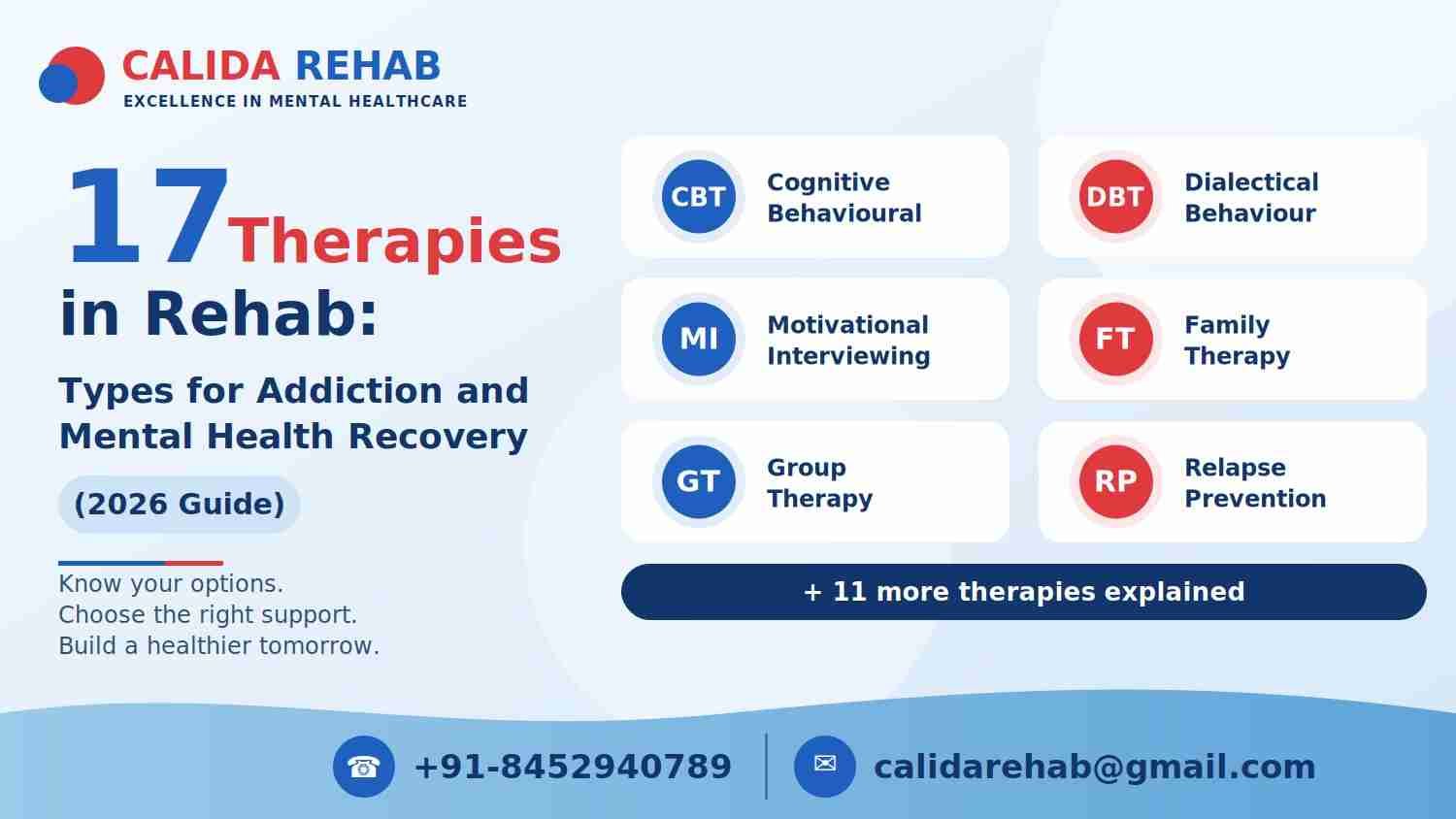

Therapies in rehab are structured, evidence-based talking, behavioural and skills-based treatments. They help a person stop using substances, heal emotionally and build a steady life afterwards. The most common ones are cognitive behavioural therapy (CBT), motivational interviewing, dialectical behaviour therapy (DBT), family therapy, group therapy and relapse prevention. Good programmes combine several of them instead of relying on one.
Most pages on this topic list a handful of therapies and stop there. This guide goes further. It covers 17 therapies in rehab. For each one, you will learn what it is, how it works inside a programme, who it helps and what the research really says. It also explains how therapy changes across the stages of recovery, how to choose the right mix, which red flags to avoid and where to get help in India.
Last updated: 9 October 2026. Sources are listed at the end. This guide is for information only. It does not replace advice from a qualified doctor or clinical psychologist.
Key Takeaways
- No single therapy works for everyone. The US National Institute on Drug Abuse (NIDA) states that no one treatment suits every person, so plans must match the individual.
- Most rehab plans blend three to five therapies. A typical mix is CBT, group therapy, family sessions and relapse prevention, plus extra support for trauma or mood problems.
- Some therapies have stronger proof than others. CBT, motivational interviewing, contingency management and relapse prevention have the deepest research. Creative and mind-body therapies are useful add-ons with thinner evidence.
- Many people in rehab also live with another condition. Depression, anxiety and trauma are common, so the plan should treat both problems together.
- Therapy changes as you recover. Early rehab focuses on safety and motivation. Later stages build skills, repair relationships and prepare you for life after discharge.
- Therapy is only one part of care. Medicines, medical monitoring, family support and aftercare matter just as much.
What Are Therapies in Rehab, and Why Does One Therapy Not Fit Everyone?
Therapies in rehab are planned sessions led by trained professionals. They run alongside medical care. Their goal is to change the thoughts, habits, relationships and coping skills that keep addiction or mental illness going.
One therapy is rarely enough. Addiction affects the brain, the body, the family and daily life all at once. Therefore, different tools are needed for different layers of the problem. For example, CBT helps with cravings and thinking patterns. Family therapy repairs trust at home. Trauma therapy treats the pain that started the drinking or drug use.
Addiction is also a chronic condition. According to NIDA, relapse rates for substance use disorders are about 40 to 60 percent. That is similar to rates for other long-term illnesses such as asthma and high blood pressure. Relapse does not mean treatment failed. Instead, it means the plan needs adjusting. NIDA also notes that people generally need at least three months in treatment to see lasting benefit.
If you are still comparing options, our guide on what rehab is and how it works in India explains the basics. Our comparison of rehab and psychiatric hospital care shows which setting fits which need.
Therapies in Rehab at a Glance
Use this table for a quick comparison. Details on each therapy follow below.
| Therapy | Best for | Usual format | Strength of evidence |
|---|---|---|---|
| Cognitive behavioural therapy (CBT) | Cravings, thinking patterns, anxiety, depression | Individual or group, weekly | Strong |
| Motivational interviewing (MI) | Mixed feelings about quitting | Short individual sessions | Strong |
| Dialectical behaviour therapy (DBT) | Intense emotions, self-harm, impulsivity | Skills group plus individual | Moderate |
| Acceptance and commitment therapy (ACT) | Shame, avoidance, chronic cravings | Individual or group | Moderate |
| Interpersonal therapy (IPT) | Depression, grief, relationship strain | 12 to 16 weekly sessions | Moderate |
| Behavioural therapy | Habits, routines, rewarding sober life | Individual or group | Strong |
| Family therapy | Broken trust, enabling, family conflict | Family sessions | Strong |
| Group therapy | Isolation, shame, peer learning | Daily or weekly groups | Strong |
| 12-step facilitation | People open to peer fellowship | 12 to 15 sessions plus meetings | Moderate to strong |
| Contingency management | Stimulant, opioid and alcohol use | Rewards for clean tests | Strong |
| Relapse prevention | Staying well long term | Individual and group | Strong |
| Trauma-focused therapy | PTSD, abuse, painful memories | Individual, trained clinician | Strong for trauma symptoms |
| Mindfulness-based relapse prevention | Urges, stress, rumination | 8-week group | Moderate |
| Yoga and breathwork | Stress, sleep, body awareness | Group classes | Emerging |
| Expressive arts therapy | Hard-to-voice feelings | Group or individual | Emerging |
| Dance and movement therapy | Body tension, low mood | Group sessions | Emerging |
| Occupational therapy | Daily routine, work skills, structure | Individual and group | Supportive |
Talk-Based Therapies Used in Rehab
Talk-based therapies form the core of most programmes. They teach you to understand your mind and change how you respond to it.
1. Cognitive Behavioural Therapy (CBT) in Rehab
What it is. CBT is a structured talking therapy built on a simple link between thoughts, feelings and actions. Psychiatrist Aaron Beck developed the approach in the 1960s. In rehab, it shows how certain thoughts, such as “one drink won’t hurt”, push people towards use. You can read more in our full guide to cognitive behavioural therapy.
How it works in rehab. You and your therapist track triggers, thoughts and cravings in a simple diary. Next, you test unhelpful thoughts and practise better responses. For example, you might rehearse how to refuse a drink at a wedding. Programmes often use 12 to 20 sessions, with homework between them.
Who it helps. CBT helps people with alcohol, cannabis, stimulant and opioid problems. It also treats the depression and anxiety that often come with addiction.
What the evidence says. A meta-analysis of 53 controlled trials by Magill and Ray (2009) found a small but reliable benefit for substance use disorders. The benefit was largest for cannabis. Overall, CBT is one of the best-studied therapies in addiction care, which is why almost every rehab uses it.
2. Motivational Interviewing (MI) in Rehab
What it is. Motivational interviewing is a warm, guiding style of conversation. Psychologists William Miller and Stephen Rollnick developed it. Instead of pushing someone to change, the therapist helps them find their own reasons.
How it works in rehab. The therapist asks open questions and listens closely. Then they reflect back what you say and highlight your strengths. Many people feel two ways about quitting. MI explores that mixed feeling without judgement. Because it is gentle, it often comes early in rehab, when motivation is shaky.
Who it helps. MI suits people who are unsure, resistant or sent to treatment by family. It also works well as a first step before deeper therapy.
What the evidence says. Reviews of many trials show that MI beats no treatment. It also performs about as well as other active therapies, often in far fewer sessions. However, its effect on drinking and drug use is clearest in the short term. For this reason, teams usually follow it with skills-based therapy.
3. Dialectical Behaviour Therapy (DBT) in Rehab
What it is. Psychologist Marsha Linehan created DBT in the late 1980s for people with intense emotions and chronic thoughts of self-harm. It balances acceptance with change. DBT teaches four skill sets: mindfulness, distress tolerance, emotion regulation and interpersonal effectiveness. Our page on dialectical behavioural therapy explains each skill in detail.
How it works in rehab. Full DBT combines a weekly skills group, individual therapy and phone coaching. Rehab versions are shorter. You learn to ride out an urge without acting on it. You also practise calming strong emotions and asking for what you need without conflict.
Who it helps. DBT helps people whose drinking or drug use is tied to emotional storms, self-harm or impulsive behaviour. It is also used for borderline personality traits.
What the evidence says. DBT is well established for borderline personality disorder. For addiction, an adapted version was tested by Linehan and colleagues in women with both borderline personality disorder and substance use. They used less of the drug than comparison groups. Evidence in the wider addiction population is smaller, so DBT works best when emotional dysregulation is clearly part of the picture.
4. Acceptance and Commitment Therapy (ACT) in Rehab
What it is. Psychologist Steven Hayes developed ACT. Its goal is psychological flexibility. That means you can feel pain, cravings or fear without letting them steer your choices. Our guide to acceptance and commitment therapy covers its six core processes.
How it works in rehab. First, you clarify your values, such as being a present parent or a reliable friend. Then you learn to notice thoughts as passing events instead of facts. Finally, you commit to small actions that match your values, even when discomfort shows up. Therapists often use stories and metaphors to make the ideas stick.
Who it helps. ACT helps people stuck in shame, avoidance or constant battles with cravings. It also suits people who feel CBT is too focused on arguing with thoughts.
What the evidence says. Reviews suggest ACT works about as well as other active therapies for substance use. Many trials, however, are small. In short, ACT is promising and increasingly common, but it has a shorter research record than CBT.
5. Interpersonal Therapy (IPT) in Rehab
What it is. Gerald Klerman and Myrna Weissman developed IPT in the 1970s to treat depression. It looks at how relationships and life changes shape mood. It focuses on four areas: grief, role disputes, role transitions and gaps in social skills. See our overview of interpersonal therapy for the full model.
How it works in rehab. IPT usually runs for 12 to 16 weekly sessions. Your therapist maps the key relationships in your life. Then you work on one or two problem areas, such as a loss or a recurring conflict. As a result, you learn to handle people-related stress without turning to substances.
Who it helps. IPT helps people whose depression, loneliness or bereavement drives their use. It also helps those whose relationships have broken down during addiction.
What the evidence says. IPT has strong evidence for depression. For addiction itself, the evidence is more limited. Because of this, teams use it mainly when mood or relationship problems sit at the centre of the case.
6. Behavioural Therapy in Rehab
What it is. Behavioural therapy rests on learning theory. It assumes that habits are learned and can be unlearned. Our page on behavioural therapy explains the main methods.
How it works in rehab. Therapists use practical tools. These include daily activity schedules, written agreements, relaxation training and gradual practice in facing triggers. One well-known approach is the community reinforcement approach. It helps you build a social and work life that is more rewarding than substance use.
Who it helps. It helps people whose daily routine is built around drinking or drug use. It also suits those who need clear, concrete steps rather than long discussions.
What the evidence says. Behavioural approaches have some of the longest research records in addiction treatment. The community reinforcement approach in particular performs well, especially when paired with other methods such as contingency management.
Family and Group Therapies in Rehab
Addiction rarely affects one person alone. These therapies bring other people into the healing process.
7. Family Therapy in Rehab
What it is. Family therapy treats the family as a system. It looks at how communication, roles and habits at home shape the addiction and the recovery. Our page on family therapy shows how sessions are run.
How it works in rehab. Sessions bring together the patient and close family members. The therapist teaches calm communication and healthy boundaries. Families also learn how well-meant actions, such as paying debts or making excuses, can keep the addiction alive. Many programmes include family education days as well.
Who it helps. It helps almost everyone, especially young people and those whose home life is tense. It also helps families who are worn out and unsure how to respond.
What the evidence says. One family method, called CRAFT, trains relatives to encourage a loved one into treatment without confrontation. In trials, about two thirds of resistant loved ones entered treatment. That was far higher than with confrontational approaches. Family-based therapies also have strong evidence for teenagers. In India, where family is central to care, this work matters even more.
8. Group Therapy in Rehab
What it is. In group therapy, a trained therapist leads a small group of people with similar struggles. Members share experiences, practise skills and support each other. You can learn more on our group therapy page.
How it works in rehab. Groups come in several forms. Education groups teach how addiction works. Skills groups practise tools such as refusal skills. Process groups let members talk openly about feelings. Because you hear others say what you feel, shame often shrinks quickly.
Who it helps. Group therapy helps people who feel alone or ashamed. It also helps those who learn best by watching others.
What the evidence says. Reviews find that group therapy works about as well as individual therapy for substance use, at a lower cost. Group formats also give you daily practice at honest communication. However, groups work best alongside private sessions, because some topics need one-to-one space. Our guide to one-on-one counselling for drug and alcohol addiction covers that side.
9. Twelve-Step Facilitation in Rehab
What it is. Twelve-step facilitation is a short, structured therapy that helps people connect with fellowship groups such as Alcoholics Anonymous (AA) or Narcotics Anonymous (NA). It builds on three ideas: accepting that you cannot control use alone, seeking support and staying actively involved.
How it works in rehab. Therapists usually offer 12 to 15 sessions. They explain the steps, encourage meeting attendance and help you find a sponsor. Many rehabs also host meetings on site. For a full picture of the fellowship, read our guide to Alcoholics Anonymous, its 12 steps and meetings.
Who it helps. It suits people who value peer fellowship and a clear path. It also helps those who need long-term community after discharge.
What the evidence says. The large US study Project MATCH found that twelve-step facilitation produced outcomes similar to CBT and motivational therapy for alcohol problems. A 2020 Cochrane review also concluded that AA and twelve-step facilitation can help people stay abstinent as well as, and sometimes better than, other therapies. The spiritual language does not suit everyone. If it does not suit you, secular options such as SMART Recovery exist.
Addiction-Specific Therapies Used in Rehab
Some therapies were built just for addiction. They focus on cravings, rewards, habits and staying well for the long term.
10. Contingency Management Therapy in Rehab
What it is. Contingency management rewards you for healthy behaviour. For example, you might earn a small prize or voucher each time a drug test comes back clean. The idea is simple. Behaviour that gets rewarded happens more often.
How it works in rehab. The team agrees on clear goals with you, such as attending every session or giving clean tests. Rewards start small and grow as your streak grows. If you slip, the reward resets. Because the reward is immediate, it competes with the quick pull of the drug.
Who it helps. It works especially well for stimulant use, such as cocaine or methamphetamine. It also helps with opioid and alcohol use. Medicines for stimulant addiction are limited, so this therapy matters even more.
What the evidence says. A large network meta-analysis in PLOS Medicine compared therapies for stimulant use. Contingency management combined with the community reinforcement approach was the only option that raised the number of abstinent patients at the end of treatment. One limit is that gains can fade when rewards stop. For that reason, teams pair it with other therapies.
11. Relapse Prevention Therapy in Rehab
What it is. Relapse prevention teaches you to predict danger and plan ahead. Psychologists Alan Marlatt and Judith Gordon built the model. It treats a slip as a learning moment instead of a disaster. Our page on relapse prevention therapy goes deeper.
How it works in rehab. First, you list your high-risk situations. Common ones include payday, a fight at home or meeting old friends. Next, you write a coping plan for each. Many programmes teach the HALT check. You ask yourself whether you are hungry, angry, lonely or tired. These states raise the risk of a lapse. You also learn urge surfing, which means watching a craving rise and fall without acting on it. Finally, you write an emergency plan that names who to call.
Who it helps. It helps everyone, but it is most useful in the final weeks of rehab and during aftercare.
What the evidence says. Meta-analyses of relapse prevention trials show it works, especially for alcohol use and when combined with medication. It also fits the facts about addiction. Because relapse is common, a plan for the “what if” is practical rather than pessimistic.
Therapies for Trauma and Co-Occurring Conditions
Many people in rehab carry more than addiction. They may also live with trauma, depression, anxiety or another condition. Doctors call this a dual diagnosis. According to NIDA research on comorbidity, large surveys show that roughly half of people with a substance use disorder also have another mental illness. Treating only one half often fails, so rehab needs a joined-up plan. Our article on abnormal psychology and dual diagnosis treatment explains this in depth.
12. Trauma-Focused Therapy in Rehab
What it is. Trauma-focused therapy helps people process painful past events. These may include abuse, accidents, violence, war or sudden loss. Common methods include trauma-focused CBT and EMDR. EMDR stands for eye movement desensitisation and reprocessing. It uses guided eye movements while you recall a memory, so the memory loses its sting. Our guides on PTSD treatment and the effects of childhood trauma in adults give more background.
How it works in rehab. Safety comes first. Your therapist builds trust and teaches calming skills before touching any memory. Then you work through the trauma at a pace you can handle. Some programmes use Seeking Safety, a gentle model that tackles trauma and addiction together in the present. It does not ask you to retell every detail.
Who it helps. It helps people whose drinking or drug use began as a way to escape painful memories. Nightmares, flashbacks and constant alertness are common signs.
What the evidence says. The World Health Organization recommends trauma-focused CBT and EMDR for post-traumatic stress. For people who also use substances, results are good for the trauma symptoms. Outcomes for substance use alone are more mixed. Because of this, teams usually add relapse prevention.
Please note that trauma therapy needs a trained clinician. Always ask about training before you start.
Mind-Body and Skills-Based Therapies in Rehab
Not all healing happens through talk. These therapies calm the body, free the creative mind and rebuild daily life. Most good programmes use them alongside the therapies above, not instead of them.
13. Mindfulness-Based Relapse Prevention in Rehab
What it is. Mindfulness-based relapse prevention (MBRP) blends mindfulness meditation with relapse prevention. Researchers Sarah Bowen and Alan Marlatt developed it. It teaches you to notice cravings, emotions and body sensations without reacting.
How it works in rehab. MBRP usually runs as an eight-week group. Sessions include short guided meditations, body scans and discussion. You practise pausing between an urge and an action. That pause is where choice returns.
Who it helps. It helps people who struggle with stress, rumination and strong urges. It also suits those finishing a residential stay who need a daily practice at home.
What the evidence says. In a randomised trial published in JAMA Psychiatry, Bowen and colleagues found that MBRP led to fewer days of substance use and heavy drinking at 12 months than usual care. Results across studies are mixed, so it is best seen as a strong add-on to core therapies.
14. Yoga and Breathwork in Rehab
What it is. Yoga combines movement, breathing and relaxation. In rehab, it is a gentle way to reconnect with a body that has been under stress.
How it works in rehab. Classes are simple and usually daily or several times a week. They include stretching, slow breathing and guided rest. Over time, many people sleep better and feel less tense.
Who it helps. It helps people dealing with stress, poor sleep, restlessness and body tension during early recovery.
What the evidence says. Early studies suggest that yoga can reduce stress and cravings. However, the research is still emerging and many studies are small. Yoga is therefore a helpful support, not a stand-alone treatment. People with medical issues should get a doctor’s clearance first.
15. Expressive Arts Therapy in Rehab
What it is. Expressive arts therapy uses art, music, drama and writing to express feelings that are hard to say aloud. You do not need any talent. The process matters more than the product. See our page on expressive arts therapy.
How it works in rehab. A trained therapist sets a gentle task, such as painting a feeling or writing a letter to your past self. Then you talk about what came up. Because the focus is on the activity, shy or guarded people often open up more easily.
Who it helps. It helps people who find it hard to talk about pain. It also helps those with trauma, grief or low mood.
What the evidence says. Research on creative therapies in addiction is limited and varies in quality. Even so, many programmes see better engagement and mood. For that reason, teams use expressive arts as a supportive therapy beside proven methods.
16. Dance and Movement Therapy in Rehab
What it is. Dance and movement therapy uses free, guided movement to release tension and rebuild a sense of self. It treats the body and mind as connected. Our page on dance therapy explains how sessions work.
How it works in rehab. Sessions are group-based and welcoming. A therapist guides simple movements, often with music. Many people find that moving together lifts mood and builds trust.
Who it helps. It helps people carrying body tension, low energy or low mood. It also helps those who struggle with traditional talk therapy.
What the evidence says. Evidence for dance therapy in addiction is still emerging. Studies are small, though they point to better mood and wellbeing. Like other creative therapies, it works best as part of a full plan.
17. Occupational Therapy in Rehab
What it is. Occupational therapy (OT) helps you rebuild the daily skills that addiction or illness eroded. These include routine, time management, work skills and self-care. Our guide to what occupational therapy is explains the approach in detail.
How it works in rehab. An occupational therapist assesses what you can do and what you need to relearn. Then they set practical goals. These may include building a daily schedule, practising job skills or learning to manage money. As a result, you leave rehab with a structure that supports sobriety.
Who it helps. It helps people who lost jobs, routines or independence. It is also valuable for those with long-term mental illness.
What the evidence says. OT is a well-established rehabilitation discipline. Direct trials in addiction are fewer. Even so, structure, purpose and work are strongly linked to staying well, which is why OT fits so naturally into rehab.
Medicines Are Not Therapy, but They Work Alongside It
Medicines are not a therapy. However, they are often part of the same plan. Doctors may prescribe medicines to ease withdrawal, reduce cravings or treat depression and anxiety. For alcohol, common options include naltrexone and acamprosate. For opioids, options include buprenorphine and methadone. NIDA notes that medication combined with behavioural therapy is often the most effective approach.
Only a qualified doctor should prescribe these medicines. Never start or stop them on your own. If alcohol withdrawal is a concern, read our guide on alcohol withdrawal symptoms and safe treatment, because withdrawal can be dangerous without medical care.
How Therapies in Rehab Change Across the Recovery Journey
Rehab is not one fixed set of sessions. The focus shifts as you heal. Most residential rehabilitation programmes run for 21 to 90 days. After that, recovery continues at home with support. Here is how therapy usually changes along the way.
Stage 1: Detox and Stabilisation
The first days are about safety. Doctors manage withdrawal and check your physical health. Therapy is light at this point, because the body is still adjusting. Short supportive talks and motivational sessions are common. Our day-by-day guide to the first week of rehab shows what to expect.
Stage 2: Early Rehab
Once you are stable, therapy gets deeper. You start CBT, daily groups and education about addiction. Family sessions often begin here too. You also learn to name your triggers and build a daily routine.
Stage 3: Deeper Healing
Now the work reaches the roots. Depending on your needs, you may add DBT, ACT, trauma therapy or family therapy. You may also join occupational therapy, yoga and expressive arts. In this stage, many people notice real change in mood and confidence.
Stage 4: Aftercare and Relapse Prevention
Leaving rehab is a beginning, not an ending. Aftercare keeps the gains going. It may include outpatient therapy, peer meetings such as AA or NA, check-in calls and family support. Your relapse prevention plan becomes your daily guide.
How to Choose the Right Therapies in Rehab
You do not need to pick the therapy yourself. A good team builds a plan after a full assessment. Still, it helps to know what to look for. Follow these steps.
- Start with a full assessment. A doctor and a clinical psychologist should review your substance use, mental health, medical history and family situation.
- Ask what the plan includes. Look for at least one proven therapy such as CBT, plus group work, family involvement and relapse prevention.
- Check for dual diagnosis care. If you live with depression, anxiety or trauma, the programme should treat both problems at once.
- Ask about the team. Look for psychiatrists, clinical psychologists, counsellors and nurses. In India, clinical psychologists should hold Rehabilitation Council of India registration.
- Match the plan to your needs. For example, strong emotions may point to DBT, painful memories to trauma therapy and family conflict to family therapy.
- Plan for aftercare. Ask what support continues after discharge, because recovery does not end at the gate.
- Review the plan often. A good team adjusts therapy as you progress.
Cost is also a real factor. Our guide on the real cost of rehab in India explains what to ask before you commit.
Red Flags to Watch for When Choosing Rehab Therapy
Not every programme is good. Be careful if you notice any of these signs.
- A promise of a guaranteed cure. Addiction is a chronic condition, so honest programmes never guarantee results.
- One therapy for everyone. A fixed script ignores your individual needs.
- No qualified clinicians. If the programme cannot name its doctors and psychologists, walk away.
- Punishment or humiliation. Therapy should be respectful. Shaming, isolation or force are not treatment.
- No family involvement. Families are a key part of recovery.
- No aftercare plan. Without follow-up, gains are easily lost.
- Pressure to hand over all medicines or documents. Your rights still apply during treatment.
In India, the Mental Healthcare Act protects your dignity and choices during treatment. Our guide to the Mental Healthcare Act 2017 and patient rights in rehab explains them.
Therapies in Rehab: Getting Help in India
In India, access to care is a major challenge. The National Mental Health Survey of 2015 to 2016 found that most people with alcohol use disorders did not receive treatment. The treatment gap was reported at around 86 percent. Stigma, cost and lack of information are common reasons. As a result, many families wait until a crisis.
Help is easier to reach than many people think.
- Tele-MANAS. The government’s free, 24-hour tele-mental health service is available on 14416 or 1-800-891-4416 in many languages. Visit the Tele-MANAS website for details.
- Local rehab and de-addiction centres. Look for centres with a medical team and a clear therapy plan. Our guide to choosing a Nasha Mukti Kendra can help you compare.
- Community support. For people who cannot leave home, our guide on community-based rehabilitation explains local options.
- Family involvement. In India, families usually lead the care decision. Therefore, family education and support should start early.
If you are in Maharashtra, you can see how residential care is structured at our rehabilitation centre in Pune and rehabilitation centre in Mumbai.
Common Myths About Therapies in Rehab
Myth: Therapy is only talking, so it does not work. Therapy teaches specific, practised skills. Research shows that several therapies reduce substance use.
Myth: Strong willpower is enough. Addiction changes the brain’s reward and control systems. Skills, support and sometimes medicine are needed.
Myth: Relapse means rehab failed. Relapse is common in chronic conditions. It signals that the plan needs adjusting, not that recovery is impossible.
Myth: Therapy is only for severe cases. Early support often leads to better outcomes.
Myth: A longer stay always means better results. Quality, fit and aftercare matter as much as length.
Frequently Asked Questions About Therapies in Rehab
What are the main types of therapies in rehab?
The main types are cognitive behavioural therapy, motivational interviewing, dialectical behaviour therapy, family therapy, group therapy, contingency management and relapse prevention. Programmes also use trauma therapy, mindfulness, yoga, expressive arts and occupational therapy.
Which therapy is most effective for addiction?
No single therapy is best for everyone. CBT, motivational interviewing, contingency management and relapse prevention have the strongest evidence. Most people do best with a mix chosen after a full assessment.
How long does therapy in rehab last?
Residential programmes often run 21 to 90 days. Therapy then continues in aftercare. NIDA notes that people generally need at least three months of treatment for lasting benefit.
Is group therapy better than individual therapy?
Neither is better in every case. Reviews show that group therapy works about as well as individual therapy for substance use. Most rehabs combine both.
What therapy helps with trauma and addiction together?
Trauma-focused CBT, EMDR and Seeking Safety are common choices. A trained clinician should lead them, and they work best with relapse prevention.
Do creative therapies like art and dance really help?
They can improve mood, engagement and self-expression. However, the evidence is thinner than for CBT. They work best as add-ons to proven therapies.
Does family therapy matter in rehab?
Yes. Family involvement improves engagement and helps repair trust. Approaches such as CRAFT have strong evidence for bringing resistant loved ones into treatment.
Can therapy alone treat addiction?
For some people, yes. For many, medicines and medical care also help. Alcohol and opioid addiction often need medical support, especially during withdrawal.
What should I do if I relapse after rehab?
Contact your therapist or aftercare team quickly. A lapse is a signal to adjust the plan, not a reason for shame. Tele-MANAS on 14416 is available 24 hours if you need to talk to someone right away.
How do I know if a rehab has good therapy?
Look for qualified clinicians, a written plan based on assessment, proven therapies, family involvement and an aftercare plan. Be wary of guaranteed cures and one-size-fits-all programmes.
Conclusion
Therapies in rehab are not a menu where you pick one item. They are a toolkit. CBT, motivational interviewing and relapse prevention build the core. Family and group work repair relationships. Trauma therapy heals the roots. Mind-body and creative therapies add calm and meaning. Medicine and aftercare hold it all together.
If you or someone you love needs help, take the first step today. Speak to a doctor, call Tele-MANAS or contact a trusted rehab team. Recovery is possible, and the right mix of therapies makes it far more likely.
Sources and Further Reading
- Principles of Drug Addiction Treatment: A Research-Based Guide, NIDA
- Common Comorbidities with Substance Use Disorders, NIDA
- De Crescenzo F. et al. Comparative efficacy and acceptability of psychosocial interventions for individuals with cocaine and amphetamine addiction, PLOS Medicine, 2018
- Magill M. and Ray L. Cognitive-behavioral treatment with adult alcohol and illicit drug users: a meta-analysis of randomized controlled trials. Journal of Studies on Alcohol and Drugs, 2009.
- Bowen S. et al. Relative efficacy of mindfulness-based relapse prevention, standard relapse prevention, and treatment as usual for substance use disorders. JAMA Psychiatry, 2014.
- Kelly J. F. et al. Alcoholics Anonymous and other 12-step programs for alcohol use disorder. Cochrane Database of Systematic Reviews, 2020.
- Meyers R. J., Miller W. R. et al. Community reinforcement and family training (CRAFT) research.
- World Health Organization. Guidelines for the management of conditions specifically related to stress, 2013.
- National Mental Health Survey of India 2015 to 2016, NIMHANS.
- Tele-MANAS, Government of India