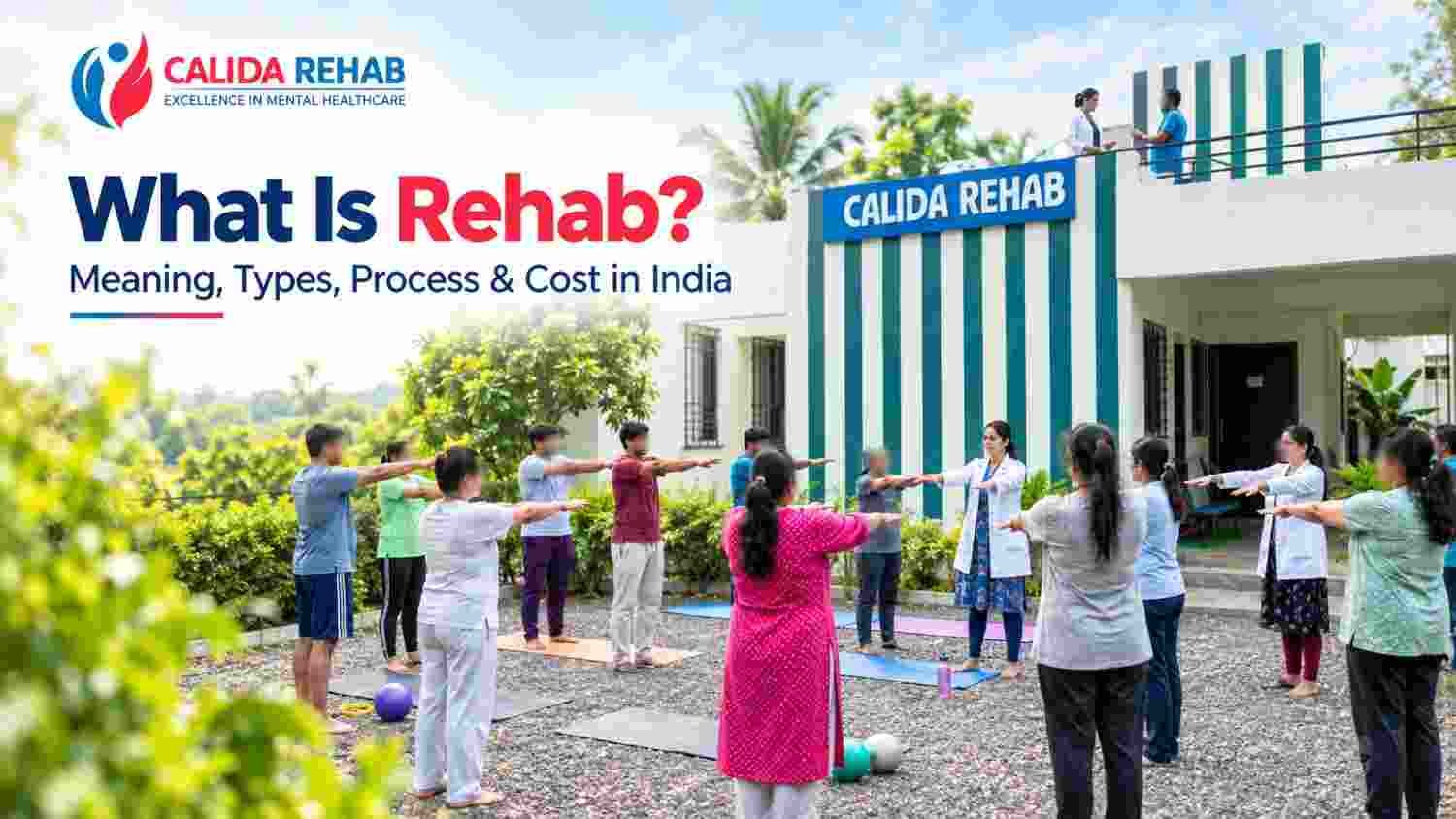
Rehab is short for rehabilitation — a structured, supervised programme that helps a person recover from drug or alcohol addiction, or from a serious mental health condition, and return to a stable, independent life. A rehab centre (or rehabilitation centre) is the facility — residential (inpatient) or day-visit (outpatient) — where this treatment happens: medical detox, therapy, counselling, and aftercare planning, usually delivered by doctors, psychiatrists, and counsellors working together.
What Does “Rehab” Mean?
“Rehab” is simply the short, everyday form of rehabilitation — a word that comes from the Latin rehabilitare, meaning “to restore” or “to make fit again.” In common usage today, especially in India, “rehab” almost always refers to addiction treatment or psychiatric/mental health treatment, though the same word is also used in physiotherapy (for example, recovering from a knee surgery).
So when someone asks “what does rehab mean”, the honest answer has two layers:
- The literal meaning: a process of restoring health, function, and independence after illness, injury, or addiction.
- The everyday meaning (what most people mean when they say it): going to a facility for a fixed period — typically 21 to 90 days — to get off drugs or alcohol, or to stabilise a mental health condition, under medical and psychological supervision.
You’ll hear it used both as a place (“he’s in rehab”) and as a process (“she’s going through rehab”). Both are correct.
What Is a Rehab Center?
A rehab center (rehabilitation centre) is a licensed facility that provides structured, professional treatment for substance addiction or mental illness. It’s different from a hospital in that the focus isn’t just on medical stabilisation — it’s on long-term behaviour change, relapse prevention, and rebuilding a functional life.
A good rehab centre in India typically combines:
- Medical detoxification — safely managing withdrawal under a doctor’s supervision
- Psychiatric care — diagnosis and medication management for co-occurring conditions like depression, anxiety, or bipolar disorder
- Individual and group therapy — CBT, DBT, and 12-step-based counselling
- Family therapy — because addiction and mental illness affect the whole household, not just the individual
- Structured daily routine — meals, activity, therapy, and rest on a fixed schedule
- Aftercare planning — a relapse-prevention plan for life after discharge
If you’re comparing options, our guide on how to choose a rehabilitation centre in Pune walks through a practical checklist families can use anywhere in India.
Types of Rehab
Not all rehab looks the same. The right type depends on the severity of the condition, medical risk, and how much support the person needs day-to-day.
Inpatient vs Outpatient Rehab: Quick Comparison
| Factor | Inpatient (Residential) Rehab | Outpatient Rehab |
|---|---|---|
| Where you stay | Lives full-time at the facility | Lives at home, visits for sessions |
| Typical duration | 21–90 days | Weeks to several months, a few sessions/week |
| Best suited for | Moderate–severe addiction, high relapse risk, unsafe home environment | Mild cases, or step-down after inpatient care |
| Medical supervision | Round-the-clock | During scheduled visits only |
| Daily structure | Fully structured routine | Person manages their own routine at home |
| Approx. cost | Higher (covers stay, meals, 24×7 staff) | Lower (pay per session/programme) |
Detox-Only Programmes
A short, medically supervised programme (usually 5–10 days) focused purely on safely clearing alcohol or drugs from the body and managing withdrawal symptoms. Detox alone is rarely enough for lasting recovery — it’s usually the first stage before therapy begins.
Dual Diagnosis / Psychiatric Rehab
For people dealing with both addiction and a mental health condition (like depression, bipolar disorder, or schizophrenia) at the same time. Treating only one side usually leads to relapse, so dual-diagnosis programmes treat both together.
Government vs Private Rehab
Government-run centres are free or low-cost but often have long waitlists and limited individual attention. Private centres cost more but typically offer faster admission, better staff-to-patient ratios, and more personalised care. We’ve broken this down in detail in Government vs Private Rehab Centre: What’s the Real Difference?
Who Actually Needs Rehab?
Rehab isn’t only for people who’ve “hit rock bottom.” Common signs that professional treatment is needed include:
- Repeated failed attempts to quit drugs or alcohol on your own
- Withdrawal symptoms (shaking, sweating, anxiety, nausea) when not using
- Using substances is affecting work, relationships, or finances
- A co-existing mental health condition that isn’t improving
- Family members expressing serious concern
If you’re trying to recognise these signs in a loved one, our article on early warning signs you need a rehab centre goes deeper into this.
What Actually Happens Inside Rehab?
This is where most people’s imagination (shaped by movies) is very different from reality. A typical day is structured, not dramatic:
- Morning: wake-up, medication (if prescribed), breakfast
- Mid-morning: individual therapy or psychiatric review
- Afternoon: group therapy, skill-building sessions (CBT, DBT), or activities like yoga
- Evening: family calls (as permitted), recreational time, reflection/journaling
- Night: structured wind-down and sleep schedule
The first week is usually the hardest, since it includes detox and withdrawal management. Our detailed guide, What Happens in the First Week of Rehab? A Day-by-Day Guide, covers this stage minute-by-minute.
Rehab vs Psychiatric Hospital — What’s the Difference?
People often confuse the two. In short: a psychiatric hospital is for acute medical/psychiatric crises (like severe psychosis or suicide risk) that need constant medical monitoring. A rehab centre is for structured, longer-term recovery from addiction or stabilised mental illness, with more focus on therapy and lifestyle change than acute medical crisis management. Read the full comparison in Rehab vs Psychiatric Hospital: What’s the Real Difference?
Rehab vs Home Recovery
Some families try to manage addiction recovery at home. It can work for very mild cases, but it usually lacks the structure, medical safety net, and distance-from-triggers that make rehab effective. We compare both approaches honestly in Rehab Centre in Mumbai vs Home Recovery: Which Option Actually Helps to Quit Addiction Faster?
How Long Does Rehab Take?
Most inpatient programmes run 21 to 90 days, depending on severity:
- 21–28 days: common minimum for stabilisation and initial behaviour change
- 45–60 days: allows deeper therapeutic work and habit-building
- 90 days: recommended for severe, long-term, or repeated-relapse cases
Recovery doesn’t end at discharge — aftercare (outpatient therapy, support groups, family involvement) is what protects the progress made during the inpatient stay.
How Much Does Rehab Cost in India?
Cost varies hugely by city, facility type, and length of stay — government centres can be free, while private centres range from a few thousand to a few lakh rupees per month depending on amenities. For an honest, itemised breakdown (not just marketing numbers), see The Real Cost of Rehab in India: What the Brochure Never Tells You.
How to Choose the Right Rehab Centre
A few non-negotiables to check before admitting a loved one:
- Is the facility licensed and are the doctors qualified psychiatrists (not just counsellors)?
- Does it offer dual-diagnosis care if there’s a co-existing mental health condition?
- What’s the staff-to-patient ratio?
- Is there a clear, written aftercare plan, not just a discharge date?
- Are family therapy sessions included?
Our step-by-step checklist for families is here: How to Choose a Rehabilitation Centre in Pune (Checklist for Families)
Common Myths About Rehab
“Rehab is only for drug addicts.” False — rehab also treats alcohol dependence, and many centres (including Calida) treat depression, bipolar disorder, schizophrenia, OCD, and other conditions.
“Rehab is like a jail.” False — modern rehab centres focus on therapy, routine, and dignity, not punishment or confinement.
“You only need to go once.” Recovery is often non-linear. Relapse doesn’t mean failure — it usually means the aftercare plan needs adjusting.
“Rehab is only for severe cases.” Early intervention — going before things become a crisis — usually leads to faster, more lasting recovery.
Frequently Asked Questions
What is rehab short for?
“Rehab” is short for “rehabilitation” — the structured process of recovering from addiction, injury, or a mental health condition.
What does it mean when someone says they’re “in rehab”?
It means they’re currently enrolled in a treatment programme — usually residential — receiving medical, psychiatric, and therapeutic care to recover from addiction or a mental health condition.
Is rehab only for drug or alcohol addiction?
No. Many rehab centres, including psychiatric rehab centres, also treat depression, anxiety, bipolar disorder, schizophrenia, OCD, and dementia-related care.
What is the difference between a rehab centre and a de-addiction centre?
In India, “de-addiction centre” and “Nasha Mukti Kendra” usually refer specifically to substance-use treatment, while “rehab centre” is a broader term that can also include mental health rehabilitation.
How do I convince a family member to go to rehab?
This is one of the hardest parts for families. We’ve written a dedicated guide: How to Convince Someone to Go to Rehab in India?
Is rehab confidential?
Yes — reputable rehab centres in India follow strict patient confidentiality, in line with the Mental Healthcare Act, 2017. Read more about patient rights in our guide to the Mental Healthcare Act 2017 and Addiction Treatment.
Bottom Line
Rehab, in simple terms, is a structured second chance — a place and a process designed to help someone step out of addiction or crisis and back into a stable, functional life, with medical and psychological support every step of the way. If you or a loved one is considering this step, Calida Rehab offers medically supervised, confidential addiction and mental health treatment across Mumbai, Pune, Thane, and Navi Mumbai — reach out for a confidential consultation.