
Community based rehabilitation (CBR) is a World Health Organization strategy that delivers rehabilitation, social inclusion and equal opportunity to people with disabilities, including people with mental illness and addiction, inside their own communities, using local people and local resources instead of distant institutions. It works through the combined effort of the person, their family, their community, and the health, education, livelihood and social services around them.
Unfortunately, most pages on this topic stop at that definition. However, this guide goes further. It explains what CBR looks like in practice, who delivers it, what the research shows, whether it is free in India, and when a family should choose residential treatment instead. Overall, it draws on WHO guidelines, randomised trials from India and systematic reviews, and it says clearly where the evidence is thin.
Last updated: 28 September 2026. Sources are listed at the end of this guide.
Key Takeaways
- CBR is a strategy, not a single treatment. It is a way of organising rehabilitation so that it reaches people where they live, using local workers supervised by professionals.
- The WHO’s 2010 guidelines define five components: health, education, livelihood, social and empowerment.
- The strongest Indian evidence is the COPSI trial (The Lancet, 2014). Adding home-based community care to clinic care reduced disability and psychotic symptoms in people with schizophrenia over 12 months.
- CBR is an approach, not a price. It is not free by definition, although services such as Tele-MANAS (14416) are free.
- Community support works best alongside clinical care. It does not replace medically supervised detoxification or inpatient treatment when risk is high.
What Is Community Based Rehabilitation (CBR)?
First, in WHO usage, “disability” is a broad term. As a result, it covers physical, sensory, intellectual and psychosocial conditions, which means mental illness, and long-term substance use problems fall in the same territory when they limit daily life. The definition also matches the one used by professional bodies such as World Physiotherapy: a strategy within community development for rehabilitation, equalisation of opportunities and social integration of all people with disabilities.
In particular, three ideas in that definition are worth slowing down on.
It is a strategy, not a treatment. In fact, there is no single thing called “CBR therapy”. It is a way of organising support so that it reaches people where they live. For example, inside a CBR programme you may find medication support, counselling, skills training, a self-help group and a job placement, all in the same week.
It relies on local resources. A trained neighbour, a health worker, a school, a family and a local employer are all part of the system. As a result, CBR can operate in places with almost no specialists.
Inclusion is the goal, not just symptom control. In other words, a person whose symptoms are under control but who has no work, no friends and no role in the family has not finished rehabilitation. Therefore, CBR measures success by participation in ordinary life.
Where Did Community Based Rehabilitation Come From?
CBR began as a practical answer to a numbers problem, not as a mental health idea. Specifically, in the late 1970s, the WHO’s primary health care movement, launched with the 1978 Alma-Ata declaration and the goal of Health for All, pushed care towards communities, and rehabilitation followed the same logic. At that time, in many low-income countries, specialist rehabilitation existed in a few urban institutions, far beyond the reach of most people who needed it. Therefore, training local workers to deliver basic rehabilitation at home was cheaper and reached further.
However, over the next three decades the idea changed character. At first, early CBR was largely medical: exercises for a child with cerebral palsy, an assistive device, a home visit. Then an international consultation in Helsinki in 2003 and a joint position paper by the ILO, UNESCO and WHO in 2004 widened the focus to education, work and social participation. Later, the UN Convention on the Rights of Persons with Disabilities (2006) supplied a rights framework. Finally, in 2010, WHO, ILO, UNESCO and the International Disability and Development Consortium published the CBR Guidelines, shaped by more than 180 individuals and nearly 300 organisations, most from low- and middle-income countries.
Today, you will also see the term Community Based Inclusive Development (CBID). It reflects the same shift in emphasis: from delivering rehabilitation to disabled people, towards changing communities so they work for everyone.
What Are the Five Components of the CBR Matrix?
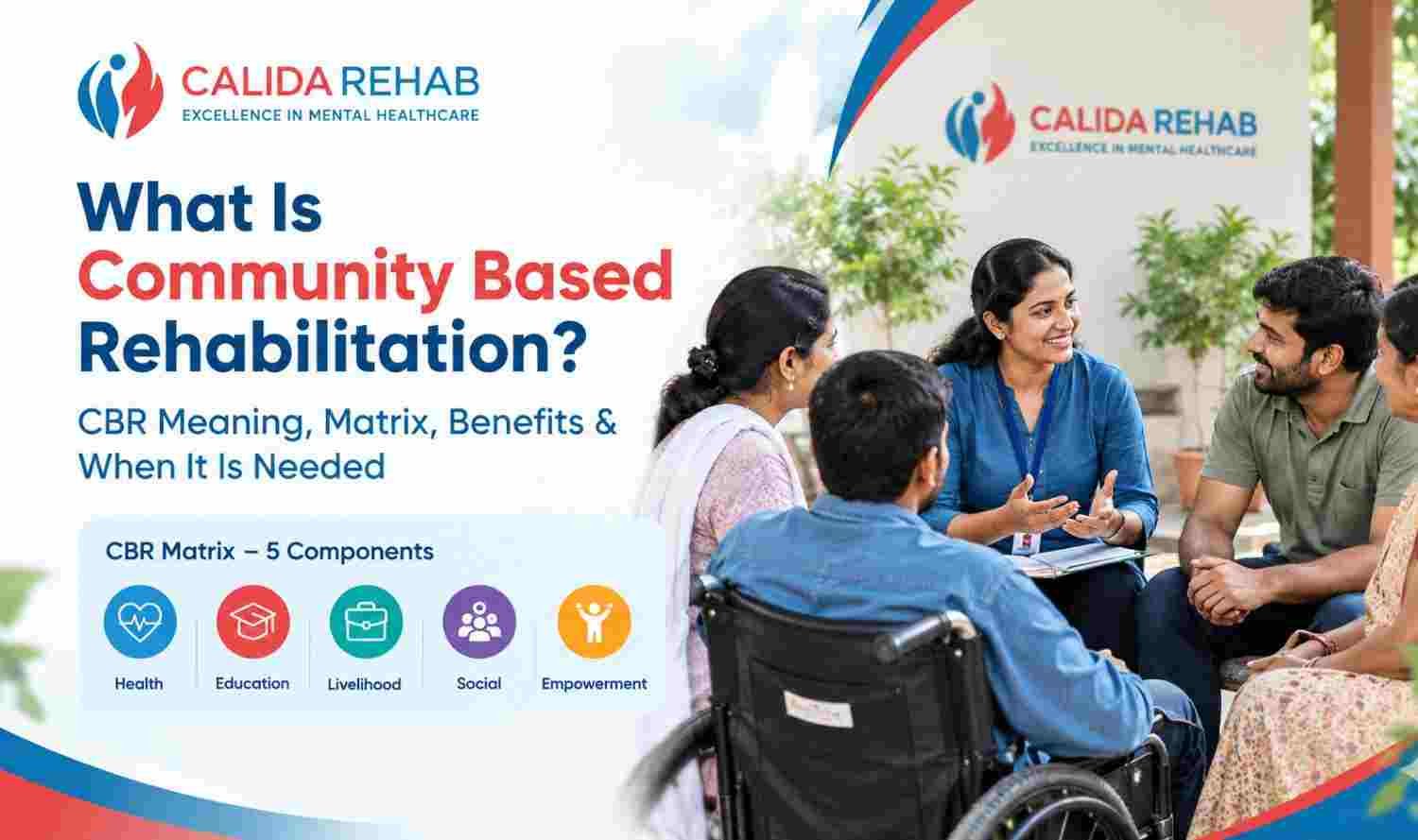
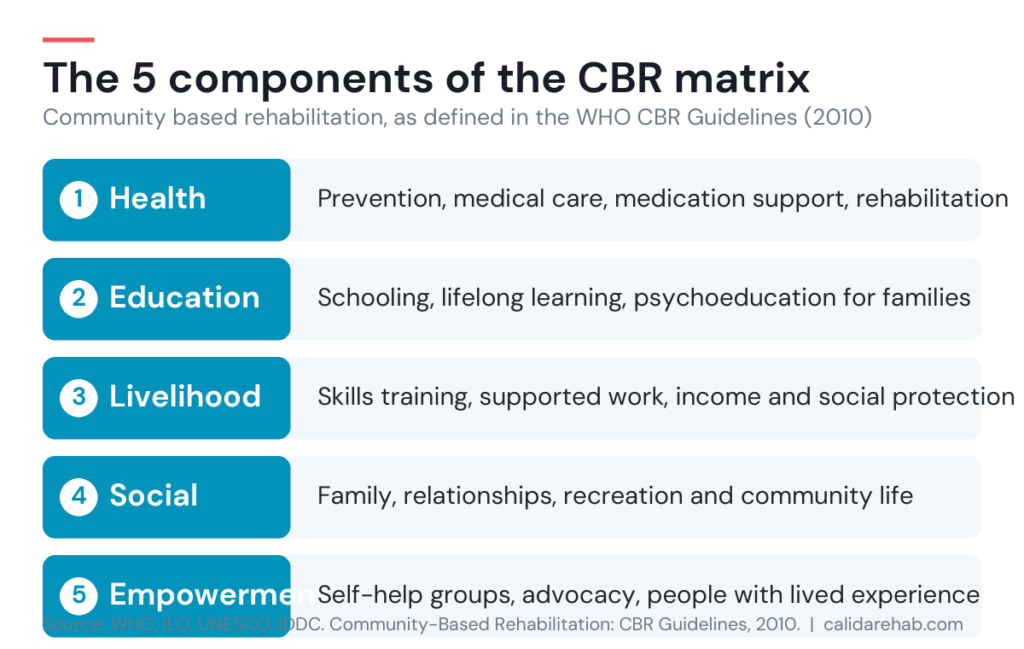
The 2010 WHO guidelines organise CBR into a matrix of five components: health, education, livelihood, social and empowerment. Programmes are therefore meant to choose the components and elements that fit local needs rather than deliver all of them at once. Also, the table shows what each component covers and what it can mean when the person has a mental health or substance use problem.
| Component | Elements in the WHO matrix | In mental health and addiction |
|---|---|---|
| Health | Prevention, promotion, medical care, rehabilitation, assistive devices | Early identification, medication support, a link to a psychiatrist, physical health checks |
| Education | Early childhood to higher education, non-formal education, lifelong learning | Return to school or learning after illness, psychoeducation for families |
| Livelihood | Skills development, self-employment, paid work, financial services, social protection | Supported employment, vocational training, a structured day and an income |
| Social | Personal assistance, relationships and family, culture and arts, recreation and sport, justice | Rebuilding relationships and a social life that does not revolve around substance use |
| Empowerment | Advocacy and communication, community mobilisation, political participation, self-help groups, disabled people’s organisations | Family support groups, peer groups in recovery, people with lived experience helping to run services |
Why Livelihood and Empowerment Matter
Livelihood is often the component that decides whether recovery lasts. For example, a person with nothing to do and no income carries a much heavier risk of relapse than one with a structured day and a reason to get up.
Empowerment cuts across the other four. In addition, the guidelines expect people with lived experience and their families to help run the programme, not just receive it.
How Well Is CBR Implemented in Practice?
However, a reality check is useful here. A 2024 review of CBR programmes documented outside academic journals found that only two addressed all five components, and livelihood programmes were the most common. Stigma and lack of resources were the most frequent implementation problems, and the review judged the quality of the evidence to be generally poor because organisations often evaluate their own work to a low standard. So when someone says “we do CBR”, it is fair to ask which components they actually cover.
Who Delivers Community Based Rehabilitation?
In a functioning programme, there are usually five groups involved, so it helps to know each role.
- The person and their family. Family members are partners in the plan, not visitors to it. They also need support themselves, because caregiving is exhausting.
- Community or lay health workers. Trained local people, typically not clinicians, who make home visits, check on medication, run psychoeducation sessions and notice early warning signs.
- A supervising professional. A psychiatric social worker, nurse, psychologist or psychiatrist who trains, supports and checks the work of community workers. In practice, supervision is what separates CBR from good intentions.
- Local services and institutions. The primary health centre, school, employer, ward or village body.
- Self-help groups. Groups of families or of people in recovery, which supply continuity that no professional can.
How Does CBR Work in Mental Illness and Addiction?
Originally, the CBR movement started with physical disability, and mental health and addiction came later. The WHO’s own guidelines include a supplementary booklet on mental health precisely because it, along with HIV, leprosy and disasters, had been historically overlooked by CBR programmes. Good CBR for psychiatric conditions therefore needs specific design, not a copy of what works for mobility problems.
Severe Mental Illness
For a person with a severe mental illness such as schizophrenia or bipolar disorder, community-based rehabilitation typically means regular home visits, help staying on medication, family therapy and education, a crisis plan the family can actually follow, and a gradual route back into daily activity or work.
Addiction Recovery
Similarly, for a person recovering from addiction, two bodies of research explain why the community matters.
The first is the Community Reinforcement Approach (CRA), introduced by Hunt and Azrin in 1973. Specifically, its central idea is simple: to compete with substance use, a person’s daily life must offer rewards for staying sober that are as strong and reliable as the pull of the substance. In addition, CRA works on family relationships, work, leisure and social contact, and treats family members as active partners. Summaries of alcohol treatment research have repeatedly placed it among the approaches with the strongest scientific support, though it is used far less often than that evidence would suggest.
The second is recovery capital, a concept associated with researchers such as Granfield and Cloud. In simple terms, it describes the personal, social and community resources a person can draw on to start and sustain recovery: stable housing, income, health, supportive relationships, peer groups and a community that does not push people away. A clinic can treat withdrawal and build coping skills, but it cannot easily supply a friendship, a job or a neighbourhood that accepts you. In short, community-based work is aimed at exactly those gaps. Research on community asset engagement in addiction recovery points to the mental health recovery themes of connectedness, hope, identity, meaning and empowerment, often abbreviated CHIME, as a guide to what community engagement should build.
Does Community Based Rehabilitation Work? What the Research Shows
In fact, CBR has a large following and a smaller evidence base than its reputation suggests. Specifically, the evidence sits at three levels.
The Strongest Indian Trial: COPSI
The COPSI trial, published in The Lancet in 2014, is the strongest single study on community-based mental health care in India. Specifically, researchers randomly assigned 282 people with moderate to severe schizophrenia at three sites to either facility-based care alone or facility-based care plus a community intervention, in a 2 to 1 ratio (187 in the community group, 95 in the comparison group). Meanwhile, in the community arm, lay health workers supervised by psychiatric social workers delivered treatment at home and supported family members.
Across 12 months, the community group showed a greater reduction in disability and psychotic symptoms, and better continuation of antipsychotic medication (LSHTM summary). Notably, the largest gains appeared at the most rural and isolated site. The community intervention also cost more, about INR 9,500 (roughly US$153) extra per participant over the study period, and the authors noted that whether that is good value is a judgement rather than a given.
What the Systematic Reviews Say
A 2016 review by Iemmi and colleagues looked at CBR for people with physical and mental disabilities in low- and middle-income countries. In total, it found 15 eligible studies, 10 of them randomised trials, and concluded that CBR may improve clinical outcomes, functioning and quality of life for the person and their carer. However, the authors were careful: the number of studies was small, study quality was a concern, and there was little information on cost-effectiveness.
As the 2024 grey-literature review shows, much of what is written about CBR programmes comes from organisations evaluating themselves, and quality is uneven.
What to Take From the Evidence
So what should a reader take from this? CBR works best as an addition to clinical care, not a replacement for it. In COPSI, everyone kept access to facility-based treatment, and the community layer improved outcomes on top of it. In short, the evidence supports community support alongside good medical care. However, it does not support the idea that community support alone can substitute for treatment when treatment is needed.
Community Based Rehabilitation in India
Indeed, India has built community mental health capacity for a long time. According to a 2025 overview in Outlook, community-based services began at NIMHANS in Bengaluru in 1975. Later, that work fed into the District Mental Health Programme (DMHP), which under the National Mental Health Programme now covers 743 districts and trains primary care doctors, nurses and community health workers such as ASHAs to identify and treat common mental disorders close to home.
Additionally, two policy milestones sit on top of that. The Mental Healthcare Act 2017 made access to mental health care a statutory right (see our guide to patient rights under the Mental Healthcare Act). Then, on 10 October 2022, the government launched Tele-MANAS, a free, round-the-clock tele-mental health service reachable on 14416 or 1800-89-14416. According to the Ministry of Health and Family Welfare (PIB, October 2024), it handled more than 14.7 lakh calls in its first two years.
Meanwhile, the need behind all this is large. Similarly, the same government document puts the treatment gap for mental disorders in India at between 70 and 92 percent, depending on the condition. Also, shortages of trained staff, stigma and under-used funds remain the recurring obstacles that experts point to. In short, India has the structure of community care. However, what it still lacks, in many districts, is depth: enough trained workers, enough supervision and enough follow-up.
Is Community Based Rehabilitation Free?
No, not by definition. CBR is an approach to organising support. In fact, it says nothing about who pays. Some CBR programmes are run by NGOs on grant funding or by government health systems, and participants pay little or nothing. In contrast, others are delivered by private organisations and charged for. So “community based” describes where and how care happens, not what it costs.
Still, there are a few reasons people assume it is free. First, many well-known programmes are publicly or philanthropically funded. Second, the word “community” suggests volunteers. Third, government schemes that are free, such as Tele-MANAS, are sometimes described in the same breath. It helps to separate the pieces:
- Free and public: Tele-MANAS counselling and consultation by phone. Services at government health facilities and under the District Mental Health Programme are generally available at no or low cost, though availability, waiting times and staffing vary a great deal by district.
- Not automatically free: private rehabilitation centres, private psychiatrists and therapists, ongoing medication costs, and transport. Our guide to the real cost of rehab in India breaks these down.
- The hidden costs: a caregiver’s time, lost wages, and travel to follow-up visits. Even in a well-run trial such as COPSI, the community model cost more than usual care.
Therefore, be cautious with any advertisement that promises “free rehab” without naming who funds it, what is included and how long it lasts. In mental health and addiction, a vague free offer is a red flag, not a bargain.
CBR vs Residential Rehab: Which One Do You Need?
Families often ask whether to choose community-based care or a residential centre, as though one must win. Instead, it is better to think in steps than in sides. For a plain-language explanation of the residential option, see what rehab involves.
| Community-based care | Outpatient clinic | Residential (inpatient) rehab | |
|---|---|---|---|
| Where care happens | At home and in the community | At a clinic or hospital, with the person returning home after each visit | In a structured, supervised facility |
| Who delivers it | Community workers with professional supervision | Psychiatrists, psychologists and counsellors | A multidisciplinary clinical team |
| Main strength | Continuity, family involvement, real-world skills | Regular specialist treatment while keeping daily routines | Safety, medical supervision, a controlled environment |
| Main limit | Weak in acute risk, and depends on supervision quality | Less support between sessions | Distance from real life, so aftercare must be planned |
| Best suited to | Stabilised conditions, long-term support, relapse prevention | Mild to moderate conditions with a stable home | Detoxification, crisis, severe illness, unsafe or trigger-filled homes |
Overall, the three are best seen as stages in a continuum. Someone may need a residential stay to become medically stable and begin treatment, then community-based support to keep the gains. Many relapses happen not during treatment but in the gap after it, when the structured environment ends and nothing replaces it. If you are weighing home-based recovery against a centre, our comparison of rehab vs home recovery and of rehab vs a psychiatric hospital may help.
When Is Community Care Not Enough?
Community-based support is usually the wrong sole option when:
- Withdrawal may be medically dangerous. For example, stopping alcohol or benzodiazepines abruptly can cause seizures and delirium. Detoxification in these cases should be medically supervised. See also our guide to alcohol dependence syndrome.
- There is a risk to life. Active suicidal thoughts, or behaviour that puts the person or others in danger, needs immediate clinical assessment.
- The illness is acute or severe. Florid psychosis, severe mania or a serious deterioration usually requires specialist inpatient care first.
- Repeated outpatient attempts have failed. If the person keeps relapsing in the same environment, a period away from that setting can help.
- The home itself is unsafe or full of triggers. Community-based care depends on a supportive base. Without one, there is nothing to build on. Co-occurring conditions add to this, as explained in our guide to dual diagnosis treatment.
Ultimately, the decision should be made with a psychiatrist, not by the family alone and not by an advertisement. Our residential inpatient programmes in Mumbai and Pune page explains what that level of care involves.
How to Judge a CBR Programme: 7 Questions to Ask
Because the label is used loosely, judge a programme by what it does.
- Who supervises the community workers, and how often? Regular supervision by a trained professional is the difference between a real programme and a friendly visit.
- Is there a clear route to a psychiatrist and to emergency care? Community workers must know when to escalate.
- Which of the five components does it actually cover? Health alone is not rehabilitation. Look for livelihood, social and family elements too.
- Does it support the family as well as the patient? Caregiver burden is a leading cause of breakdown.
- What does it measure? Good programmes track function, relapse and return to work, not just attendance.
- Are people with lived experience involved in running it? This is the empowerment component in practice.
- Does it say who it is not suitable for? A programme that claims to suit everyone probably does not know its limits.
Frequently Asked Questions
Helping a person with a disability, mental health problem or substance use problem recover and take part in life while living in their own community, with support from family, trained local workers and health services.
Health, education, livelihood, social and empowerment, as defined in the WHO’s 2010 guidelines. Programmes choose the parts that fit local needs, so not every programme covers all five.
The World Health Organization developed and promoted CBR from the late 1970s, building on the Alma-Ata primary health care movement. Its current guidelines date from 2010.
No. Outpatient treatment means visiting a specialist at a clinic. CBR is wider and includes livelihood, family, social participation and self-help, usually delivered at home.
Trained community health workers, supervised by nurses, social workers, psychologists or psychiatrists. Families and people with lived experience take part too.
Community-based approaches such as the Community Reinforcement Approach have strong research support. It works best alongside medical care and does not replace supervised detoxification when withdrawal is risky.
Not automatically. Tele-MANAS (14416) is free and government services are generally low cost, but private programmes charge and families bear indirect costs such as travel and lost wages.
When withdrawal may be dangerous, there is a risk to life, the illness is severe, or the home is unsafe. A psychiatrist should make this decision.
Need Help Deciding? Talk to Calida Rehab
Choosing between community support, outpatient care and a residential stay is difficult, especially when a family is already exhausted. However, there is rarely one correct answer, but there is usually a right sequence: the level of care the person needs now, followed by the support that keeps them well afterwards.
Calida Rehab offers medically supervised, confidential addiction and mental health treatment across Mumbai, Pune, Thane and Navi Mumbai. To talk through which level of care fits your situation, call +91 84529 40789 or see our centres in Mumbai and Pune. If someone is in immediate danger, contact your local emergency services. For free, confidential support from anywhere in India, you can call Tele-MANAS on 14416.
This article is for general education and is not a substitute for medical advice. Diagnosis and treatment decisions should be made with a qualified mental health professional.
Sources and Further Reading
- World Health Organization, ILO, UNESCO, IDDC. Community-Based Rehabilitation: CBR Guidelines. WHO, 2010.
- Chatterjee S, Naik S, John S, et al. Effectiveness of a community-based intervention for people with schizophrenia and their caregivers in India (COPSI): a randomised controlled trial. The Lancet. 2014;383(9926):1385-1394.
- Iemmi V, Blanchet K, Gibson LJ, et al. Community-based rehabilitation for people with physical and mental disabilities in low- and middle-income countries: a systematic review and meta-analysis. Journal of Development Effectiveness. 2016;8(3):368-387.
- Iemmi V, Gibson L, Blanchet K, et al. Community-based rehabilitation for people with disabilities in low- and middle-income countries: a systematic review. Campbell Systematic Reviews. 2015;15.
- Grey literature review of community-based rehabilitation programmes. International Journal of Mental Health Systems. 2024.
- Collinson B, Best D. Promoting recovery from substance misuse through engagement with community assets: Asset Based Community Engagement. Substance Abuse: Research and Treatment. 2019;13.
- Hunt GM, Azrin NH. A community-reinforcement approach to alcoholism. Behaviour Research and Therapy. 1973;11:91-104.
- World Physiotherapy. Policy statement: Community based rehabilitation. 2019.
- Ministry of Health and Family Welfare, Government of India. Tele MANAS: two years of the National Tele Mental Health Programme. PIB, 13 October 2024.
- National Mental Health Programme. Vikaspedia, Government of India.
- Kumar KVK. The District Mental Health Programme: the story so far. Outlook India, October 2025.