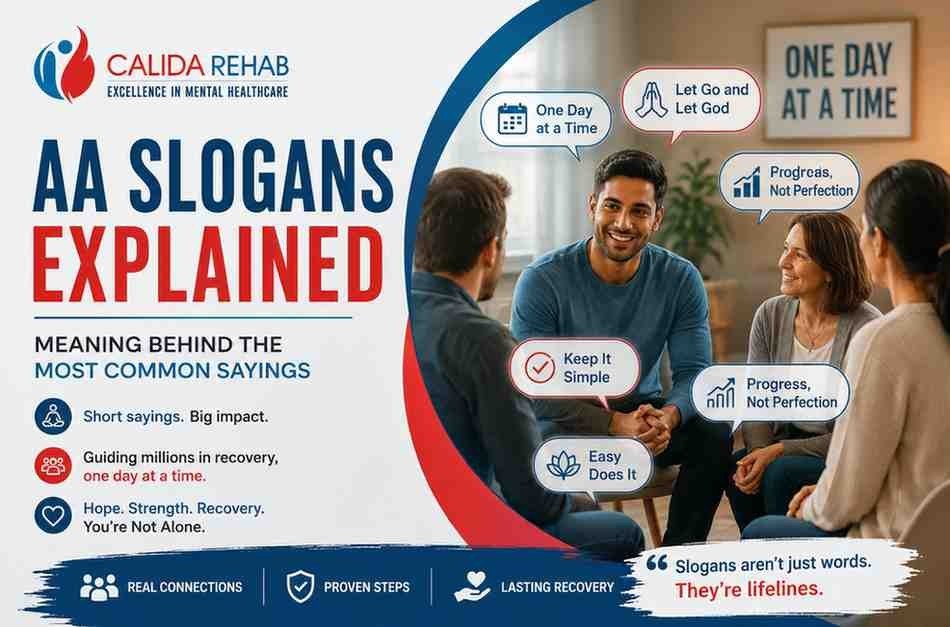

If you’ve ever sat in an AA meeting, you’ve probably heard short phrases repeated again and again — “One Day at a Time,” “Let Go and Let God,” “Keep It Simple.” These are AA slogans: short, memorable sayings that condense the core ideas of recovery into a few words a person can hold onto during a hard moment.
Quick answer: AA slogans are short recovery mottos that Alcoholics Anonymous members use to reinforce key principles of sobriety — patience, surrender, honesty, and living in the present. They work because a person can recall them easily exactly when they need them most, such as during a craving or moment of stress.
This guide explains the meaning behind the most common AA slogans, why members use them, and how they connect to the deeper principles of 12-step recovery.
Why Does AA Use Slogans At All?
Early AA members found that long explanations of recovery philosophy were hard to remember in a moment of crisis. A slogan, on the other hand, can surface in someone’s mind seconds before they’re about to pick up a drink. The simplicity is the point — these sayings act like mental shortcuts back to a healthier way of thinking, especially for someone new to sobriety who hasn’t yet built other coping tools.
The Most Common AA Slogans and What They Mean
“One Day at a Time”
Perhaps the most well-known AA slogan of all. It reminds a person not to think about staying sober forever, which can feel impossible, but only about staying sober today. Breaking recovery into 24-hour chunks — instead of a lifetime commitment — makes it manageable.
“Let Go and Let God”
This phrase reflects Step Three of the 12 steps — turning one’s will over to a higher power as the individual understands it. Those who aren’t religious often reinterpret it as surrendering the illusion of total control and trusting the recovery process itself.
“Easy Does It”
A reminder against rushing recovery or trying to fix every problem in life at once. Early sobriety is fragile, and this slogan encourages patience rather than the all-or-nothing thinking that often accompanies addiction.
“First Things First”
This slogan is about priority. In active addiction, obligations often got pushed aside for the substance. In recovery, staying sober has to come first — before work stress, relationships, or other pressures — because without sobriety, nothing else is sustainable.
“Keep It Simple”
Overthinking and overanalyzing can be triggers for relapse. This slogan is a reminder not to overcomplicate recovery with too many rules, too much self-judgment, or too many “what ifs.”
“Progress, Not Perfection”
Recovery isn’t linear, and this slogan makes room for that. It shifts the goal away from being flawless and toward simply moving forward, even if that movement is slow or imperfect.
“This Too Shall Pass”
Cravings, bad days, and difficult emotions feel permanent in the moment. This slogan is a reminder that intense feelings are temporary, even when they don’t feel that way.
“Fake It Till You Make It”
Motivation doesn’t always come before action — sometimes it follows it. This slogan encourages people to go through the motions of recovery (attending meetings, staying accountable) even on days they don’t feel like it, trusting that belief will catch up with behavior.
“Principles Before Personalities”
This slogan is more about group dynamics than individual recovery. It reminds members that AA’s principles matter more than any one person’s opinions, conflicts, or ego — helping keep meetings focused and free of infighting.
“How Important Is It?”
A grounding question used to defuse anger or anxiety over small frustrations, helping members separate what truly matters from what’s just noise.
How AA Slogans Connect to the 12 Steps
Most AA slogans aren’t random — they’re compressed versions of the 12 steps. “Let Go and Let God” mirrors Step Three. “Keep It Simple” reflects the overall spirit of working one step at a time rather than trying to overhaul an entire life overnight. Understanding this connection can help a slogan feel less like a cliché and more like a doorway into the deeper step work behind it.
Do AA Slogans Actually Work?
Critics sometimes dismiss AA slogans as overly simplistic. But cognitive behavioral research on habit change supports the idea that short, repeatable phrases can interrupt automatic thought patterns — which is exactly the moment a craving or relapse trigger tends to strike. The slogans aren’t meant to replace deeper therapeutic work like the structured programs offered at a rehabilitation centre; they’re meant to be a fast, accessible first response in a difficult moment.
AA Slogans at a Glance
| Slogan | Core Meaning | Use It When… |
|---|---|---|
| One Day at a Time | Focus only on staying sober today | Recovery feels overwhelming long-term |
| Let Go and Let God | Surrender control to a higher power/process | You’re trying to control everything |
| Easy Does It | Slow down, don’t force outcomes | You’re rushing or panicking |
| First Things First | Sobriety comes before everything else | Priorities feel scattered |
| Keep It Simple | Don’t overanalyze; stick to basics | You’re spiraling in your head |
| Progress, Not Perfection | Small steps forward still count | You’re being hard on yourself |
| This Too Shall Pass | Intense feelings are temporary | A craving or bad mood feels permanent |
| Fake It Till You Make It | Action can come before motivation | You don’t feel like showing up |
| Principles Before Personalities | Focus on the program, not group drama | Group conflict is distracting you |
| How Important Is It? | Separate real problems from small stuff | You’re angry over something minor |
Common AA Acronyms Used Alongside Slogans
Slogans are often paired with short acronyms that serve the same purpose — quick mental check-ins.
- HALT — Hungry, Angry, Lonely, Tired. A checklist to run through before reacting to a craving or strong emotion.
- G.O.D. — Good Orderly Direction. A non-religious reinterpretation of “God” used by members who aren’t spiritual.
- ODAAT — One Day at a Time, shorthand for the slogan above.
Are Some AA Slogans Controversial?
Not everyone in recovery loves every slogan. Newcomers sometimes criticize phrases like ‘Fake It Till You Make It’ or repeated catchphrases without explanation as dismissive or overly simplistic, especially when they feel a cliché minimizes their pain. Most long-term members argue the slogans only work when someone actually understands the reasoning behind them — not when someone uses them to shut down a real conversation.
If a slogan feels hollow, it’s worth asking a sponsor or group member to unpack the meaning further rather than dismissing the phrase entirely.
How to Actually Use AA Slogans (Not Just Hear Them)
Slogans work best when they’re built into daily routines, not just repeated in meetings — ideally alongside structured support such as a residential recovery program in Karjat:
- Write it down: Sticky notes on a mirror, fridge, or desk keep a slogan visible during ordinary moments, not just crises.
- Use it as a check-in: Before reacting to stress, silently ask “How important is it?” or run through HALT.
- Journal on one slogan a week: Reflect on what it means in your specific situation, not just its general definition.
- Say it out loud during a craving: Verbalizing a slogan can interrupt the automatic thought pattern that leads toward relapse.
Final Thoughts
AA slogans aren’t magic words, but they are effective tools — small, repeatable reminders that can interrupt a spiral of negative thinking and pull someone back toward the principles that support their sobriety. Whether or not someone is part of AA specifically, these sayings offer a simple vocabulary for staying grounded through the ups and downs of recovery.
If you or someone you love is struggling with alcohol use, reaching out to a licensed treatment provider or support group is a strong first step toward lasting recovery.
Frequently Asked Questions
Most people generally consider ‘One Day at a Time’ the most widely recognized AA slogan, both inside and outside recovery circles.
Are AA slogans religious? Some slogans, like “Let Go and Let God,” have spiritual roots, but AA is not tied to any specific religion. Many members interpret “God” as any higher power, purpose, or force greater than themselves — including the recovery community itself.
Can non-alcoholics use AA slogans?
Yes. People use many of these sayings, such as “Progress, Not Perfection” and “This Too Shall Pass,” well beyond AA in general mental health and stress-management contexts.
Where do AA slogans come from?
Most originated informally within early AA meetings, and the fellowship passed them down rather than a single author writing them, though some appear in AA’s official literature, including the Big Book.
Are AA slogans part of the official 12 Steps or 12 Traditions?
No. Slogans are not part of AA’s official 12 Steps or 12 Traditions — meetings, sponsors, and shares pass down these informal sayings, though they reflect the same underlying principles.
What does HALT mean in AA? HALT stands for Hungry, Angry, Lonely, Tired — a quick self-check members use to catch early warning signs before a craving turns into a relapse.