
When a family member or friend is struggling with addiction, the first question that comes up is usually — “Can we admit them to rehab against their will?” or “What legal protections apply to them once they’re in treatment?” Both questions lead to the same piece of legislation: the Mental Healthcare Act, 2017 (MHCA).
Most people learn about the law only during a crisis. If you’re researching a rehab centre, this article explains in simple terms how the MHCA applies to addiction treatment, patient rights, and what families should know before admission. If you’re comparing centres, Calida Rehab’s Team offers a confidential consultation to help you understand your options before making a decision.
Families in Pune who want admission guidance can read about our mental hospital in Pune.
What Is the MHCA 2017?
The Mental Healthcare Act, 2017 is India’s central legislation governing the treatment of mental illness and the regulation of mental health establishments. Its core philosophy is straightforward — people affected by mental illness deserve dignity, informed consent, and protection from cruel or inhuman treatment, just as they would for any other medical condition.
Here’s the detail most families don’t realize: the MHCA’s definition of “mental illness” explicitly includes Substance Use Disorders (SUDs) — that is, drug or alcohol addiction. This means addiction treatment falls under the same legal framework as conditions like depression or schizophrenia, not a separate, looser set of rules. This applies uniformly whether the facility is a rehab centre in Mumbai, a rehab centre in Pune, or anywhere else in India.
How Rehab Admission Legally Works
The MHCA broadly defines two types of admission:
1. Voluntary Admission This is when the patient consents to treatment themselves. It’s the most straightforward and legally safest route — the patient must be clearly informed about their condition, the treatment plan, and the expected duration, and their informed consent must be documented.
2. Supported Admission This applies when a patient isn’t in a state to make the decision themselves due to severe impairment. Admission can proceed with the help of family or a nominated representative — but only under strict criteria: two independent medical practitioners must assess that the person poses a risk to themselves or others, and that less restrictive treatment options aren’t viable.
Here’s something most rehab blogs don’t mention: addiction psychiatrists themselves are divided on how cleanly supported admission applies to SUD cases. The threshold set for severe mental illness (“gross impairment,” “harm to self or others”) doesn’t always fit addiction cases neatly — someone whose life is clearly deteriorating due to substance use but who isn’t yet ready for treatment can fall into a legally ambiguous category. This is why most reputable centres, including Calida’s rehab centre in Mumbai and rehab centre in Pune, strongly favour voluntary admission and encourage families to work through structured intervention or motivational counselling first, rather than pursuing admission unilaterally. Calida Rehab follows intake process is built around this principle — the first conversation is about understanding the situation, not forcing a decision.
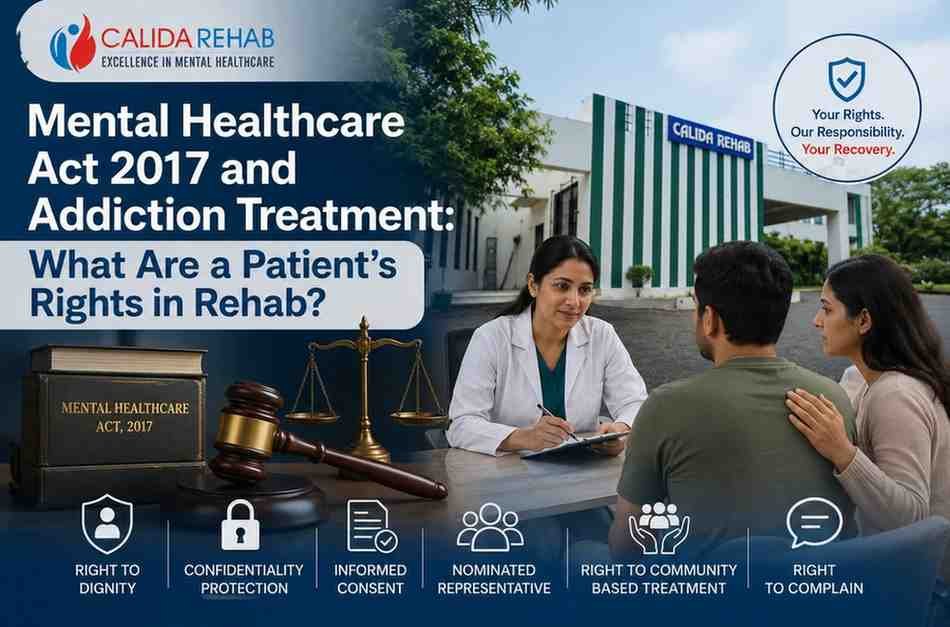
Core Patient Rights (Chapter 5, MHCA)
Chapter 5 of the MHCA, titled “Rights of Persons with Mental Illness,” applies equally to addiction patients:
- Right to dignity — no cruel, inhuman, or degrading treatment, whether in residential or outpatient care.
- Confidentiality — a patient’s medical information can’t be shared without consent (with limited legal exceptions).
- Informed consent — the treatment plan, medications, and expected duration must be explained to the patient as far as practically possible.
- Nominated representative — a patient can designate, in advance, who among their family should make decisions on their behalf if they’re ever unable to.
- Right to community-based treatment — a person cannot be institutionalised simply for convenience; the least restrictive treatment option should be attempted first.
- Right to complain — patients or families who believe rights are being violated at a facility can file a complaint with the State Mental Health Review Board.
These rights don’t change based on location — a patient at a rehab centre in Pune has the exact same legal protections as one at a rehab centre in Mumbai. What differs is how seriously individual facilities implement them in practice.
A Practical Checkpoint for Families
One useful due-diligence step before choosing a rehab centre: under the MHCA, mental health establishments — including addiction treatment centres — are required to register with the state mental health authority. Registration signals that a centre meets minimum standards around staff qualifications, infrastructure, and patient-rights protocols.
Simply asking a shortlisted centre about their registration status is a quick way to vet them. This applies whether you’re comparing a rehab centre in Mumbai near home or considering a rehab centre in Pune for more distance from a triggering environment — both should be able to show you their registration on request. Calida is registered with the relevant state mental health authority, and this can be verified directly during your first consultation.
How Different Cities Approach This
Families often ask whether choosing a rehab centre in Mumbai versus a rehab centre in Pune makes a legal difference — it doesn’t, since the MHCA is a central law applied uniformly across Maharashtra. The real differences are practical: a rehab centre in Mumbai may suit families who want to stay closely involved with weekly visits, while a rehab centre in Pune is sometimes chosen specifically for its distance from the patient’s usual social environment and triggers. Both approaches are valid — the legal protections and admission process remain identical either way, so the decision should come down to what suits the patient’s recovery needs, not perceived legal differences between the two cities.
An Honest Caveat
Applying the MHCA to addiction treatment isn’t entirely clean-cut. The Act doesn’t clearly define terms like “substance abuse,” and it treats SUD largely as a single category without distinguishing between different substances or severity levels. Psychiatrists continue to actively debate how the law’s language should be interpreted for addiction cases specifically. Practically, this means a good rehab centre won’t just say “we can legally admit them” — it will walk the family through the entire process transparently and prioritise voluntary, consent-based treatment wherever possible.
Bottom Line
If you or someone close to you is considering addiction treatment, keep these in mind:
- Voluntary admission is always the safest and legally cleanest route.
- Patients have a legal right to dignity, confidentiality, and informed consent — these aren’t “extra amenities,” they’re the law.
- Verifying a centre’s MHCA registration is a simple but important step, whether you’re evaluating a rehab centre in Mumbai or a rehab centre in Pune.
- Supported/involuntary admission is legally complex — this decision should involve a qualified psychiatrist, not just the family acting alone.
If you’re trying to work through this decision for a loved one, reach out to Calida Rehab’s team for a confidential conversation — no commitment, just clarity on what your options actually are.
Disclaimer: This article is for general informational purposes and does not constitute legal advice. For your specific situation, please consult a qualified psychiatrist or lawyer.