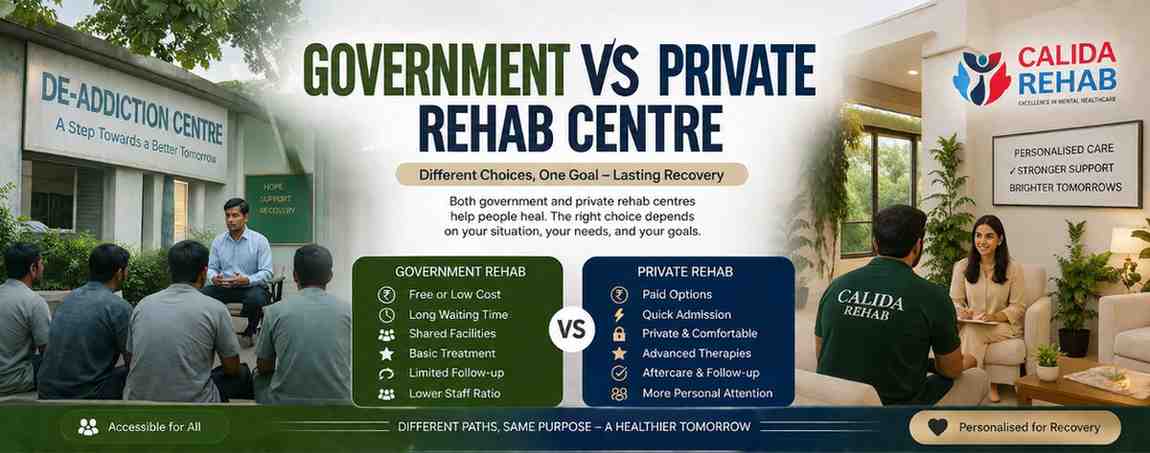

When a family member is struggling with alcohol or drug addiction, one of the first questions people ask is simple: should we go to a government rehab centre or a private one? The honest answer is — it depends on the person’s condition, the family’s budget, and how much privacy and personalised care they need. Government centres are free or low-cost but often overcrowded, while private rehab centres cost more but offer faster admission, personal attention, and better facilities.
That’s the short version. Here’s the detailed breakdown so you can actually make the right call for your family.
What Is a Government Rehab Centre?
Government rehab centres are addiction treatment facilities run or funded by the central or state government, usually under the Ministry of Social Justice and Empowerment or state health departments. In India, these are often called de-addiction centres and are attached to district hospitals or run as standalone Integrated Rehabilitation Centres for Addicts (IRCAs).
They exist to make treatment accessible to everyone, regardless of income. Treatment is either free or available at a token fee, which is a huge relief for families who simply cannot afford private care. But because demand is high and government funding is limited, these centres often deal with long waiting lists, shared wards with many patients, and staff who are managing far more cases than they can comfortably handle.
What Is a Private Rehab Centre?
A private rehab centre, on the other hand, is run independently — usually by psychiatrists, doctors, or private healthcare groups — and is funded through patient fees rather than government budgets. This is where you typically find better infrastructure: private or semi-private rooms, a lower patient-to-staff ratio, structured daily therapy schedules, and additional facilities like yoga studios, healing gardens, and recreational spaces.
Private centres also tend to move faster. There’s usually no long waiting period, and admission can often happen within a day or two once the family decides to go ahead. For families dealing with a crisis situation, that speed matters a lot.
Government vs Private Rehab Centre — Key Differences
| Factor | Government Rehab Centre | Private Rehab Centre |
|---|---|---|
| Cost | Free or very low cost | Paid, varies by facility and duration |
| Waiting time | Often long, due to high demand | Usually quick, within days |
| Room type | Shared wards | Private or shared rooms, based on choice |
| Staff-to-patient ratio | Lower, higher patient load per staff | Higher, more individual attention |
| Therapy structure | Basic counselling, limited one-on-one sessions | Structured individual and group therapy, family therapy |
| Confidentiality | Limited, due to shared spaces | Higher, with private consultation rooms |
| Aftercare support | Often minimal | Usually includes follow-up and aftercare planning |
| Additional therapies | Rarely available | Yoga, art therapy, music therapy, recreational activities |
Cost: The Biggest Deciding Factor for Most Families
Let’s be direct about this, because it’s usually the first question families have. Government de-addiction centres are either free or charge a nominal amount, which makes them the only realistic option for many households. Private centres, depending on the city, the duration of the program, and the type of room, can range anywhere from a modest monthly fee to a significantly higher one for premium facilities.
If cost is the only concern, a government centre is worth exploring first. But if the person needs more intensive medical supervision, has a dual diagnosis (addiction along with a mental health condition like depression or bipolar disorder), or has already relapsed after a previous government-run program, a private centre with a more structured approach often gives better long-term results.
Quality of Care and Individual Attention
This is where the real difference shows up. In a government setup, one counsellor or psychiatrist might be responsible for a large number of patients at once. That’s not a criticism of the staff — it’s simply a resource limitation. In a private centre, the patient-to-staff ratio is usually much better, which means more one-on-one counselling, closer monitoring during detox, and a treatment plan that’s adjusted to the individual rather than a general protocol.
For someone going through a difficult withdrawal phase, or someone who has an underlying psychiatric condition alongside addiction, this closer supervision can genuinely change the outcome.
Privacy and Family Comfort
Addiction still carries stigma in most Indian households, and many families are hesitant about who finds out. Government centres, being larger and more crowded, offer less privacy. Private rehab centres are usually more discreet — from the intake process to the daily routine — which makes a real difference for families who are worried about judgment from relatives or neighbours.
So, Which One Should You Actually Choose?
There’s no single right answer, but here’s a simple way to think about it:
- If budget is the main constraint and the addiction is not accompanied by a serious mental health condition, a government centre is a reasonable starting point.
- If the person needs faster admission, more individual attention, better facilities, or has a dual diagnosis, a private centre is usually the safer choice.
- If a previous attempt at recovery through a government program didn’t hold, it may be time to consider a private facility with more structured aftercare.
Either way, what matters most is that treatment happens with proper medical supervision — not delayed, not rushed, and not left to willpower alone.
Is a Nasha Mukti Kendra the Same as a De-Addiction Centre?
Yes. “Nasha Mukti Kendra” is simply the Hindi term for a de-addiction centre — a facility dedicated to helping people recover from alcohol or drug dependency through medical detox, counselling, and structured rehabilitation. Whether it’s called a de-addiction centre, a rehab centre, or a nasha mukti kendra, the core purpose remains the same: helping someone break free from substance dependency in a safe, supervised environment.
If you’re based in Maharashtra and weighing your options, it’s worth looking closely at what a private centre actually offers before deciding. For instance, Calida’s nasha mukti kendra in Pune and the nasha mukti kendra in Mumbai both offer structured medical detox, individual and family counselling, and a private, comfortable environment — without the long waiting periods often associated with government facilities.
NOTE: For reference, private rehab room options at Calida Rehab range from Rs. 30,000 (shared twin room) to Rs. 1,60,000 (suite room) per month, depending on the type of accommodation and level of care.
Final Thought
Choosing between a government and a private rehab centre isn’t about which one is “better” in general — it’s about which one fits your situation right now. Budget, urgency, the severity of the addiction, and whether there’s an underlying mental health condition should all factor into the decision. What should never be a deciding factor is delay. The sooner proper treatment begins, the better the chances of a lasting recovery.
Frequently Asked Questions
Is treatment at a government rehab centre completely free?
In most cases, treatment at a government rehab centre is either completely free or available at a very low token fee. However, the availability of beds and waiting time can vary significantly depending on the state and the specific facility.
Are private rehab centres more effective than government ones?
Effectiveness depends on the quality of medical supervision, therapy programs, and follow-up care, not just whether the centre is government or private. However, private rehab centres generally provide more personalised attention, which can improve recovery outcomes, especially in complex cases.
Can a family choose a private rehab centre after trying a government one?
Yes, this is quite common. Many families opt for a private rehabilitation centre after finding that a government program did not provide enough continuity of care, structured therapy, or individual attention needed for long-term recovery.
Is it possible to get admitted to a private rehab centre urgently?
Yes, most private rehab centres, including Calida Rehab, can arrange urgent admissions. In many cases, the process can be completed within a day or two once the family reaches out and completes the initial assessment.