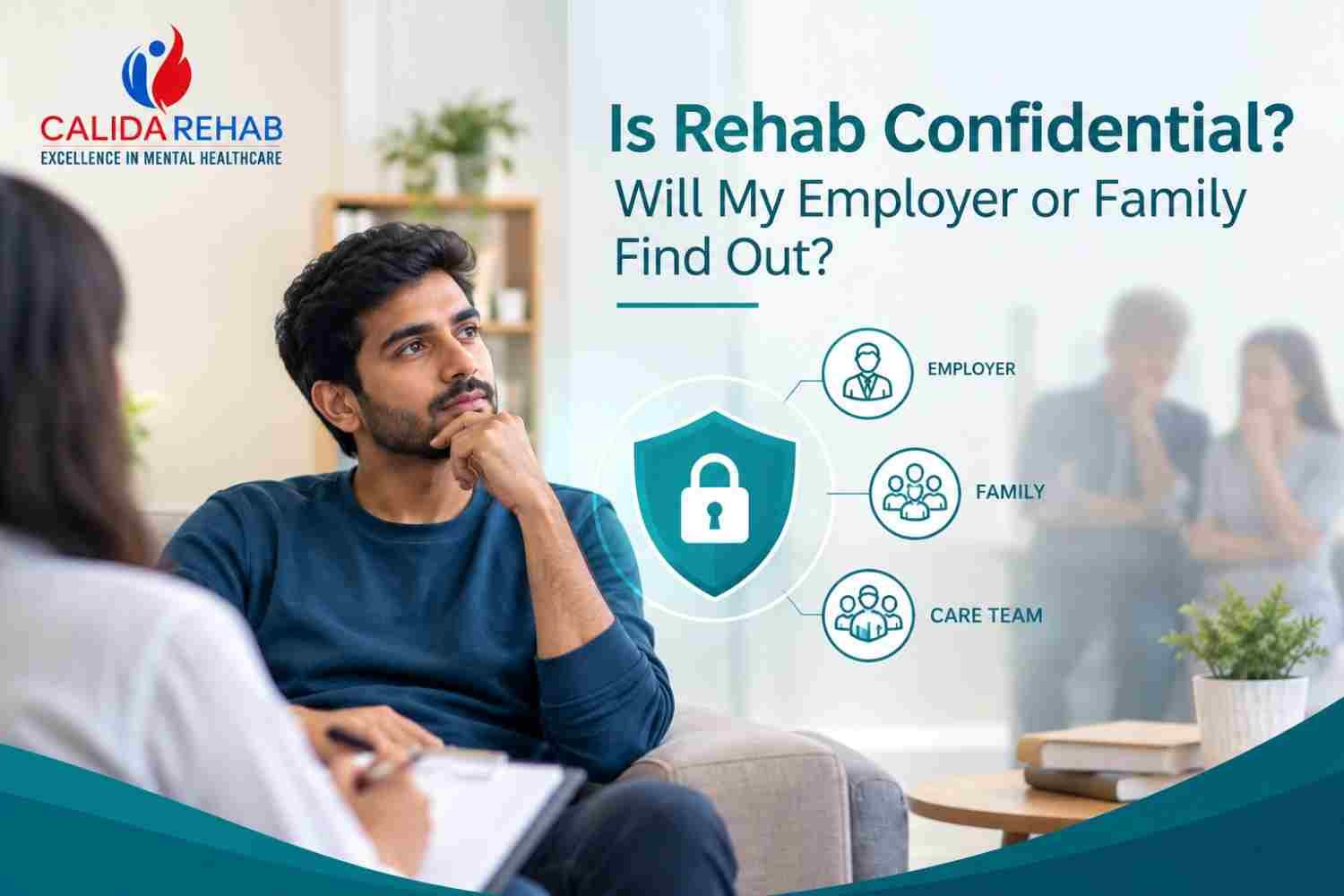

If you are thinking about rehab, the first fear is often not about the treatment. It is about who will know. Will the office hear about it? Will relatives, neighbours or the society WhatsApp group find out? Will it follow you into your next job?
These are fair questions, and the short answer is reassuring: rehab in India is confidential, and that confidentiality is backed by law. This guide explains what is protected, who can see your information, the few situations where it can be shared, and how to plan leave from work without exposing your diagnosis.
Yes. Under the Mental Healthcare Act, 2017, a patient being treated for alcohol or drug addiction has a legal right to confidentiality about their mental health, treatment and physical healthcare. Doctors, psychologists, counsellors and nurses must keep that information private. Your employer and family are told only if you agree, apart from a few narrow exceptions such as a court order or a threat to life.
- A registered rehab centre must keep your treatment private. The Mental Healthcare Act, 2017 gives you a right to confidentiality about your mental health, treatment and physical healthcare (Section 23).
- Your employer needs a reason for leave, not your diagnosis. You and your doctor control the wording of any medical certificate.
- Your family is told only if you agree, apart from narrow exceptions such as a nominated representative, a threat to life or a court order.
- Seeking treatment does not by itself start a police case. Section 64A of the NDPS Act can give immunity from prosecution in specific situations, so take legal advice if you have a case.
- Most privacy leaks come from paperwork, not doctors. Check bills, payment names, discharge papers and insurance claims before you are admitted.
Why the fear of being found out keeps people away from treatment
The worry about privacy is common, and it has a cost. The national survey on substance use carried out by AIIMS for the Ministry of Social Justice and Empowerment, published in 2019, found that about 14.6% of Indians aged 10 to 75 use alcohol, which is roughly 16 crore people. About 5.2% of the population, more than 5.7 crore people, needed help for alcohol-related problems. Yet only about 1 in 38 people with alcohol dependence reported getting any treatment, and only about 1 in 180 reported inpatient treatment.
Many things sit behind that gap. Cost, distance and not believing the problem is serious enough all play a part. So does the fear of what other people will think. A 2023 study of male patients with alcohol dependence at a private de-addiction centre in India, by researchers at AIIMS Gorakhpur, named affordability, feeling not serious enough to change and fear of what others might think among the most common barriers to seeking treatment.
Alcohol use in India: how many people get help?
National survey of 10 to 75-year-olds, by AIIMS for the Ministry of Social Justice and Empowerment, 2019
Any treatment: 1 in every 38 people with alcohol dependence (about 2.6%)
Inpatient treatment: 1 in every 180 people with alcohol dependence (about 0.6%)
Each square is one person with alcohol dependence. The dark square is the one person who reported getting treatment. Source: Magnitude of Substance Use in India, 2019 (Ministry of Social Justice and Empowerment and NDDTC, AIIMS).
Affordability and awareness take time to fix. Privacy is different, because a centre can answer it directly, with clear rules and a clear explanation of the law. The rest of this article shows what those rules look like.
What does the law say about confidentiality in rehab?
Addiction treatment in India comes under the Mental Healthcare Act, 2017. The Act’s definition of mental illness includes mental conditions linked to the abuse of alcohol and drugs, so a patient in a registered rehab centre has the same legal rights as a patient being treated for depression or schizophrenia.
Two sections matter most here.
- Section 23, right to confidentiality. A person with mental illness has the right to confidentiality about their mental health, mental healthcare, treatment and physical healthcare. Every health professional who provides care or treatment must keep the information they gather confidential, apart from a short list of exceptions.
- Section 24, restriction on release of information. No photograph or other information about a person undergoing treatment at a mental health establishment can be released to the media without that person’s consent. The same right of confidentiality applies to information stored in electronic or digital form.
In plain words, the duty sits with the psychiatrists, psychologists, counsellors and nurses treating you. It covers what you say in therapy, your diagnosis, your medicines, your test results and your records, on paper or on a computer. It does not depend on who is paying the bill.
Calida Rehab’s rehab centre in Mumbai works from an admissions office in Colaba and a residential centre in Karjat, which holds MSMHA Permanent Registration No. 60/2023. Assessment and treatment details are shared with family or employers only with the patient’s consent. Whichever centre you choose, you should be able to ask for the same assurance in writing.
Who can see your information, and who cannot
Who can see your treatment information
Adult patient in a registered centre. Based on Sections 23 and 24 of the Mental Healthcare Act, 2017.
Always: your care team
- Treating psychiatrist
- Psychologists and counsellors
- Nurses and medical staff
- Other doctors treating you, when they need it for your care
Only in narrow cases
- Your nominated representative, to carry out duties under the Act
- A person at risk of harm, with only the details needed
- Anyone, to prevent a threat to life, with only the details needed
- Courts, the Review Board or other competent authorities, by order
- Public safety and security
Not without your consent
- Your employer or HR
- Colleagues and friends
- Relatives who are not your nominated representative
- Neighbours and housing society
- The media, including photographs
Information about a person under treatment cannot be released to the media without their consent, and the right covers electronic records too.
The diagram sorts the people around you into three groups. Your care team needs the information to treat you safely. A small group, such as a court or your nominated representative, can receive information for specific reasons set by law. Everyone else, including your employer, colleagues, relatives, the media and your neighbours, gets nothing unless you agree.
When can a rehab centre share information without your consent?
Section 23(2) of the Act lists the situations. In everyday language:
- Your nominated representative. The person you have named can receive the information they need to carry out their duties under the Act.
- Other doctors involved in your care. A psychiatrist can share what another doctor needs to treat you safely, for example if you are admitted to a hospital for a medical problem.
- Danger to another person. Information can be released if it is necessary to protect someone else from harm or violence, and only the information needed for that purpose.
- Threat to life. Only the information necessary to prevent a threat to life can be released.
- Legal orders. A Mental Health Review Board, the Central Authority, a High Court, the Supreme Court or another competent authority can order disclosure.
- Public safety and security. Information can be released in the interests of public safety and security.
Three things are worth noticing about this list. The exceptions are narrow and each one is tied to a purpose. Several of them limit the release to only what is necessary, so a full medical file is not meant to be handed over for a limited reason. And none of them mention employers, relatives, friends or colleagues asking out of concern or curiosity. Those requests need your consent.
Will I be reported to the police if I go to rehab?
This is the fear behind many silent delays, especially for people who use drugs. Possession and consumption of certain substances are offences under the Narcotic Drugs and Psychotropic Substances (NDPS) Act, 1985, so it is natural to wonder whether asking for help could lead to a case.
A registered rehab centre is a medical facility. Its job is treatment, and the confidentiality duty in Section 23 of the Mental Healthcare Act applies to it in the same way as it applies to any other mental health service. Information goes out without your consent only in the narrow situations described above, such as a court order or a serious threat to life.
The law also has a provision that works in favour of people who seek treatment. Section 64A of the NDPS Act gives immunity from prosecution to an addict who is charged with consumption, or with an offence involving a small quantity of a narcotic drug or psychotropic substance, if the person voluntarily seeks and undergoes de-addiction treatment at a hospital or institution maintained or recognised by the Government or a local authority. The immunity can be withdrawn if the person does not complete the treatment. The Indian legal-rights group Nyaaya explains the provision in a plain-language explainer.
Before relying on it, keep these limits in mind:
- It is not blanket protection. It covers consumption and small-quantity cases, not large or commercial quantities.
- The treatment must be completed. If a person leaves early, the immunity can be withdrawn.
- The institution must be maintained or recognised by the Government or a local authority. Registration under the Mental Healthcare Act and recognition under the NDPS Act are not the same thing, so ask a lawyer whether a particular centre qualifies.
- Courts decide each case on its facts, and the rules for what counts as a small quantity depend on the substance.
If you already have a case pending, or fear one, speak to a lawyer first and then to the centre. Do not hold back information from your doctor out of fear. The team needs to know exactly what you have used, and how much, to manage withdrawal safely, and what you tell them for treatment is covered by the confidentiality rules above.
Will my employer find out I am in rehab?
Not through the centre, unless you allow it. Your employer is not on the list of people who can receive information about you without consent, so a centre that follows the Act will not confirm your admission, your diagnosis or your treatment to HR or a manager who phones to ask.
What your employer does need is a reason for your absence. That is a leave question, not a medical-records question, and you have more control over it than most people assume.
| What an employer may reasonably ask for | What stays private |
|---|---|
| A leave application with dates | Your diagnosis and the substance involved |
| A medical certificate from a registered doctor | Therapy notes and what you say in sessions |
| A fitness-to-resume note, if the policy requires one | Your medicines, test results and treatment plan |
| An emergency contact number | Other patients’ names and what they share in group |
| Clarification of leave policy from HR | Your records, unless you consent or a legal order requires release |
The wording of the certificate is the part to plan. A common approach is to ask the treating doctor to state only that you are under medical treatment and advised leave for specific dates. Whether your employer accepts that depends on its own policy, so check your leave rules or speak to HR before admission. If your company has an employee assistance programme or a confidential HR contact, that is often the safest first conversation.
Planning leave for rehab: five steps
A sequence that keeps your diagnosis out of the workplace
- Read the leave policyCheck leave types, notice period and certificate rules.
- Plan the certificateTalk to the treating doctor about honest, minimal wording.
- Decide who needs to knowHR only, a manager, or nobody beyond the leave form.
- Apply in writingKeep copies of the application and approval safely.
- Plan your returnAgree a return date, workload and follow-up visits.
A few practical points that people overlook:
- Group health insurance. If you claim through your employer’s group policy, the insurer will usually receive the diagnosis for the claim. Ask HR or the insurer in advance who can see claim details, and decide whether to claim through the group policy or pay yourself and reimburse later.
- Length of leave. Programmes are usually planned at 30, 60 or 90 days depending on the assessment. Work out what leave you can take, and how, before you fix an admission date.
- What colleagues are told. If you work in a team, agree on a short, true and limited line before your first day, such as “I am on medical leave and will be back on this date.” That is enough.
- No false papers. A forged or altered certificate creates a bigger problem than the one you are trying to avoid. Work with the doctor on honest, minimal wording.
You do not owe colleagues an explanation. Whether to tell your manager is your decision, and the treatment stays private either way.
Will my family find out?
If you are an adult and you admit yourself voluntarily, you decide who is told. In practice, three things often bring family in.
First, admission itself. Many families are part of the decision, the paperwork and the payment. If a relative is paying or travelling with you, they will know.
Second, absence. A person who disappears for 30 to 90 days without a word causes worry, and sometimes a missing-person complaint. Telling one trusted person, such as a sibling, a close friend or a spouse, protects your privacy better than silence does.
Third, support. Family involvement is a normal part of good addiction care, because recovery at home depends on the people at home.
You can keep control with a few simple steps:
- Give the centre a written list of the people it may speak to, and what each of them may be told.
- Name a nominated representative you trust. This is the person the team can share information with when it is needed for your care.
- Ask what staff will say if someone outside the list phones. A sensible answer is that staff neither confirm nor deny that you are a patient.
- Decide in advance whether you want visits, and from whom. The Act gives an admitted patient the right to refuse or receive visitors.
If the patient is under 18, the picture is different, because parents or legal guardians take part in decisions for a minor. If a patient is in medical danger, or too unwell from severe withdrawal to make decisions, the team may need to contact family or an emergency contact. That falls under the narrow exceptions above and is done for safety, not to expose you.
What about photos, social media and the press?
Section 24 says information about a person under treatment cannot be released to the media without their consent, and it extends the right of confidentiality to electronic data. For daily life in rehab, that has three practical meanings.
- Ask whether the centre allows phones and cameras, and what the rule is on photographing other patients. Your privacy depends partly on theirs.
- Ask how the centre uses patient stories, photographs or video testimonials. Anything that identifies a patient should be published only with that patient’s written consent.
- Ask how your records are stored and who inside the centre can open them.
It is also reasonable to ask the centre to keep your name off any list or notice that visitors can see.
Bills, payments and phone records: the paper trail
Privacy rarely breaks because of a doctor. It breaks because of paperwork, phone screens and shared devices. Before admission, check these five places:
- Payments. A bank statement or UPI history shows the name of the payee. Ask what name will appear on the receipt and on the payment, and choose a payment method that you control. Never ask a centre to issue a false receipt.
- Invoices and discharge papers. These can carry a diagnosis. Ask who they will be addressed to and whether you can collect them yourself. Under Section 25 of the Mental Healthcare Act, you have a right to access your own medical records.
- Insurance claims. A claim usually means the insurer sees the diagnosis, and a group policy can mean your employer’s HR team handles the paperwork. Ask who can see claim details before you file.
- Phone and messages. Agree how the team will contact you after discharge. Check how the number appears on your caller ID and whether messages will show on a lock screen that others can see.
- Shared devices and accounts. A family laptop, a shared email address or an automatic photo backup can reveal appointment emails or reports. Use your own device and account for anything related to your treatment.
A good centre will explain its answers on all five points and put them in writing if you ask.
What to say: sample wording for work and family
Having a short, true and calm line ready removes most of the stress. These are examples to adapt, not scripts to memorise.
For your employer or HR
“I need to take medical leave from [date] to [date] for planned treatment. I will submit the medical certificate through HR. [Name] will cover my work, and I can be reached only for urgent matters.” You owe your employer a reason for leave and a certificate, not a diagnosis. If someone asks for more, “it is a private medical matter” is true and enough.
For a spouse, parent or sibling
“I have decided to get treatment for my drinking (or drug use). I will be at a registered centre from [date] to [date]. I would like you to be my contact. Please do not share this with others, and if anyone asks, say I am away for medical treatment.” Choosing one trusted person, and being clear about what they may say, protects your privacy better than saying nothing at all.
For friends, neighbours and the wider circle
“I will be away for a few weeks for medical treatment and I will be back on [date].” You do not need to say more.
Keep it truthful. A made-up story or a forged certificate creates a bigger risk than the one you are trying to avoid, and it can cost you trust when you most need it.
Eight questions to ask any rehab centre about privacy
Use this checklist before you pay an advance, and put the same questions to any centre you are considering, including our rehabilitation centre in Mumbai and our rehab centre in Pune. A good centre will answer clearly, and in writing if you ask.
| Question | What a good answer sounds like |
|---|---|
| Is the centre registered with the Maharashtra State Mental Health Authority? | A registration number and certificate you can check, not a verbal assurance. |
| Who will be told about my admission? | Only the people you name, recorded on a consent form. |
| What do staff say if someone phones and asks whether I am a patient? | They neither confirm nor deny, unless the caller is on your approved list. |
| Can my employer or relatives get my records? | Not without your written consent or a legal order. |
| How are my records stored? | A clear answer on paper files and computer systems, and who has access. |
| How is privacy kept in group therapy? | A rule that what is said in the room stays in the room, explained to every patient. |
| How are photographs, video and testimonials handled? | Written consent for any use, and nothing identifying without it. |
| What will my bill and discharge papers say? | Wording you can see and discuss before admission, so you can plan for HR or insurance. |
What to do next
If privacy is the only thing holding you back, ask these questions now, before you decide anything. A confidential first conversation commits you to nothing.
Families and patients in the city can read how assessment, admission and treatment are organised at our rehabilitation centre in Mumbai, or call +91 84529 40789 (Karjat, Mumbai region). If Pune is closer to you, you can have the same confidential first conversation at our Pune rehabilitation centre on +91 74991 74304. Just ask for a confidential conversation at either centre. If you are the family member reading this, remember that an adult decides for themselves. The most useful thing you can offer is a calm, private conversation and the assurance that the information will stay with the people who need it.
Frequently asked questions
Is rehab confidential in India?
Yes. Under the Mental Healthcare Act, 2017, a person receiving mental healthcare, including treatment for alcohol or drug addiction, has the right to confidentiality about their mental health, treatment and physical healthcare. Health professionals must keep this information private, apart from narrow exceptions such as a court order or a threat to life.
Will my employer be told that I am in rehab?
Not by a registered centre, unless you consent. Your employer needs a reason for leave, not your diagnosis. Plan the wording of your medical certificate with your doctor and check your company’s leave policy before admission.
Can a rehab centre tell my family without my permission?
For an adult patient, the centre should share information with family only with your consent. The exceptions are narrow: a nominated representative carrying out their duties, a threat to life or harm to others, and legal orders. Give the centre a written list of the people it may speak to.
Can my family call the centre and get updates?
Only if you have agreed. Many patients allow one or two named relatives to receive regular updates, which keeps the family informed without exposing details to everyone else.
Will a medical certificate for rehab name addiction?
That depends on what you and your doctor agree and on what your employer requires. A common approach is a certificate that states only that the person is under medical treatment and needs leave for specific dates. Ask the treating doctor about the wording before admission, and do not accept a false or altered certificate.
Does confidentiality apply to outpatient counselling and online therapy?
Yes. The duty applies to all health professionals providing care or treatment to a person with mental illness, not only to residential centres.
What if I think a centre has broken my confidentiality?
Write to the head of the centre, describing what was shared, with whom and when. If the response is not satisfactory, you can complain to the Maharashtra State Mental Health Authority, which registers these centres, and you can take legal advice.
Will being in rehab affect my future jobs?
Your treatment records are not passed to employers or other agencies on their own. They are released only with your consent or under a legal order. Completing treatment is also one of the most reliable ways to protect your health and your work.
Will I be reported to the police if I go to rehab?
A registered rehab centre is a medical facility and is bound by the confidentiality rules of the Mental Healthcare Act, 2017. Seeking treatment does not by itself start a police case. Under Section 64A of the NDPS Act, an addict charged with consumption or a small-quantity offence can get immunity from prosecution after voluntarily completing treatment at a government-maintained or recognised institution. The immunity can be withdrawn if treatment is not completed. If you have a case, speak to a lawyer.
Will my bank statement or insurance claim reveal that I was in rehab?
It can. A bank or UPI statement shows the payee name, and an insurance claim usually carries the diagnosis. Ask the centre what name will appear on payments and receipts, and ask your insurer or HR who can see claim details, before you are admitted.
Related reading
- How to verify a rehab centre is licensed in Maharashtra
- Mental Healthcare Act 2017 and addiction treatment: a patient’s rights in rehab
- How to choose a rehabilitation centre in Mumbai: 12 questions to ask before admission
- What happens in the first week of rehab
- Is rehab free in India? Government de-addiction centres vs private rehab
- Rehabilitation centre in Mumbai: treatment, programmes and admission
- Rehabilitation centre in Pune: treatment, programmes and admission
- How to convince someone to go to rehab in India
Sources and editorial note
Legal reference: Mental Healthcare Act, 2017, Section 23 (right to confidentiality), Section 24 (restriction on release of information) and Section 25 (right to access medical records), summarised by Nyaaya. Narcotic Drugs and Psychotropic Substances Act, 1985, Section 64A (immunity from prosecution to addicts volunteering for treatment). Survey data: Magnitude of Substance Use in India, 2019, Ministry of Social Justice and Empowerment and the National Drug Dependence Treatment Centre, AIIMS. Barriers to treatment: Perceived stigma, self stigma and barriers to treatment in alcohol dependent individuals, European Psychiatry, volume 66, supplement 1, 2023.
This article is for general information. It is not legal or medical advice, and policies differ between centres, so confirm the details with the centre you are considering.
Published by Calida Rehab, which runs centres registered with the Maharashtra State Mental Health Authority in Karjat (serving Mumbai) and Pune. Last updated 30 October 2026.