
The stages of alcoholism describe how drinking slowly moves from occasional or risky use to dependence and, in the last stage, to serious damage to health. Doctors do not use one official stage chart, but most clinicians and rehab programmes work with five practical stages, from occasional binge drinking to end-stage alcohol dependence. The most dangerous complication is delirium tremens (DTs), a severe form of alcohol withdrawal that can cause confusion, hallucinations, seizures and death without hospital care.
This guide explains the 5 stages with warning signs for each, an 11-point self-check, delirium tremens symptoms and timeline, who is at risk, what to do in an emergency, and which treatment fits which stage. It is written for education and does not replace a doctor’s advice. If someone who drinks heavily has a seizure, is confused, sees things that are not there, or has a high fever and a racing heart after stopping alcohol, call 112 or 108 straight away.
Last updated: October 2026.
Key Takeaways
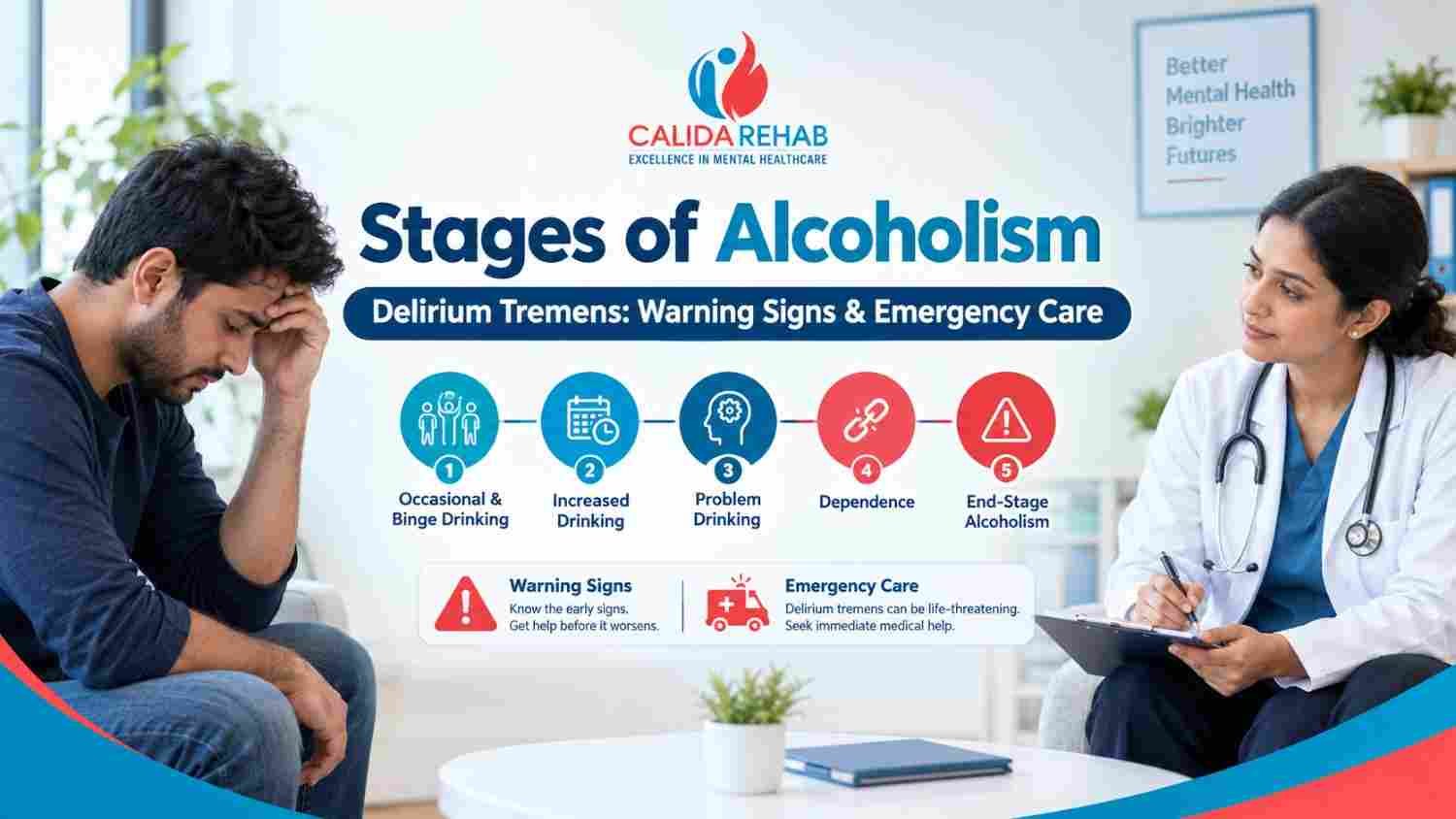
- Alcoholism is not one sudden event. It builds over months or years through five practical stages: occasional or binge drinking, increased drinking, problem drinking, dependence and end-stage alcoholism.
- Doctors diagnose alcohol use disorder as mild (2 to 3 criteria), moderate (4 to 5) or severe (6 or more) out of 11 criteria. You do not need to be a daily drinker to qualify.
- Delirium tremens is the most severe form of alcohol withdrawal. It usually begins 48 to 96 hours after the last drink, but can appear as late as 7 to 10 days later.
- DTs are a medical emergency. Quoted death rates for untreated cases range from about 15% to 40%, and are far lower with hospital treatment.
- Anyone who drinks heavily every day should not stop suddenly without medical advice. A supervised detox is the safe way to quit.
- India’s National Mental Health Survey (2015-16) found alcohol use disorders have the largest treatment gap of any mental disorder, at 86%. Help is available, and it works best when it starts early.
What Are the Stages of Alcoholism?
There is no single medical staging system for alcoholism. However, three frameworks help people understand where drinking can lead. The first is the Jellinek curve, described by E. M. Jellinek in the 1950s, which moves from a pre-alcoholic phase to prodromal, crucial and chronic phases. The second is the DSM-5, which grades alcohol use disorder as mild, moderate or severe. The third is the ICD-10 label of alcohol dependence syndrome, which is the one Indian psychiatrists use most often. Our guide on alcohol dependence syndrome and the post on ADS full form in psychiatry explain it in detail.
In everyday practice, the five stages below combine these ideas. A person may move forward, stay put for years, or step back with help. Not everyone passes through every stage in order.
| Stage | What it looks like | Main risk |
|---|---|---|
| 1. Occasional and binge drinking | Drinking at parties, weekends and festivals, sometimes to excess | Accidents, injuries, poor decisions |
| 2. Increased drinking | Drinking more often and in larger amounts, drinking to relax or cope | Rising tolerance, habit forming |
| 3. Problem drinking | Loss of control, lying, missed work, family conflict | Mild to moderate alcohol use disorder |
| 4. Alcohol dependence | Cravings, high tolerance, withdrawal when alcohol stops | Moderate to severe alcohol use disorder, withdrawal |
| 5. End-stage alcoholism | Drinking to avoid withdrawal, major organ damage | Cirrhosis, brain damage, seizures, delirium tremens |
Stage 1: Occasional and Binge Drinking
At this stage, drinking is social and irregular. Most people feel in control, and alcohol has not yet changed daily life. Even so, the pattern matters. The US National Institute on Alcohol Abuse and Alcoholism (NIAAA) defines binge drinking as a pattern that brings blood alcohol to 0.08%, which is typically 5 or more drinks for men and 4 or more for women within about 2 hours. A standard drink is roughly a 350 ml beer, a 150 ml glass of wine or 45 ml of spirits.
Warning signs
- Drinking mainly to get drunk rather than to socialise
- Blackouts or memory gaps after a night out
- Regular weekend binges, even if weekdays are dry
- Risky behaviour such as drink driving
Binge drinking can cause injury, alcohol poisoning and heart rhythm problems even in people who are not dependent. Read more in our post on binge drinking and its health risks.
Stage 2: Increased Drinking
Here, alcohol shifts from an occasional event to a habit. Drinking becomes more frequent, often after work or at home. The person starts using alcohol to relax, sleep, handle stress or feel confident. Meanwhile, tolerance begins to build, so the same amount no longer has the same effect.
Warning signs
- Needing more drinks to feel the same effect
- Drinking alone or hiding how much you drink
- Thinking about the next drink during the day
- Feeling irritable or low on days without alcohol
- Choosing events and friends based on whether alcohol will be there
This is the best time to cut down, because the brain has not yet fully adapted to alcohol. Our article on the effects of alcohol on the brain explains why tolerance and cravings grow.
Stage 3: Problem Drinking
At stage 3, alcohol starts causing visible harm. The person may promise to cut down and fail. Work, money and relationships begin to suffer. Family members often notice first, while the drinker explains it away.
Warning signs
- Missing work or college, or falling behind
- Lying about how much or where they drank
- Drinking in the morning or in risky situations
- Arguments at home about alcohol
- Money problems linked to drinking
- Continuing to drink despite health warnings from a doctor
Many people at this stage meet the criteria for mild to moderate alcohol use disorder. Counselling works well here. If you are worried about a loved one, our guide on how to convince someone to go to rehab offers practical steps.
Stage 4: Alcohol Dependence
Dependence means the brain and body have adapted to alcohol and now need it to feel normal. Two features define this stage: tolerance and withdrawal. The person drinks large amounts without looking drunk, and when alcohol stops, the body reacts with tremors, sweating, anxiety and poor sleep. Cravings are strong and hard to resist.
Warning signs
- Shaky hands, sweating or nausea in the morning that ease after a drink
- Drinking every day, often from early in the day
- Strong cravings and loss of control once drinking starts
- Giving up hobbies, friends and responsibilities
- Failed attempts to quit
At this stage, stopping suddenly can be dangerous. Always read our guide on alcohol withdrawal symptoms and timeline and speak to a doctor before you quit.
Stage 5: End-Stage Alcoholism
In the final stage, drinking continues mainly to avoid withdrawal, and the body shows long-term damage. Many people are physically unable to stop without hospital care. Sadly, this is also the stage with the highest risk of seizures and delirium tremens.
Possible complications
- Fatty liver, alcoholic hepatitis and cirrhosis
- Pancreatitis and stomach bleeding
- High blood pressure, heart muscle damage and irregular heartbeat. See does alcohol increase blood pressure
- Memory loss and nerve damage, including Wernicke-Korsakoff syndrome, which is linked to vitamin B1 (thiamine) deficiency
- Depression, anxiety and a higher risk of suicidal thoughts
- A higher risk of several cancers. Alcohol is classified as a Group 1 carcinogen by the International Agency for Research on Cancer
Even at this stage, recovery is possible. Treatment simply needs to start in a medical setting.
Which Stage Am I In? An 11-Point Self-Check
Doctors use 11 questions from the DSM-5 to grade alcohol use disorder. In the past 12 months, have you:
- Drunk more or for longer than you meant to?
- Wanted to cut down or tried to, without success?
- Spent a lot of time drinking or recovering from drinking?
- Felt strong cravings or urges to drink?
- Failed to meet duties at work, college or home because of alcohol?
- Kept drinking despite problems with family or friends?
- Given up activities you enjoyed because of drinking?
- Drunk in risky situations, such as before driving?
- Kept drinking despite a health or mental health problem it caused or worsened?
- Needed more alcohol to get the same effect (tolerance)?
- Had withdrawal symptoms, or drunk to relieve them?
Two or three yes answers suggest mild alcohol use disorder, four or five suggest moderate, and six or more suggest severe. This is a screening guide, not a diagnosis. Only a doctor or psychiatrist can confirm it. If you answered yes to question 11, speak to a doctor before you stop drinking.
What Is Delirium Tremens (DTs)?
Delirium tremens is the most severe form of alcohol withdrawal. It is a sudden and serious change in the brain and nervous system that happens when a person who has been drinking heavily for a long time stops or sharply cuts down. It causes confusion, hallucinations, shaking, a racing heart and sometimes seizures. MedlinePlus describes it as a medical emergency that can be life threatening.
Only a minority of people with alcohol withdrawal develop DTs. Figures of about 5% are commonly quoted. However, nobody can predict who will be affected, which is why heavy drinkers should detox under medical care. DTs are most likely in people with a long history of heavy drinking. Our alcohol withdrawal symptoms guide covers the milder symptoms that come before it.
Delirium Tremens Symptoms
DTs usually begin with ordinary withdrawal symptoms that then worsen quickly. Look for a mix of mental and physical changes.
- Sudden, severe confusion and disorientation, including not recognising family
- Seeing, hearing or feeling things that are not there, such as insects crawling on the skin
- Strong agitation, fear or a sense of impending doom
- Heavy sweating and body tremors
- Fever
- Fast heartbeat and high blood pressure
- Nightmares and severe insomnia, or a deep sleep lasting a day or longer
- Seizures
Symptoms can swing during the day. A person may seem clear in the morning and be severely confused by night.
Delirium Tremens Timeline: When Do DTs Start?
The timeline below is typical. However, every person is different, and the order is not always the same.
| Time after last drink | What may happen |
|---|---|
| 6 to 12 hours | Minor withdrawal: tremor, anxiety, sweating, nausea, headache, poor sleep |
| 12 to 48 hours | Withdrawal seizures can occur. Some people have alcoholic hallucinosis |
| 48 to 96 hours | Delirium tremens can begin: confusion, agitation, fever, fast heartbeat |
| Up to 7 to 10 days | DTs can still appear later, according to MedlinePlus |
DTs usually last a few days. Some sources report up to five days, while others describe severe withdrawal lasting up to 10 days. During that time, the person needs constant medical monitoring.
Delirium Tremens vs Alcohol Hallucinosis vs Simple Withdrawal
People often mix these up. The key difference is how clear the person’s thinking is.
| Feature | Simple withdrawal | Alcoholic hallucinosis | Delirium tremens |
|---|---|---|---|
| Typical start | 6 to 12 hours | 12 to 48 hours | 48 to 96 hours |
| Awareness | Clear | Usually clear | Confused and disoriented |
| Main signs | Tremor, anxiety, sweating | Hallucinations | Hallucinations, confusion, fever, racing heart |
| Danger level | Mild to moderate | Moderate | Life threatening |
Who Is at Higher Risk of Delirium Tremens?
The risk is higher in people who:
- Have drunk heavily for many years. MedlinePlus notes it is common in those who have used alcohol for more than 10 years
- Have had withdrawal seizures or DTs before
- Are older
- Have liver disease, infection, a head injury or another serious illness
- Are poorly nourished or dehydrated
- Have also been using sedatives or sleeping pills
- Quit suddenly after long daily drinking
Note that a head injury, infection or illness can also trigger DTs in people with a history of heavy drinking, even before they try to quit.
Can Delirium Tremens Kill You?
Yes. Without treatment, DTs can cause fatal complications such as seizures, heart rhythm problems, very high temperature, dehydration and injury from confusion. Quoted death rates for untreated cases vary widely between sources, from about 15% to as high as 40%. With early hospital care, the risk falls sharply. Some sources put it at around 5% or lower for treated patients. The takeaway is simple: do not wait to see if it settles.
What to Do If Someone Has Delirium Tremens Symptoms
Call 112 or 108 immediately. Then, while waiting for help:
- Stay with the person. Do not leave them alone
- Keep the room quiet, calm and well lit, and speak in a steady voice
- If they have a seizure, move hard objects away, lay them on their side and never put anything in their mouth
- Do not give more alcohol, and do not give sleeping pills or anyone else’s medicines
- Do not restrain them unless it is needed to prevent harm
- Tell the doctors when the last drink was, how much the person usually drinks, any medicines and any past seizures or DTs
How Delirium Tremens Is Treated
Treatment happens in a hospital, often in an intensive care unit for the first days. Doctors usually:
- Give benzodiazepines under close monitoring to calm the nervous system and prevent seizures
- Give thiamine (vitamin B1) and other vitamins, because deficiency can damage the brain
- Replace fluids and correct low salts such as potassium and magnesium
- Monitor heart rate, blood pressure, temperature and oxygen
- Treat infections, injuries or liver problems that may be present
Doses are decided by the treating doctor. Never take leftover sedatives to manage withdrawal on your own, because the wrong dose can be dangerous.
How to Prevent Delirium Tremens
The best prevention is a planned, medically supervised detox. If you drink heavily every day, or have had seizures or hallucinations before, do not quit abruptly at home.
- See a doctor first so your risk can be assessed
- Ask about a supervised detox, either in hospital or at a rehab centre with medical staff
- Do not rely on cutting down at home, herbal remedies or home detox kits
- Eat regular meals, drink fluids and take thiamine only as your doctor advises
- Plan for what comes after detox, because the first week is only the start
Our guide on how to stop drinking alcohol safely explains who can quit at home and who needs supervision. You can also read about the detoxification programme at Calida Rehab.
Treatment for Each Stage of Alcoholism
The right help depends on the stage. Earlier treatment is simpler, cheaper and safer.
| Stage | What usually helps |
|---|---|
| 1. Occasional and binge | Honest self-review, limits, avoiding binges, brief advice from a doctor |
| 2. Increased drinking | Tracking intake, counselling, motivational interviewing |
| 3. Problem drinking | Counselling, cognitive behavioural therapy, family involvement, doctor review |
| 4. Dependence | Medically supervised detox, then residential rehab and relapse prevention |
| 5. End-stage | Hospital-level care first, then long-term rehab and treatment of liver and brain complications |
From stage 4 onwards, a residential setting is the safest choice, because detox and the first weeks of recovery need round-the-clock medical supervision. If you are in or near the city, a rehabilitation centre in Mumbai or a rehabilitation centre in Pune can arrange detox, therapy and relapse-prevention support under one roof.
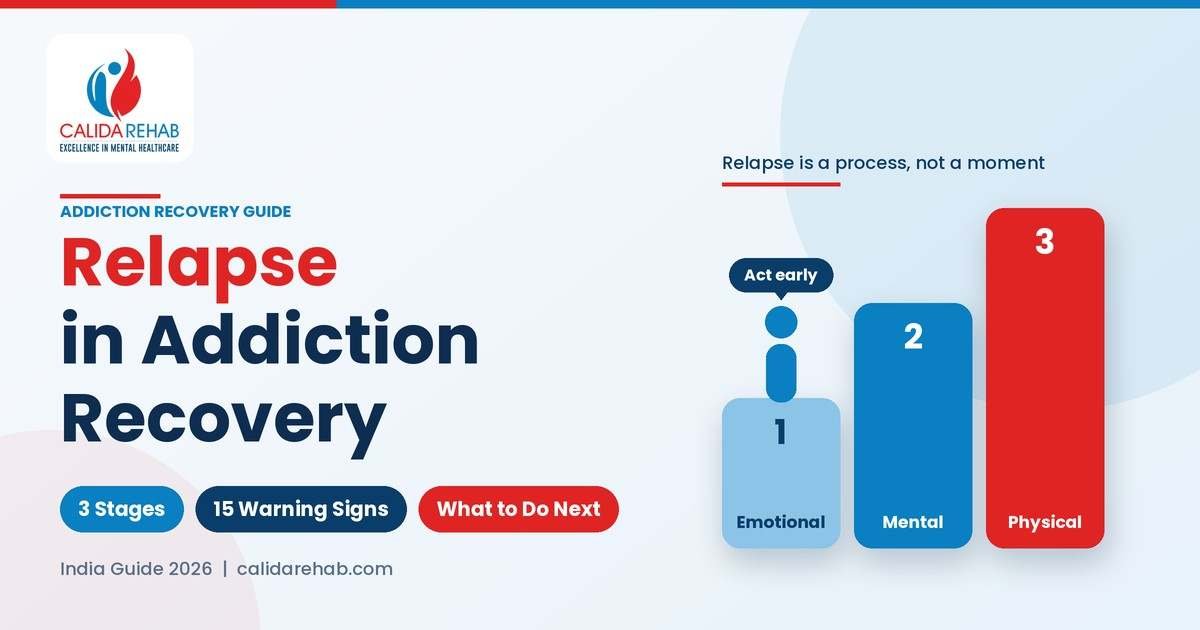
After detox, doctors may prescribe medicines that reduce cravings or support abstinence, such as naltrexone, acamprosate or disulfiram. These are used only under medical supervision. Therapy is just as important. Approaches such as relapse prevention therapy and family therapy help people stay sober and rebuild trust. Because slips are common, also read our guide to relapse in addiction recovery.
Alcohol Addiction Treatment in Mumbai, Pune and Nearby
India has a large treatment gap. The National Mental Health Survey of India 2015-16, led by NIMHANS, found that alcohol use disorders have the highest treatment gap of all mental disorders at 86%. In other words, most people who need help never get it.
If you need to talk to someone first, the government’s Tele-MANAS helpline is free and open 24 hours at 14416 or 1800-891-4416, in around 20 languages.
Calida Rehab offers medically supervised care for alcohol addiction, from detox to long-term recovery. You can read about our programmes for alcohol addiction treatment, or find a centre near you:
- Alcohol rehab centre in Mumbai
- Alcohol rehabilitation centre in Kalyan
- Alcohol rehabilitation centre in Badlapur
Calida Rehab runs residential programmes for alcohol dependence at its Mumbai rehabilitation centre and its Pune rehabilitation centre, so families do not have to travel far for a safe, supervised detox.
Wondering about fees? See how much an alcohol de-addiction programme in Mumbai costs.
Patients also have legal rights during treatment, explained in our post on the Mental Healthcare Act 2017 and addiction treatment.
To see what recovery can look like, read a real alcoholism case study.
How Families Can Help
Families often see the stages long before the drinker admits a problem. Speak when the person is sober and calm, describe specific events rather than labelling them, and avoid shouting or threats. Do not cover up for the drinking or pay its costs, because that can delay treatment. Most importantly, learn the emergency signs above so you can act quickly if withdrawal turns dangerous.
Frequently Asked Questions
What are the stages of alcoholism?
Doctors do not use one official chart, but five practical stages are widely used: occasional and binge drinking, increased drinking, problem drinking, alcohol dependence and end-stage alcoholism. Formally, doctors grade alcohol use disorder as mild, moderate or severe using 11 criteria.
What are the 3 stages of alcohol withdrawal?
Withdrawal is often described in three stages. Minor symptoms such as tremor and anxiety start 6 to 12 hours after the last drink. Seizures and hallucinations can follow at 12 to 48 hours. Delirium tremens, the most severe stage, usually begins 48 to 96 hours after the last drink.
What is delirium tremens?
Delirium tremens is the most severe form of alcohol withdrawal. It causes sudden confusion, hallucinations, tremors, fever, fast heartbeat and sometimes seizures in people who stop or cut down heavy drinking. It is a medical emergency that needs hospital treatment.
How long after stopping alcohol do DTs start?
DTs most often start 48 to 96 hours after the last drink. In some people they appear later, up to 7 to 10 days after the last drink, so the risk does not end after the first few days.
What are the symptoms of delirium tremens?
Symptoms include severe confusion, hallucinations, agitation, heavy sweating, body tremors, fever, fast heartbeat, high blood pressure, nightmares or severe insomnia, and sometimes seizures. Symptoms can change quickly during the day.
Can delirium tremens be fatal?
Yes. Without treatment it can be fatal, and quoted death rates for untreated cases range from about 15% to 40%. With prompt hospital care, the risk is much lower. Call 112 or 108 at the first signs.
Can you get DTs if you only drink on weekends?
DTs are rare without long-term heavy drinking, but binge drinkers can still have withdrawal symptoms such as shaking, anxiety and poor sleep. Anyone who has had seizures or hallucinations after stopping alcohol should see a doctor before drinking again.
Is it safe to stop drinking at home?
If you drink heavily every day, it is not safe to stop suddenly at home. Withdrawal can cause seizures and delirium tremens. See a doctor first and plan a medically supervised detox. Light or occasional drinkers face a much lower risk but should still seek advice if symptoms appear.
Can alcoholism be cured?
Alcohol use disorder is a treatable long-term condition. Many people recover and stay sober with detox, therapy, medicines and family support. Relapse can happen, so ongoing support matters. It is not a sign that treatment has failed.
The Bottom Line
Alcoholism develops in stages, and each stage is a chance to change course. The earlier help starts, the easier recovery is. Delirium tremens is the clearest reminder that quitting heavy drinking is a medical decision, not a test of willpower. If you or someone you love is drinking heavily, speak to a doctor about a supervised detox. Calida Rehab can guide you through medically supervised treatment in Mumbai, Pune, Thane and Navi Mumbai.
Related Reading
- Alcohol Withdrawal Symptoms: timeline, dangers and safe treatment
- How to Stop Drinking Alcohol: a doctor-guided plan for India
- Alcohol Dependence Syndrome: early warning signs and recovery options
- Binge Drinking: effects and risks
- What alcohol does to your brain
- Alcoholics Anonymous (AA): 12 steps and how it works
- Relapse in Addiction Recovery: stages and warning signs
- Detoxification at Calida Rehab