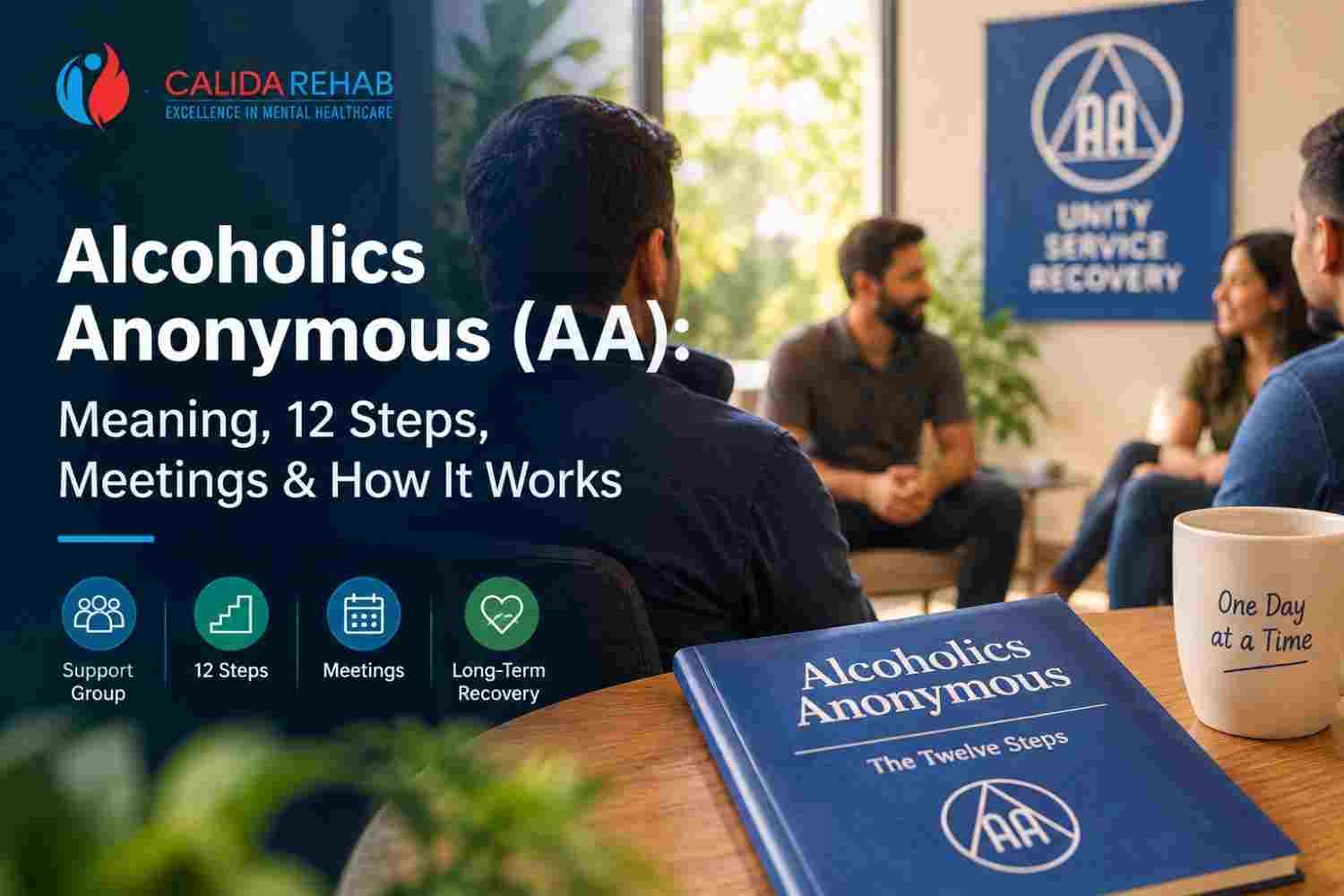

Alcoholics Anonymous (AA) is one of the most widely recognised peer-support programs for people who want to recover from alcohol addiction. In fact, millions of people across the world — including a growing number in India — attend AA meetings as part of their recovery journey, either on their own or alongside professional treatment.
So, what exactly is Alcoholics Anonymous, and how does it work? In this guide, we cover what Alcoholics Anonymous means, how the 12 Steps work, what actually happens in an AA meeting, how Alcoholics Anonymous compares to a professional rehab program, and where to find support in Mumbai and Pune.
Note: AA can be a valuable support system, but it is not a substitute for medical detox or clinical treatment in cases of severe alcohol dependence. Combining professional rehab care with peer support like AA often gives the best long-term outcome.
What Is Alcoholics Anonymous?
Alcoholics Anonymous is a global fellowship of men and women who have had a drinking problem. It was founded in 1935 in Akron, Ohio, by Bill Wilson and Dr. Bob Smith, two men who found that talking to each other about their own struggle with alcohol helped them stay sober.
AA is not a medical treatment, a hospital program, or a religious organisation. It is a free, self-supporting, peer-led group where members share their experience, strength, and hope with each other to solve their common problem of alcoholism, as described on the official Alcoholics Anonymous website.
Key facts about AA:
- Founded: 1935, United States
- Membership: Open to anyone with a desire to stop drinking
- Cost: Free (voluntary donations only)
- Format: In-person and online meetings
- Core method: The 12 Steps and 12 Traditions
- Anonymity: Members are identified only by first name
How Does Alcoholics Anonymous Work?
AA works on the principle that people who have gone through the same struggle with alcohol can support each other in ways that others cannot. Meetings usually involve members sitting together and sharing their personal experiences with alcohol — the problems it caused, how they realised they needed help, and how they are working toward staying sober.
There is no doctor, therapist, or formal instructor running the session. Instead, meetings are peer-led, often by a member who has been sober for a period of time and volunteers to chair the meeting.
The program is built around two documents:
- The 12 Steps – a set of guiding principles for personal recovery
- The 12 Traditions – guidelines for how AA groups should function
The 12 Steps of Alcoholics Anonymous
The 12 Steps form the heart of the AA program. Members generally follow them in order, often guided by a “sponsor” — a more experienced AA member who mentors a newer member through the steps.
| Step | Core Idea |
|---|---|
| 1 | Admitting powerlessness over alcohol |
| 2 | Believing a higher power can restore sanity |
| 3 | Deciding to turn one’s will over to that higher power |
| 4 | Making a searching moral inventory of oneself |
| 5 | Admitting wrongs to oneself, a higher power, and another person |
| 6 | Becoming ready to have these defects removed |
| 7 | Humbly asking for shortcomings to be removed |
| 8 | Listing people harmed and becoming willing to make amends |
| 9 | Making direct amends wherever possible |
| 10 | Continuing self-inventory and admitting wrongs promptly |
| 11 | Seeking growth through prayer or meditation |
| 12 | Carrying the message to other alcoholics |
Important Snippet: The 12 Steps are a structured, self-reflective process — not a religious requirement. Many non-religious members interpret “higher power” as their group, nature, or their own inner values.
What Happens in an AA Meeting?
Many people considering AA for the first time want to know what an actual meeting looks like. Broadly, AA meetings fall into two types:
- Open meetings – anyone can attend, including family members, friends, or students researching addiction
- Closed meetings – only for people who identify as having a drinking problem
A typical meeting includes:
- A welcome and reading of the AA preamble
- Members introducing themselves by first name only (“Hi, I’m [Name], and I’m an alcoholic”)
- Sharing of personal experiences related to drinking and recovery
- Discussion of a step, tradition, or recovery-related topic
- Closing, often with a group prayer or statement
Meetings typically last 60–90 minutes and are held in community halls, hospitals, religious spaces, or online via video call.
AA Meetings in India (Mumbai & Pune)
AA has an active presence across major Indian cities, including Mumbai and Pune, with both in-person and online meeting options. However, AA meetings are unsupervised peer groups with no medical staff on site — they cannot assess withdrawal risk, prescribe medication, or manage complications during early recovery.
If you or a loved one is looking for structured support in addition to AA meetings, a professional rehabilitation centre can help manage withdrawal safely and address any underlying mental health concerns. Calida Rehab’s alcohol rehab centre in Mumbai and alcohol rehabilitation centre in Pune offer medically supervised detox and therapy alongside peer-support recommendations like AA.
Alcoholics Anonymous vs Professional Rehab: What’s the Difference?
A common question is whether someone should join AA, go to rehab, or do both. The table below breaks down the key differences.
| Feature | Alcoholics Anonymous (AA) | Professional Rehab |
|---|---|---|
| Cost | Free | Paid (varies by facility) |
| Medical supervision | No | Yes |
| Detox support | No | Yes, medically managed |
| Format | Peer-led group meetings | Structured clinical program |
| Duration | Ongoing, lifelong support | Fixed program (weeks to months) |
| Best suited for | Ongoing support, relapse prevention | Severe dependence, withdrawal risk |
| Professional therapy | Not included | Included (CBT, counselling, etc.) |
| Family involvement | Informal | Structured family therapy |
Expert Insight: AA is designed as ongoing peer support, not as a treatment for the underlying causes of addiction. Alcohol dependence is a medical condition, and unmanaged withdrawal can be dangerous or even life-threatening. This is why doctors typically recommend a medically supervised program — including safe detox, Cognitive Behavioural Therapy, and family therapy — as the foundation of recovery, with AA used alongside it for long-term relapse prevention rather than as a starting point on its own.
Alcoholics Anonymous vs Narcotics Anonymous (NA): What’s the Difference?
People often confuse AA with Narcotics Anonymous (NA). Both follow the same 12-Step model, but they serve different groups.
| Feature | AA | NA |
|---|---|---|
| Focus | Alcohol addiction | Drug addiction (all substances) |
| Founded | 1935 | 1953 |
| Steps used | 12 Steps of AA | 12 Steps of NA (adapted from AA) |
| Membership | Anyone with a drinking problem | Anyone with a drug problem |
Benefits of Attending AA Meetings
- Provides a free, judgement-free space to talk about drinking problems
- Reduces feelings of isolation through shared experience
- Offers a sponsor system for one-on-one accountability
- Encourages long-term, ongoing support beyond a treatment program
- Available in almost every city, with flexible meeting times
- Online meeting options make it accessible from anywhere
Why AA Alone Is Not Enough for Real Recovery
AA is a support group, not a treatment provider — and this distinction matters more than most people realise. Because AA meetings are run entirely by volunteers with no clinical training, they come with real gaps that can put someone’s recovery, or even their safety, at risk:
- No medical supervision: alcohol withdrawal can cause seizures and other dangerous complications that a peer group is not equipped to handle
- No clinical diagnosis: AA cannot identify how severe a person’s dependence actually is, which means high-risk cases often go unrecognised
- No mental health treatment: co-occurring conditions like depression or anxiety, which drive a large share of relapses, are not addressed at all
- No structured accountability: attendance is entirely voluntary, so there is nothing to stop someone from quietly dropping out during a vulnerable phase
- No family or relationship support: addiction affects the whole household, but AA has no structured process to repair or involve family
This is why doctors and addiction specialists consistently recommend that AA be used alongside — never instead of — a medically supervised program. A licensed rehab addresses the physical, psychological, and family dimensions of addiction that a peer-support meeting simply is not designed to cover.
Myths vs Facts About Alcoholics Anonymous
| Myth | Fact |
|---|---|
| AA is a religious cult | AA is not affiliated with any religion; “higher power” is interpreted individually |
| AA is only for severe alcoholics | Anyone with a desire to stop drinking can attend, regardless of severity |
| You have to speak at meetings | Members can attend and simply listen (“sit in the back”) |
| AA replaces medical treatment | AA is a support system, not a medical or clinical treatment |
| AA meetings cost money | AA meetings are free; donations are voluntary |
| There is no support once you stop attending | Many members stay lifelong for ongoing relapse-prevention support |
Who Should Consider Alcoholics Anonymous?
AA is best used as ongoing, add-on support rather than a first step. It can be useful for:
- People who recognise a drinking problem and want peer support
- Those who have completed rehab and need continued relapse-prevention support
- Family members wanting to understand addiction better (via open meetings)
- Anyone looking for a free, flexible, community-based recovery option
However, if there are signs of severe physical dependence — such as withdrawal symptoms (tremors, seizures, severe anxiety) when not drinking — medical evaluation and possibly supervised detoxification should come first.
Frequently Asked Questions (FAQs)
What is Alcoholics Anonymous (AA)?
AA is a free, peer-led support group for people who want to stop drinking, based on a 12-Step recovery program.
Is Alcoholics Anonymous free?
Yes. AA meetings are free to attend; groups run on voluntary member donations only.
Do I have to be religious to join AA?
No. While the 12 Steps mention a “higher power,” AA is not tied to any specific religion, and many members interpret this concept in a non-religious way.
How do I find an AA meeting in Mumbai or Pune?
AA groups hold regular in-person and online meetings in most major Indian cities, including Mumbai and Pune. Local AA intergroup contacts and online directories list current meeting schedules.
Is AA enough to treat alcohol addiction?
No. AA offers valuable peer support, but it is not a medical treatment and has no clinical or diagnostic component. Even drinking that feels “mild” can mask an underlying alcohol dependence that needs proper evaluation. A doctor-led assessment and structured rehab program address the physical and psychological roots of addiction, while AA works best as continued support after that foundation is in place.
What is the difference between AA and rehab?
AA is a free, peer-support group with no medical component. Rehab is a paid, medically supervised program that includes detox, therapy, and structured treatment.
Can family members attend AA meetings?
Yes, but only “open” AA meetings. “Closed” meetings are reserved for people who identify as having a drinking problem. Family members looking for their own support can also look into Al-Anon, a related fellowship for families of alcoholics.
Getting Help Beyond AA
If drinking has started to affect your health, relationships, or daily life, peer support alone may not be enough. Calida Rehab offers medically supervised detox, therapy, and structured alcohol addiction treatment programs in Mumbai and Pune, designed to work alongside — not replace — community support systems like AA.
You may also find our related article on AA Slogans Explained helpful for understanding common phrases used in meetings.