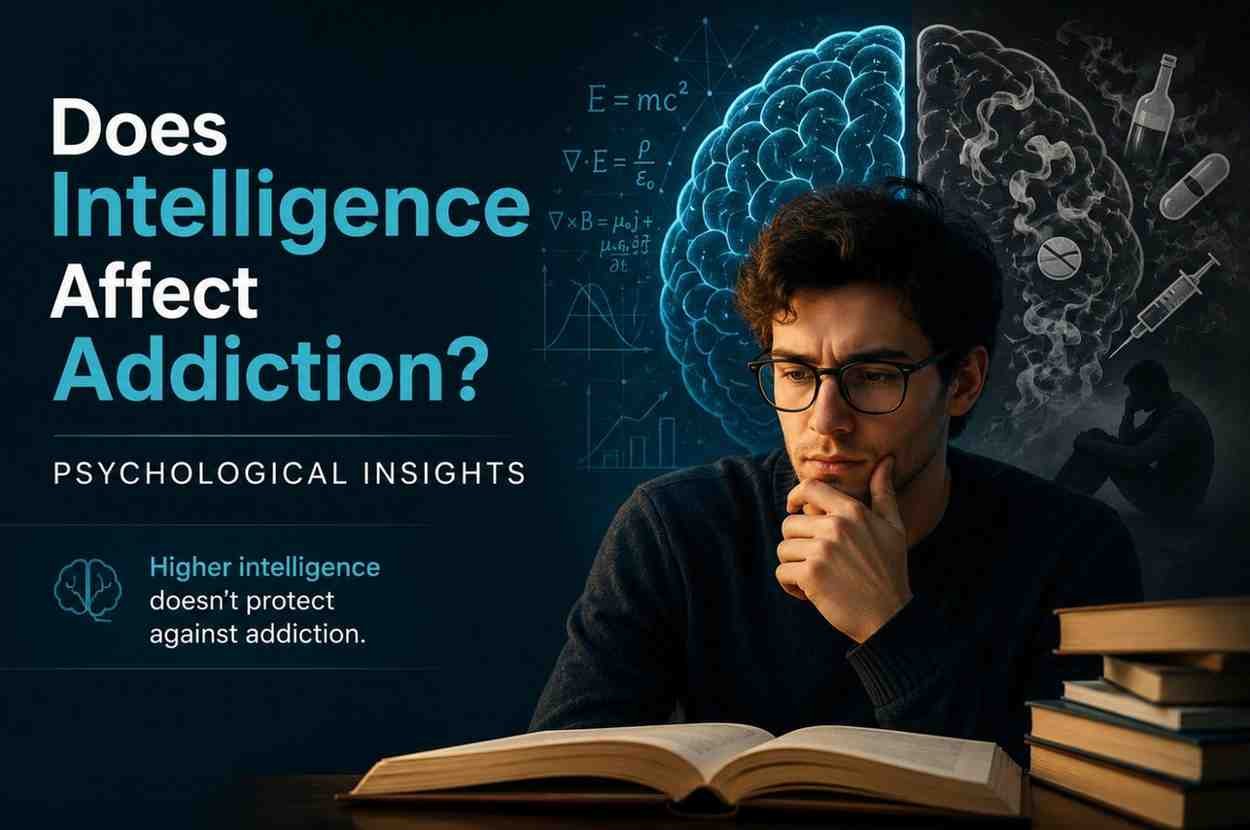

Higher intelligence doesn’t protect against addiction. In some cases, it may increase risk.
That probably sounds counterintuitive. Most people assume that smarter people make better decisions, and better decisions mean staying away from drugs or alcohol. But the relationship between intelligence, psychology, and addiction is far more complicated than that. And once you dig into the research, it actually starts to make a lot of sense.
The Curious Case of the High-IQ Risk-Taker
Think about the kind of mind that scores high on intelligence tests. It’s restless. It gets bored easily. It asks “why” constantly and pushes at limits. These are genuinely great qualities, until they’re pointed in the wrong direction.
Several studies in the US and UK tracked children over decades and found that those with an IQ above 110 were significantly more likely to use psychoactive substances as adults. A 2011 longitudinal study followed nearly 8,000 people from childhood into their 30s. They confirmed that higher childhood IQ scores were associated with greater use of cannabis, cocaine, ecstasy, and amphetamines in adulthood.
The data doesn’t lie. The simple reason for this behaviour in high IQ individuals is curiosity, boredom, and the deep human need to feel something when your brain is running faster than your life can keep up with.
The Boredom Problem
This issue isn’t discussed much when people talk about iq and addiction. Intelligent people genuinely experience boredom differently. When your brain processes information quickly and craves novelty, ordinary life can start to feel flat. School feels slow. Repetitive jobs feel suffocating. Even social situations can feel unstimulating.
Research backs this up, and people with higher IQs tend to seek higher levels of stimulation; when ordinary environments don’t provide it, they look for it elsewhere. For some people, that looks like extreme sports or starting a new company every few years. For others, it starts with a drink to take the edge off, or a pill to make a dull party feel interesting. What begins as experimentation can become a dependency over time.
Moreover, intelligent people often believe they’re too aware of the risks to actually get addicted. That overconfidence is its own trap. They think they’re in control longer than they actually are.
Overthinking, Anxiety, and the Mental Health Connection
Here’s where mental health and intelligence become deeply intertwined with addiction risk.
A study of over 3,700 Mensa members, all in the top 2% for IQ, found that 26.7% had been formally diagnosed with a mood disorder, and 20% had an anxiety disorder. The national averages for each sit around 10%. That’s a significant gap, not a rounding error.
What’s behind it? Researchers describe something called “hyper brain” theory, which holds that the same heightened processing ability that makes someone intellectually sharp also makes them hyperreactive to stress and more susceptible to emotional overwhelm. The brain that can hold twelve variables in mind at once is also the brain that replays a difficult conversation on a loop at 2 am.
For someone living with that kind of mental load, substances offer some relief. A glass of wine quiets the overthinking. Stimulants like Adderall or cocaine feel like they bring a scattered, overactive mind into sharp focus. Benzodiazepines stop the spiral. The self-medication isn’t random. It’s almost logical, which is part of why it’s so hard to interrupt.
Real People, Real Patterns
Think about a high-performing professional who pours two drinks every night because it’s the only way to switch off a brain that never stops working. They’re not struggling at work. They’re excelling. But behind the performance, there’s a quiet dependency building.
Or consider a university student who starts using stimulants to get through exam season. They’re aware of the risks; they’ve read about dependency, they tell themselves it’s temporary. But what began as a coping strategy for academic pressure slowly becomes the only way they can concentrate at all.
Or the overthinker who has struggled with anxiety for years, never quite found the right treatment, and discovered that alcohol at social events is the one thing that shuts the internal noise down long enough to feel comfortable. They’re not partying irresponsibly. They’re medicating something real.
None of these people set out to develop an addiction. But the combination of intellectual pressure, high internal standards, anxiety, and access to effective-feeling relief is a genuinely dangerous mix. This is the part that intelligence psychology research is only beginning to examine properly.
The Dopamine Connection
It’s worth understanding what’s happening in the brain, because it changes how we see addiction entirely.
Highly intelligent people often have a more reactive dopamine system, meaning they feel rewards more intensely but also feel the absence of reward more sharply. Every addictive substance hijacks this dopamine pathway, flooding the brain with more pleasure than any natural reward could produce. For someone already wired for stimulation-seeking, that rush lands harder. The brain adapts fast, requiring more of the substance for the same effect, while ordinary rewards start to feel flat.
Impulse control is the other piece. Intelligence and impulse control are not the same thing. Someone can be brilliant at long-term planning and still struggle to say no in the moment, especially when a substance is genuinely relieving emotional pain that hasn’t been addressed.
Why Can Smart People Also Recover Better?
This isn’t entirely a one-sided story, and it’s important to say that.
Intelligent people, when they do get addiction treatment, often have real advantages. They tend to be good at pattern recognition, which means they can often identify their own triggers once someone helps them look for them. They can engage deeply with therapeutic frameworks like Cognitive Behavioural Therapy (CBT). They’re often highly motivated once they understand the mechanism of what’s happening in their brain, because understanding it makes the problem feel more solvable.
The challenge is getting them there. Many high-functioning people delay treatment precisely because they’re managing. Their job is intact, their relationships are still holding, and their intelligence lets them mask symptoms well. By the time they seek help, the dependency is often more than it would have been for someone who sought help earlier.
Rehab and Therapy
What works well for intellectually curious people in treatment tends to be approaches that explain the “why” rather than just the “what.” Therapy that only says “don’t use drugs” without exploring the underlying anxiety, existential questioning, or unmet emotional needs is likely to miss the mark.
At Calida Rehab, our approach recognises that addiction does not exist in isolation. The overlap with mental health conditions such as anxiety and depression—which are often more common in individuals with high intelligence—must be addressed alongside substance use. At Calida’s rehabilitation centre in Mumbai and the rehabilitation centre in Pune, we focus on treating both the addiction and its underlying causes.
Treating only substance use without understanding what the substance was doing—whether it was managing stress, calming an overactive mind, or coping with loneliness—can increase the risk of relapse. That is why our programs in Mumbai and Pune are designed to address both psychological and behavioural aspects of addiction.
Effective treatment for highly intelligent individuals often includes:
- Psychotherapy that explores root causes, not just behaviours
- Dual diagnosis treatment that addresses co-occurring mental health and intelligence-related conditions like anxiety or depression simultaneously
- Mindfulness and cognitive techniques that give the overactive brain somewhere productive to go
- Honest, evidence-based information about what addiction does to the brain’s chemistry, because understanding the mechanism often matters to people who need to understand things
In a Nutshell
Intelligence is not a shield against addiction. In some ways, the traits that come with a high-functioning mind, including curiosity, novelty-seeking, emotional intensity, and overthinking, can quietly increase risk. Add in the higher rates of anxiety and mood disorders seen in people with high IQs, and the picture becomes clearer.
At the same time, addiction doesn’t mean failure, and intelligence doesn’t mean immunity. The most important insight from iq and addiction research isn’t that smart people are doomed. It’s that addiction is complex, deeply tied to brain chemistry and mental health, and that the path through it requires honest, personalised support rather than assumptions about who “should” be struggling.
FAQs-Frequently Asked Questions Answered
Does having a high IQ make you more likely to become addicted?
Not automatically, but research shows children with higher IQs are more likely to use psychoactive substances as adults, partly due to curiosity, stimulation-seeking, and higher rates of anxiety and mood disorders.
Why do intelligent people sometimes use substances more?
Common reasons include boredom, novelty-seeking, managing anxiety or overthinking, and overconfidence in their ability to control substance use.
What is the link between mental health and intelligence?
Studies show higher rates of anxiety and mood disorders in high-IQ individuals, which are major risk factors for substance use.
Can therapy work for highly intelligent people dealing with addiction?
Yes, therapies like CBT work particularly well as they engage analytical thinking and address both addiction and underlying mental health conditions.
Does intelligence help in addiction recovery?
It can help. Intelligent individuals often identify triggers quickly and respond well to evidence-based treatment, though seeking help early is crucial.
Is self-medication common in people with anxiety and high IQ?
Yes, anxiety is more common in high-IQ populations, and substances are often used to cope before the root issue is identified.